Sep 23, 2026News & Insights
Mechanical Testing Methods Explained: Types, Standards and Equipment Guide
Discover mechanical testing methods, standards, and equipment for material analysis. Learn how tensile, compression, impact, and hardness testing machines help improve product quality.
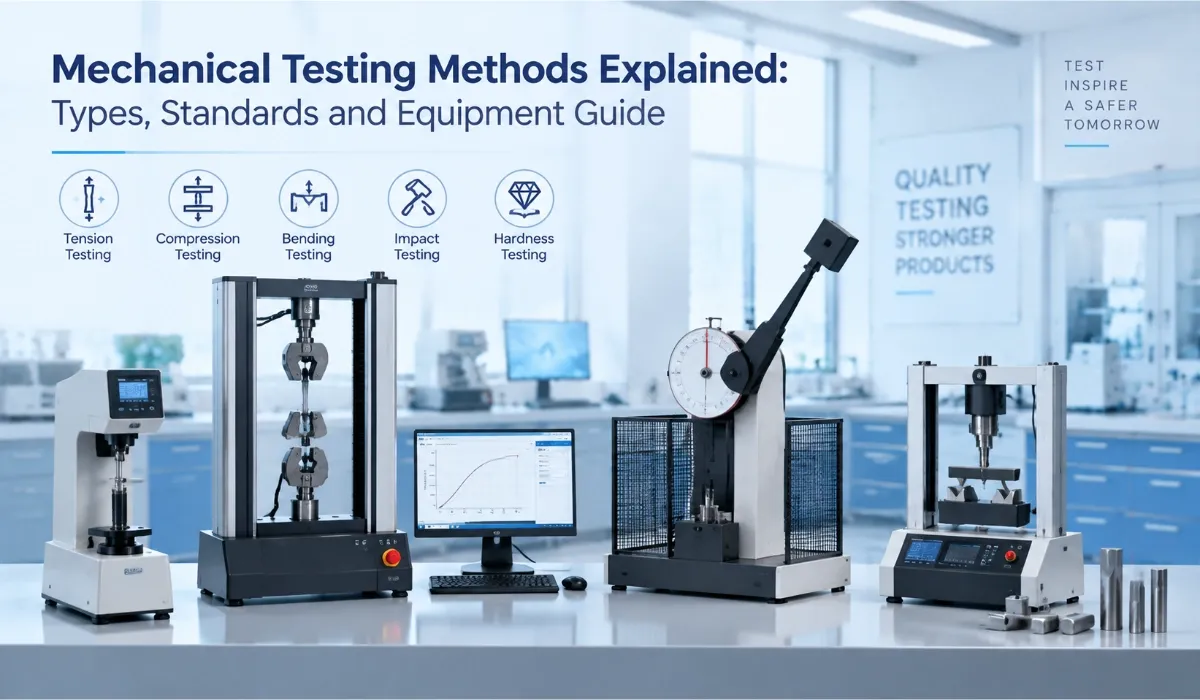
Mechanical testing methods measure how materials, components and finished products respond to forces — pulling, squeezing, bending, sudden impact, and the repeated shocks of transport. The main families are tensile, impact, drop, vibration, compression and bending tests. Which one you need comes down to three questions: what the product is made of, what forces it will face in use and in transit, and which standard your customer or regulator specifies. This guide explains each method, the standards behind it, and how to match a test to the right equipment.
What Are Mechanical Testing Methods?
Mechanical testing methods are procedures that apply a controlled mechanical load — tension, compression, bending, impact or repeated stress — to a material specimen, a component or a finished product, and measure the response. They are used to:
- Verify that a design meets the strength and durability requirements of its standard
- Identify weak points in materials, joints and structures before production
- Keep manufacturing consistent through incoming and outgoing quality control
- Provide the data that supports safety claims, certifications and customer approvals
Why Does Mechanical Testing Matter for Product Reliability?
Goal | What testing gives you |
|---|---|
Product safety | Structural failures are found in the lab, not in the field or in a customer's hands |
Durability | Realistic load and transport data to predict how long a product survives repeated stress |
Quality control | Batch-to-batch consistency; defects in materials or production show up as out-of-range results |
Development cost | Design problems surface early, before tooling, recalls and warranty claims multiply |
What Are the Main Types of Mechanical Testing?
Method | What it measures | Typical standards | Typical specimens |
|---|---|---|---|
Tensile testing | Resistance to pulling forces: tensile strength, yield strength, elongation | ASTM D882, ISO 527 | Plastics, films, rubber, metal parts |
Impact testing | Energy absorbed under sudden loading; toughness | ASTM D256, ISO 179, ASTM D3763 | Plastic specimens, sheet materials |
Drop testing | Survival of free-fall impacts in handling and transport | ASTM D5276 | Packaged products |
Vibration testing | Survival of transport and in-use vibration | ASTM D999, ASTM D4169, ISTA | Packaged products, assemblies |
Compression testing | Resistance to crushing and stacking loads | ISO 2759, ISO 3037 | Corrugated board, boxes, foam |
Bending testing | Resistance to flexural and repeated bending loads | ISO 178, product standards | Plastic parts, wires and cables |
IK impact testing | Impact resistance of electrical enclosures | IEC 60068-2-75 | Enclosures, housings |
Hardness testing (Rockwell, Brinell, Vickers) and high-cycle fatigue testing are further mechanical methods used mainly in metals laboratories. This guide focuses on the methods most used for products, packaging and transport simulation.
What Does Tensile Testing Measure?
Tensile testing pulls a specimen apart at a controlled speed and records the force–extension curve. From that curve you get tensile strength, yield strength, elongation at break and elastic modulus — the basic numbers behind almost every material datasheet.
For thin plastic films, ASTM D882 specifies the strip specimen geometry, grip separation and test speed; a 100 kN tensile testing machine set up for ASTM D882 covers film specimens as well as higher-force materials. For general component and material testing, a universal tensile testing machine with interchangeable grips and force sensors is the standard configuration.
How Do Impact Tests Work?
Impact testing measures how much energy a material absorbs when loaded suddenly, which slow tensile tests cannot show.
- Pendulum impact testing (ASTM D256 / ISO 179 / ISO 180) swings a hammer into a notched or unnotched specimen and reports the absorbed energy. It is the routine toughness test for plastics — see this pendulum impact tester for plastics.
- Drop-weight impact testing (ASTM D3763) drives a falling dart into a plate specimen at realistic impact speeds and records the full force–displacement curve, including how the crack initiates and propagates. The ASTM D3763 drop-weight impact tester is built for this test on plastic sheet and finished parts.
- IK impact testing (IEC 60068-2-75) applies defined impact energies to an electrical enclosure using swinging hammers, verifying the IK code marked on the product. The adjustable-energy IK test apparatus covers the standard energy levels.
Why Perform Drop Testing on Packaged Products?
A drop test releases a packaged product in free fall from a set height onto a rigid floor, in a defined orientation — most standards require drops on a corner, three edges and three faces. It answers one question: will the product survive the handling it will actually get between your factory and the end user?
ASTM D5276 defines the free-fall drop test for loaded containers. Two equipment formats dominate: a zero-distance drop tester built to ASTM D5276 for repeatable drops at precise heights, and a double-arm drop tester for packaging that releases larger, heavier cartons while letting the operator set the impact orientation. For small consumer products, a tumbling barrel testing machine complements the single drop: the specimen tumbles repeatedly inside a rotating barrel, simulating the cumulative impacts of bulk transport and handling.
What Does Transport Vibration Testing Simulate?
Trucks, ships and aircraft excite packaged products over a broad frequency range for hours or days. Vibration testing reproduces this on an electrodynamic or mechanical table, then checks the product and pack for loosened fasteners, fatigue cracks, abrasion, cushion settling and resonance damage.
The governing references are ASTM D999 (vibration testing of shipping containers), ASTM D4169 (which assigns a full transport test schedule — drop, vibration, compression — according to the hazard level of the distribution system) and the ISTA procedures used by most retailers. A transport vibration tester runs these schedules on packaged units up to laboratory weight limits.
How Do You Test Packaging Materials Under Compression?
Compression testing pushes the specimen in the opposite direction of tensile testing, and for packaging it comes in two forms:
- Edge crush test (ECT) measures the edgewise compressive strength of corrugated board (ISO 3037, TAPPI T 811) — the number that predicts a box's stacking strength. A high-precision edge crush tester is the standard instrument.
- Bursting strength (ISO 2759) measures the hydraulic pressure at which board ruptures — a long-standing incoming-inspection metric for paper and board. The automatic bursting strength tester automates clamping, rupture detection and reporting.
The same logic extends to foam, cushioning and whole boxes tested under sustained stacking loads.
What Do Bending and Flex Tests Check?
Bending tests load a specimen between two supports and measure flexural strength and modulus — for rigid plastics, ISO 178 is the reference method. For wires and cables, the practical form is repeated bend testing: the specimen is flexed back and forth at a set angle and speed until the conductor or insulation fails, giving a flex-life count. This is the everyday fatigue test for cable products, and a dedicated wire and cable bending test machine runs it continuously with automatic failure detection.
Which Industries Rely on Mechanical Testing?
Industry | Typical mechanical tests | Purpose |
|---|---|---|
Electronics and consumer goods | Drop, vibration, tumbling, wire bending | Survive handling, transport and daily use |
Automotive and EV | Vibration, impact, tensile, cable bending | Component durability under road loads and repeated plugging |
Aerospace | Vibration, impact, tensile | Performance under extreme mechanical environments |
Plastics and rubber | Tensile, pendulum impact, drop-weight puncture | Material qualification and lot release |
Packaging and logistics | Drop, vibration, ECT, bursting | Prove the pack protects the product through the distribution chain |
Which Standards Govern Mechanical Testing?
Standard | What it covers |
|---|---|
ASTM D882 | Tensile properties of thin plastic sheeting |
ASTM D256 / ISO 179 / ISO 180 | Pendulum (Izod and Charpy) impact of plastics |
ASTM D3763 | High-speed puncture of plastics by drop-weight impact |
ASTM D5276 | Free-fall drop test of loaded containers |
ASTM D999 | Vibration testing of shipping containers |
ASTM D4169 | Performance testing of shipping units across the distribution cycle |
ISTA procedures | Packaged-product transport simulation sequences |
ISO 2759 | Bursting strength of board |
ISO 3037 / TAPPI T 811 | Edgewise crush resistance of corrugated fibreboard |
IEC 60068-2-75 | IK-code impact tests on enclosures |
Always test to the edition your customer or product standard cites — methods and acceptance criteria are revised periodically.
How Do You Choose the Right Testing Method and Equipment?
Work through four factors in order:
- Material type. Films, rigid plastics, metals, corrugated board and cables each have their own standard test methods; a tensile machine for films is configured differently from one for metal parts.
- Product application. A test for in-use loads (bending, plugging, impact) is different from a test for transport loads (drop, vibration, stacking).
- Expected loads. Static, dynamic or repeated? One hard impact or thousands of small cycles? This decides whether you need a strength test or an endurance test.
- Testing goal. Pass/fail quality control, design data, or failure analysis all need different instrumentation and reporting depth.
Then match the equipment to the standard, not the other way round. When requesting a quotation, specify the standard and edition, specimen dimensions and weight, required capacity range, and your lab's power and space constraints.
Mechanical Testing vs Reliability Testing: What's the Difference?
| Mechanical Testing | Reliability Testing |
|---|---|---|
Focus | Mechanical properties under defined loads | Long-term performance over the product life |
Output | Strength, deformation and energy values | Failure rates, life estimates, failure probability |
Specimen | Materials, components, packaged units | Usually finished products |
Examples | Tensile, impact, drop, compression | Lifecycle tests, environmental and combined-stress tests |
The two overlap — a drop test is part of a reliability programme — but they answer different questions: "how strong is it?" versus "how long will it last?"
Frequently Asked Questions
1.What are the most common mechanical testing methods?
Tensile, compression, impact (pendulum and drop-weight), drop, vibration, bending and IK impact testing. For packaging, drop, vibration, edge crush and bursting tests make up the core set.
2.What is the difference between a drop test and an impact test?
A drop test releases the whole packaged product in free fall and evaluates the pack plus product together. An impact test applies a controlled impact energy to a material specimen or an enclosure, measuring how the material itself absorbs energy.
Which standards cover transport simulation testing?
ASTM D4169 defines the overall distribution-cycle schedule; ASTM D999 covers vibration and ASTM D5276 covers free-fall drop within it. ISTA procedures are the common alternative, especially for retail supply chains.
Is mechanical testing the same as reliability testing?
No. Mechanical testing measures properties under defined loads; reliability testing evaluates whether a finished product keeps performing over its expected life, usually adding environmental and combined stresses.
What information should I provide when requesting a test machine?The standard and edition, specimen dimensions and weight, the capacity or energy range you need, and your testing goal (QC, design data or failure analysis). With this, a supplier can propose a configuration and quote accurately.
Choosing Mechanical Testing Equipment
Start from the standard, then the specimen, then the equipment. Browse the full mechanical testing equipment range to see the machines behind each method, or send us your test standard, specimen details and target capacity — we will recommend a configuration for your lab.
Contact us to get the technical datasheet.