Oct 16, 2026News & Insights
IP Waterproof Testing for Outdoor LED Lighting: IEC 60529 vs UL Rain Test
Which waterproof tests outdoor LED luminaires face: IPX3–IPX8 under IEC 60529 for most markets, the UL 1598 rain test for North America, and the equipment for each route.
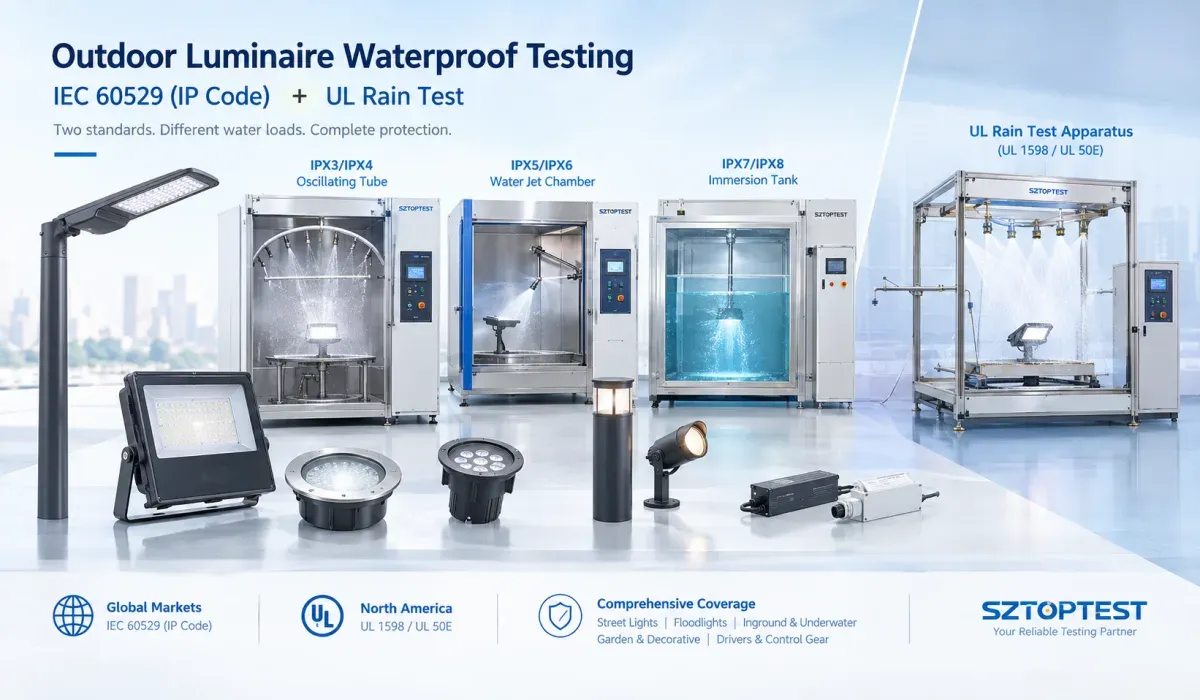
An outdoor luminaire has to prove its waterproofing twice over: once against the IP code for most world markets, and once against the UL rain test when it is bound for North America.
The two routes are not interchangeable — different standards, different water loads, different equipment — and lighting manufacturers exporting globally need both in the lab.
This guide maps the tests for:
• Street lights, floodlights and area lighting
• Inground and underwater luminaires
• Garden and decorative outdoor lighting
• LED drivers and control gear housings
Which IP Ratings Outdoor Luminaires Carry
Luminaire standards (IEC 60598-1 and its family) call up the IP code of IEC 60529, and outdoor products commonly declare:
• IP65/IP66 — the standard street and floodlight range: dust-tight, protected against jets (IPX5) or powerful jets (IPX6)
• IP67/IPX8 — inground, underwater and decorative units that face temporary or continuous immersion
• IPX3/IPX4 — covered and semi-exposed fixtures where rain and splash, not jets, are the design case
The declared digits decide the test, and each test needs its own apparatus.
The IEC 60529 Route: Test Equipment by Level
Rain and Splash — IPX3/IPX4
The IPX3/IPX4 oscillating tube rain test device swings a tube of nozzles across the specimen (IPX3 at ±60° oscillation, IPX4 with a full 350° sweep), with flow, speed and turntable rotation controlled to the standard. For large luminaires that exceed the tube radius, the IPX3/IPX4 handheld spray nozzle performs the same IEC 60529 Figure 5 test on big or installed-style units.
Jets — IPX5/IPX6
The IPX5/IPX6 water jet test chamber delivers the standard's two jet loads: Φ6.3 mm nozzle at 10 L/min for IPX5 and Φ12.5 mm at 100 L/min for IPX6, from 2.5–3 m distance with a rotating turntable for all-angle coverage.
Immersion — IPX7/IPX8
The IPX7 water immersion test equipment covers the standard's conditions: 1 m of water for 30 minutes for IPX7, with the sample-height rule applied (samples below 850 mm sit 1 m under the surface; taller samples sit with their top at least 150 mm below). IPX8 runs deeper or longer as agreed — the typical case for underwater luminaires.
The UL Route: Rain Testing for North America
North American certification does not simply accept an IEC IP report. UL 1598 (luminaires) and UL 50E (electrical enclosures, NEMA 3R/4/4X) specify their own water exposure test, and the apparatus is prescribed in detail.
• 3 nozzles (optional 4), spaced 710 mm, set 1400 mm from the sample
• Spray angled 45° from vertical, per nozzle pressure 34.5 kPa (5 psi)
• Total working pressure 50–150 kPa, flow ≥10 L/min
• Height adjustment 1000–2000 mm for different product sizes
• Compliance set: UL 50E, UL 1598, UL 60507, UL 1703/8750, CSA C22.2 equivalents
Engineering note: a luminaire can pass IPX6 and still need re-testing on the UL rig — the UL spray geometry and pressure were chosen to reproduce wind-driven rain, not to duplicate IEC jets. Certification bodies treat the two reports as independent evidence.
IEC vs UL at a Glance
• Governing standard — IEC 60529 route: IEC 60529 (via IEC 60598-1); UL rain test route: UL 1598 / UL 50E, CSA equivalents
• Water load — IEC 60529 route: Drip, oscillating spray, jets or immersion; UL rain test route: 45° spray at defined pressure and spacing
• Rating declared — IEC 60529 route: IPX1–IPX9K digits; UL rain test route: NEMA type or UL listing requirement
• Key equipment — IEC 60529 route: Oscillating tube, jet chamber, immersion tank; UL rain test route: UL-specified nozzle rack
• Markets — IEC 60529 route: Global (EU, Asia, Middle East, Australia…); UL rain test route: USA and Canada
Choosing Equipment for a Lighting Lab
• Exporting to most markets: an oscillating tube (IPX3/4) plus a jet chamber (IPX5/6) covers the common outdoor luminaire declarations; add an immersion tank if the range includes IP67/IPX8 products.
• Exporting to North America: add the UL rain test apparatus — it is the only way to generate the UL 1598/50E spray conditions as specified.
• Larger fixtures: check the tube radius against your biggest luminaire, and keep a handheld spray nozzle for specimens that do not fit.
The full selection is in the IP waterproof test equipment range, and the IP ratings guide explains the code itself level by level.
Frequently Asked Questions
Is IP66 better than IP65 for street lights?
IPX6 adds protection against powerful jets over IPX5, which is why exposed roadway and floodlight products commonly declare IP66. The dust digit (6, dust-tight) is the same. The specification your customer or tender cites decides it — the test equipment difference is the nozzle diameter and flow rate.
Does UL accept an IEC IP test report?
No. UL 1598 and UL 50E define their own rain and spray tests with prescribed nozzle geometry, pressure and duration. Passing IPX5/IPX6 under IEC 60529 is separate evidence and does not substitute for the UL test.
What equipment covers IPX3 and IPX4 in one machine?
The oscillating tube device performs both: IPX3 with the standard ±60° oscillation and IPX4 with the full sweep, by changing oscillation and flow settings. A handheld spray nozzle replicates both levels for oversized specimens.
Do underwater luminaires still need jet testing?
Not usually — IPX7/IPX8 immersion covers the service condition more severely than splash. The product standard decides which water tests apply to the declared rating.
Conclusion
Outdoor LED lighting faces two waterproofing regimes: the IP code of IEC 60529 for most of the world, and the UL rain test for North America. Labs that serve global lighting customers need the oscillating tube, the jet chamber, the immersion tank and the UL rain rig — each reproducing a different water load that the other cannot.
Tell Top Test your luminaire dimensions, the declared IP levels and your target markets, and contact us for a quotation that covers both certification routes.