Oct 13, 2026News & Insights
What Is Double 85 Testing (85°C / 85% RH)? Damp Heat Test Guide and Chamber Requirements
Double 85 testing holds samples at 85°C and 85% relative humidity for 500–1000 hours to expose moisture-related failures. Learn the standards, what it finds and how chambers are specified.
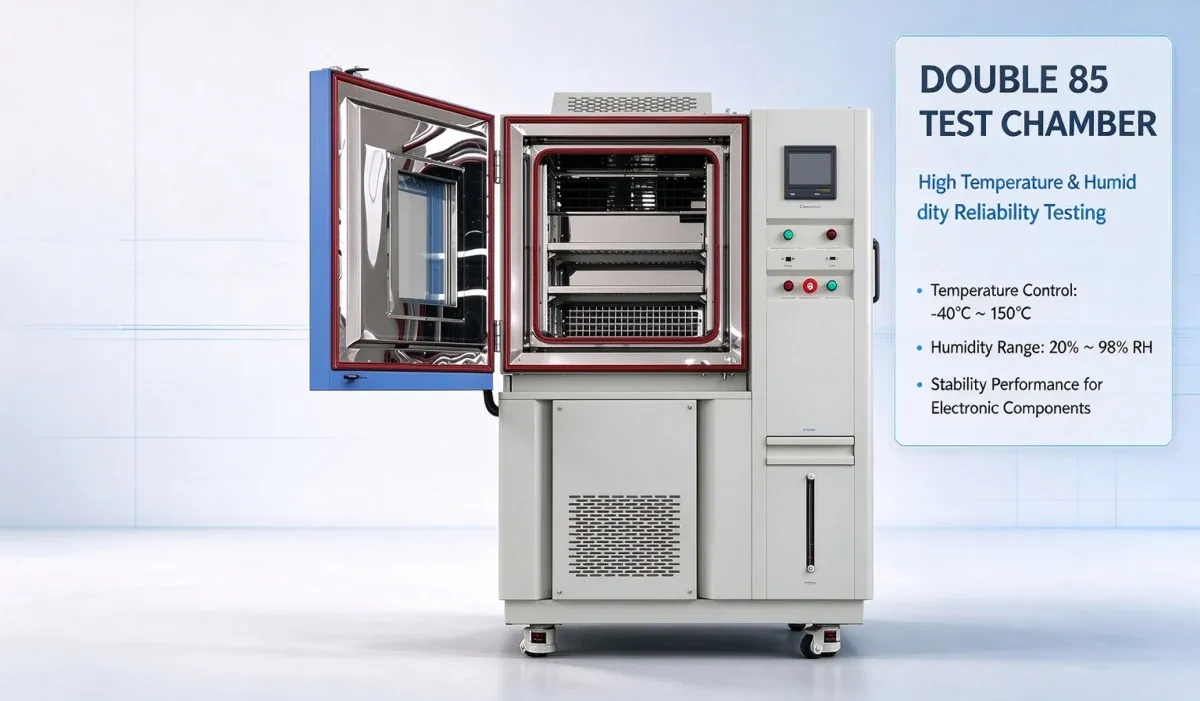
Double 85 testing is a steady-state damp heat test that holds a product at 85 °C and 85 % relative humidity, continuously, typically for 500 or 1000 hours.
The combination is aggressive enough to drive moisture through seals, encapsulants and coatings, yet controlled enough to remain repeatable. This is why photovoltaic, semiconductor, LED and battery standards converged on the same two numbers.
Double 85 testing is commonly required for products such as:
- Photovoltaic modules and backsheets
- PCB assemblies, connectors and semiconductors
- LED packages and display modules
- Lithium batteries and sensors
- Adhesives, encapsulants and laminates
This guide explains the origin of the two setpoints, the standards that require them, the failure mechanisms the test reveals, and the chamber requirements for a valid 1000-hour run.
Understanding the Two Setpoints
The conditions trace back to steady-state damp heat testing in IEC 60068-2-78, the environmental standard defining damp heat, steady state exposure. Semiconductor reliability practice uses the same point in JESD22-A101, the steady temperature-humidity bias life test.
The combination is deliberate:
- 85 °C accelerates moisture diffusion and softens polymers, so water that would sit on a surface at room temperature works into interfaces
- 85 % RH stays below condensation — the sample remains dry to the touch — so moisture must penetrate the material rather than pool on it
Together they create a test that is fast, but that keeps the failure mechanism honest.
Standards That Require Double 85
Standard | Industry | Double 85 requirement |
|---|---|---|
IEC 61215 (damp heat test) | Photovoltaic modules | 1000 h at 85 °C / 85 % RH |
JESD22-A101 | Semiconductors | 85/85 steady state, commonly 1000 h, often with bias |
IEC 60068-2-78 | General electronics | Damp heat steady state; severity per product standard |
LED and display reliability specs | Lighting, automotive electronics | 500–1000 h by specification |
The photovoltaic requirement is the most widely met: a module that survives 1000 hours of 85/85 without delamination, significant power loss or insulation failure has demonstrated that its encapsulation will hold for decades outdoors.
Failure Mechanisms the Test Reveals
The test exposes the weak links that short-term tests miss:
- Delamination between laminate and encapsulant layers as moisture breaks adhesive interfaces
- Hydrolysis of polymers that decompose in the presence of hot water vapor
- Corrosion and electromigration on fine-pitch traces and connectors, especially under bias
- Seal and gasket degradation that admits water once the product returns to service
Failures appear after the test, during functional checks and insulation resistance measurement. The test report is only as good as the inspection that follows it.
Chamber Requirements for a Valid Double 85 Test
Running 1000 hours continuously puts demands on the equipment that short-cycle climatic tests do not.
Long-Term Stability
The chamber must hold the setpoint for weeks, not merely reach it:
- Temperature fluctuation: ± 0.5 °C, uniformity within ± 1 °C
- Humidity fluctuation: ± 2 % RH, uniformity within ± 3 % RH
Top Test's Double 85 temperature humidity test chamber is specified to these values, sized from 80 L for components up to 1000 L for full photovoltaic modules.
Water System
Weeks of humidification consume water and concentrate impurities. The chamber requires:
- A purified water supply arrangement
- Convenient reservoir access for scheduled service
Specimen Power Feed-Through
Bias testing in the JESD22-A101 style requires ports to power samples inside the chamber. Confirm the feed-through configuration before the test campaign, not during it.
Recovery Behavior
Door openings for mid-test inspection should not crash the environment for hours. Chamber recovery rate belongs in the purchase specification.
Related Chambers for Wider Programs
Labs combining damp heat with cycling tests typically add:
- High and low temperature humidity test chamber — −70 °C to +150 °C with 20–98 % RH control, for hot-cold profiles that include double 85 hold periods
- IEC 60068-2-38 temperature and humidity chamber — for the cyclic temperature-humidity test that pairs with steady-state damp heat
Test Duration
Follow the product standard where one exists — 1000 hours for photovoltaic modules per the applicable edition.
Without a governing standard, 500 hours is a common development-screening duration, with 1000 hours reserved for qualification.
Shorter runs produce more optimism than data: moisture-driven failures are slow by nature, which is the point of the test.
Frequently Asked Questions
Is 85°C/85%RH the same as "85/85 with bias"?
No. Plain double 85 is an unpowered exposure. The JESD22-A101 style test applies operating voltage throughout, which accelerates corrosion and migration failures. Check which form the specification means.
Does condensation appear during a double 85 test?
It should not. The test is steady state: 85 % RH at 85 °C leaves no free water on samples. Condensation indicates poor temperature uniformity or changed setpoints, and it compromises the test.
Can a normal temperature humidity chamber run double 85?
Many can reach the setpoint. A valid 1000-hour run additionally requires verified stability at the 85/85 point, humidity system capacity and water-system ratings. Check these before committing the chamber.
Conclusion
Double 85 testing is the reference damp heat exposure for PV, electronics and battery qualification: 85 °C, 85 % RH, 500 to 1000 hours, no condensation.
The chamber's long-term stability at the setpoint — not its range — decides whether the results hold up.
Send Top Test your sample dimensions, quantity and the governing standard, and we will recommend the chamber volume and configuration. Contact us for the datasheet, or browse the temperature and humidity test equipment range.