Oct 14, 2026News & Insights
IEC 61032 Probe 18 vs Probe 19: Child Finger Probe Guide for Accessibility Testing
Probe 18 simulates the finger of a child over 3 years old, Probe 19 a child under 3. Compare dimensions, applied force and applications under IEC 61032.
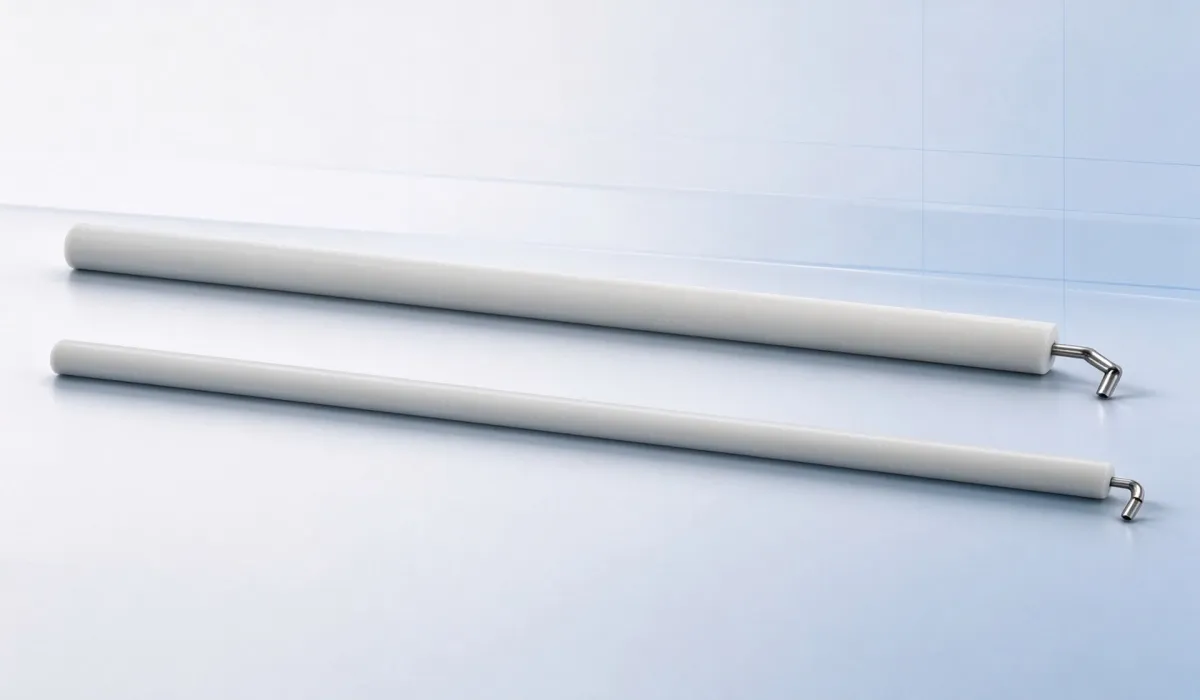
IEC 61032 defines two jointed "child finger" probes for enclosure accessibility testing:
- Test Probe 18 — simulates the finger of a child aged approximately 3 to 14 years, with an 8.6 mm finger
- Test Probe 19 — simulates the finger of a child aged 3 years and under, with a 5.6 mm finger
The adult finger is covered by Test Probe B, which the IEC 61032 test probes guide explains in detail. Children's fingers are smaller and more flexible, so the standard scales the probe down rather than reusing the adult shape.
Child finger probes are commonly required for products such as:
- Household appliances
- Toys and infant care devices
- Medical devices
- Power tools
- Small electronic devices
This guide compares the two probes, explains the standards that call them up, and describes how the test is run.
Probe Dimensions at a Glance
Item | Test Probe 18 | Test Probe 19 |
|---|---|---|
Simulates | Children aged 3–14 years | Children aged 36 months and under |
Bent finger diameter | 8.6 mm ± 0.1 | 5.6 mm |
Finger length | 57.9 mm (three 19.3 mm sections) | 44 mm |
Handle extension | 451.6 mm | 464.3 mm |
Joint | Bends 90° in one plane | Same |
IEC 61032 figure | Figure 12 | Figure 13 |
Both probes use a stainless steel finger with an insulating handle, and both carry the extended second handle that keeps the operator's hand clear during deep insertion.
Test Probe 18 – Finger of a Child Aged 3 to 14
Definition
Probe 18 verifies that openings in an enclosure do not admit the larger child finger.
- Finger diameter: 8.6 mm ± 0.1
- Tip radius: 4.3 mm, hemispherical to prevent surface scratching
- Joint movement: 90° in the same plane, imitating natural finger bending
Applied Force
The probe is inserted with a force of 30 N ± 3 N, approximately the push a young child can deliver.
Typical Applications
- Household appliances
- Power tools
- Equipment accessible to older children
Engineering Note
A three-year-old's finger is narrower relative to its length and bends more readily than an adult's. Probe 18 reflects the older child; openings it cannot enter are still reachable by Probe 19.
Test Probe 19 – Finger of a Child Under 3
Definition
Probe 19 verifies that openings do not admit the smallest credible child finger.
- Finger diameter: 5.6 mm
- Finger length: 44 mm
- Handle extension: 464.3 mm
- Joint: 90° bend in the same plane and direction
Applied Force
The insertion condition follows the invoking product standard. Check the standard the product is certified against rather than assuming a value.
Typical Applications
- Toys and infant care appliances
- Medical devices
- Household appliances with narrow slots
- Small electronic devices
Engineering Note
Any opening that admits Probe 19 must not contain hazardous live or moving parts. A toddler will find that opening.
Which Standards Call Them Up
- Probe 18 appears in IEC 61032:1997 Figure 12 and is referenced in the GB 4706 household appliance series and GB/T 16842, the Chinese mirror of IEC 61032.
- Probe 19 appears in IEC 61032 Figure 13 and is called up by standards for toys, infant appliances and medical devices.
Product standards specify the force applied at insertion, and regional versions may differ. For multi-market products, check each standard's wording: some require Probe 18 for main enclosures and Probe 19 for secondary openings, while several toy and infant-product standards skip Probe 18 entirely.
How the Test Is Run
The procedure is the same in spirit for both probes:
- Every opening, gap and joint is offered the probe
- The jointed finger bends the way a real finger does when probing a slot
- The applied force is held at the standard's value
- The specimen fails if the probe touches hazardous live parts, hazardous mechanical parts or hot surfaces
Specimens with membrane switches, rubber grommets or soft seals can pass when new and fail after aging. Teams planning certification therefore run the probe test on samples that have completed the standard's conditioning.
Choosing the Probes
Both are precision-machined tools, and the dimensions are the whole point — a fraction of a millimetre changes the verdict.
- Test Finger Probe 18 — built to IEC 61032 Figure 12, 8.6 mm finger, 30 N test arrangement, insulated handle
- Test Probe 19 small finger probe — 5.6 mm finger per Figure 13 with extended handle
- Test Probe B of IEC 61032 — the adult finger reference for comparison
- Test Probe 41 — the rigid heat-resistant probe for hot-surface checks on heaters and ovens
A typical household appliance laboratory keeps Probe B plus 18 and 19, adding specialty probes such as 31 or 41 when particular standards require them.
Frequently Asked Questions
Can Probe 18 replace Probe 19?
No. The 8.6 mm Probe 18 cannot enter openings that the 5.6 mm Probe 19 reaches, so passing Probe 18 proves nothing about the smaller openings. Products for households with small children commonly require both.
What is the difference between Probe 19 and Probe B?
Probe B simulates an adult finger with a 12 mm diameter; Probe 19 uses a 5.6 mm finger for children under three. The openings each probe can enter differ, so the two probes produce different verdicts on the same enclosure.
What force is applied during the test?
For Probe 18, the customary arrangement is 30 N ± 3 N. For Probe 19, the condition comes from the invoking product standard.
Do I need one probe or a full set?
It depends on the product standards. Listing the target standards is the fastest way to specify the set.
Conclusion
Probe 18 and Probe 19 differ in one variable — the age of the child simulated — and that single variable changes which openings a product must protect.
Both probes carry calibration certificates and are supplied with the documented dimensions their standards require.
Tell us which standards and markets the products are tested for, and we will confirm the probes the cases require. Contact Top Test for quotations, or browse the IEC test finger probe range.