
Sep 6, 2026News & Insights
IEC 60529 IP Ratings & Testing Equipment Guide
Learn how IEC 60529 IP ratings work and which equipment is used for dust, water spray, water jet, immersion, and enclosure protection testing.
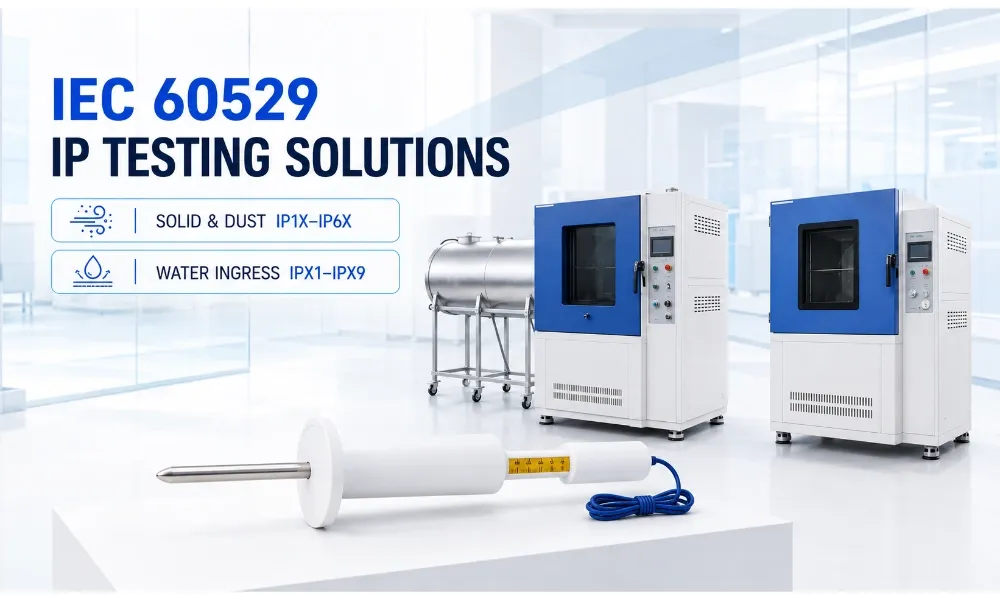
Understanding IEC 60529 IP Ratings and Testing Equipment
Electrical and electronic products are often exposed to dust, rain, splashing water, water jets, or temporary immersion. IEC 60529 ingress protection testing is used to evaluate how effectively an enclosure protects internal components against these external conditions.
The test results are expressed as an IP rating. Manufacturers use IP testing equipment during product development, quality control, and third-party testing to verify enclosure protection performance.
This guide explains how IP ratings work and introduces the equipment commonly used for different IEC 60529 tests.
What Is an IP Rating?
IP stands for Ingress Protection. An IP code normally consists of the letters “IP” followed by two characteristic numerals.
For example, in IP65:
- The first numeral, 6, indicates protection against solid foreign objects and dust.
- The second numeral, 5, indicates protection against water jets.
The two numerals represent separate test requirements. Therefore, an IP65 enclosure must meet both the IP6X dust test and the IPX5 water-jet test.
If one protection level is not declared, it is replaced by the letter X. For example, IPX4 declares protection against splashing water but does not specify a solid-ingress protection level.
Protection Against Solid Objects and Dust
The first characteristic numeral indicates protection against access to hazardous parts and the ingress of solid foreign objects.
IP Level | General Protection Description |
|---|---|
IP0X | No specified protection |
IP1X | Protection against objects 50 mm or larger |
IP2X | Protection against objects 12.5 mm or larger |
IP3X | Protection against objects 2.5 mm or larger |
IP4X | Protection against objects 1.0 mm or larger |
IP5X | Dust protected |
IP6X | Dust-tight |
IP1X to IP4X tests are generally performed using standardized access probes or object probes.
IP5X and IP6X tests require dust testing equipment. A dust chamber circulates specified test dust around the specimen under controlled conditions. Depending on the test procedure and enclosure category, a vacuum system may also be required.
IP5X does not necessarily require the complete absence of dust inside the enclosure. IP6X represents the higher, dust-tight protection level.
Protection Against Water Ingress
The second characteristic numeral indicates the enclosure’s protection against water.
IP Level | General Test Description |
|---|---|
IPX0 | No specified protection |
IPX1 | Vertically dripping water |
IPX2 | Dripping water when the enclosure is tilted |
IPX3 | Spraying water |
IPX4 | Splashing water |
IPX5 | Water jets |
IPX6 | Powerful water jets |
IPX7 | Temporary immersion |
IPX8 | Continuous immersion under agreed conditions |
IPX9 | High-pressure, high-temperature water jets |
Different levels require different types of waterproof test equipment.
IPX1 and IPX2 Drip Test Equipment
A drip box produces controlled water droplets over the specimen. The test system may include a rotating or tilting specimen table, depending on the required test method.
IPX3 and IPX4 Spray Test Equipment
IPX3 and IPX4 tests are commonly performed using an oscillating tube system or a handheld spray nozzle.
When choosing an oscillating tube tester, the tube radius and effective spray area must be suitable for the dimensions of the specimen.
IPX5 and IPX6 Water Jet Equipment
IPX5 and IPX6 tests use specified nozzles and controlled water flow to expose the enclosure to water jets.
A typical system includes a water tank, pump, flowmeter, pressure indicator, test nozzle, and specimen support. Stable water flow and the correct nozzle are essential for repeatable testing.
IPX7 and IPX8 Immersion Equipment
IPX7 is a temporary immersion test performed under defined conditions. It is normally conducted in an immersion tank with sufficient water depth for the specimen.
IPX8 testing uses immersion conditions agreed between the manufacturer and user. These conditions should be more severe than IPX7 and may involve greater depth, longer duration, or both.
For greater simulated water depths, a pressure vessel may be used instead of a deep open tank.
IPX9 Test Equipment
IPX9 equipment applies high-pressure, high-temperature water jets from specified directions.
The system generally includes water heating, pressure and flow control, a test nozzle, a specimen turntable, and safety protection against hot water and spray.
Additional Letters in an IP Code
An IP code may include additional letters describing protection against access to hazardous parts.
Letter | General Meaning |
|---|---|
A | Back of the hand |
B | Finger |
C | Tool |
D | Wire |
Supplementary letters may also be used:
- H – High-voltage apparatus
- M – Moving parts were in motion during the water test
- S – Moving parts were stationary during the water test
- W – Specified weather conditions
These letters should only be used when the applicable requirements have been satisfied.
Common IP Rating Examples
IP54
An IP54 enclosure is dust protected and protected against splashing water.
IP65
An IP65 enclosure is dust-tight and protected against water jets. IP65 does not declare protection against immersion.
IP66
An IP66 enclosure is dust-tight and protected against powerful water jets. It does not automatically include IPX7 or IPX8 immersion protection.
IP67
An IP67 enclosure is dust-tight and protected under the specified IPX7 temporary-immersion conditions.
Water-jet and immersion tests use different methods. If a product requires protection against both, the required ratings should be specified separately.
How to Choose IP Testing Equipment
Before requesting a quotation, buyers should confirm:
- Required IP protection levels
- Applicable standard and edition
- Maximum specimen dimensions and weight
- Test duration and testing frequency
- Whether the specimen operates during testing
- Available power supply, water supply, and drainage
- Required data recording and calibration documents
- Installation country
Sample dimensions are especially important. A product may physically fit inside a chamber but still be too large for the effective drip or spray area.
Product-specific standards may also contain additional requirements. Buyers should therefore provide the complete standard designation instead of requesting equipment by IP rating alone.
IP Testing Equipment from Shenzhen Top Test Equipment Company
Shenzhen Top Test Equipment Company provides testing equipment for evaluating enclosure protection against solid objects, dust, dripping water, spraying water, water jets, immersion, and high-pressure hot-water exposure.
Available equipment categories include:
- IP access and object test probes
- IP5X and IP6X dust test chambers
- IPX1 and IPX2 drip test equipment
- IPX3 and IPX4 oscillating tube systems
- IPX5 and IPX6 water jet equipment
- IPX7 and IPX8 immersion test equipment
- IPX9 high-pressure, high-temperature test systems
Equipment configurations can be selected according to the applicable test standard, specimen size, test method, and laboratory requirements.
To receive a suitable technical proposal, send us your required IP levels, applicable standard, specimen dimensions, specimen weight, test state, and installation country.
Related product: