
IPX1-IPX9 Waterproof Test Equipment
IPX7 Water Immersion Test Equipment
According to testing standards such as IEC 60529, ISO 20653, and DIN 40050-9, IPX7 is a very high level of waterproofing. If a finished product or component passes the IPX7 waterproof rating test, it means that under normal operating or service conditions, after being submerged in one meter of water for 30 minutes continuously, no water will penetrate the interior, and the product or component will function normally.
IPX7 Immersion Tank Waterproof Test Equipment
We provide different types of IPX7 Immersion Test Chambers
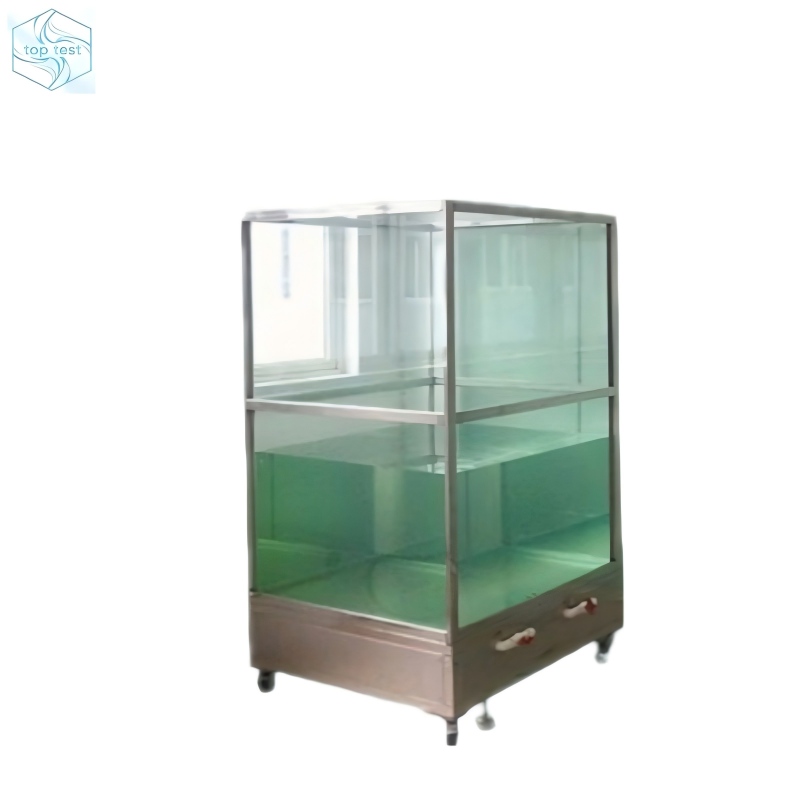
1. Vertical Tempered Glass IPX7 Immersion Test Chamber
- Function: Simulate standard water immersion conditions to verify the IPX7 waterproof performance of products, providing a basis for product design, improvement and factory inspection.
- Test Depth Requirements:
- Samples height < 850mm: The bottom of the sample enclosure shall be placed 1000mm below the water surface;
- Samples ≥ 850mm: The top of the sample enclosure shall be placed 150mm under the water surface.
- Result Judgment: After 30 minutes of temporary immersion, check whether water ingress that causes harmful effects or impairs performance occurs.
2. Transparent IPX7 Immersion Test Chambers
Tempered Glass Vertical Model
- Material: 12mm thick pressure-resistant tempered glass + 304 stainless steel;
- Customization: Tank size can be customized according to sample specifications;
- Waterway Operation: Water injection via inlet valve and drainage via drain valve for easy operation;
- Maximum Water Depth: Up to 1200mm, meeting the testing needs of most samples.
Acrylic Cylindrical Model
- Material Advantages: Fully transparent acrylic (organic glass) tank for unobstructed observation of samples and leakage bubbles;
- Customization: Cylinder diameter and height can be customized according to sample size;
- Water Level Measurement: Equipped with a vertical stainless steel ruler with an accuracy of 1mm for precise control of immersion depth;
- Mobility and Fixation: Equipped with casters and adjustable foot cups at the bottom for easy movement and stable positioning.
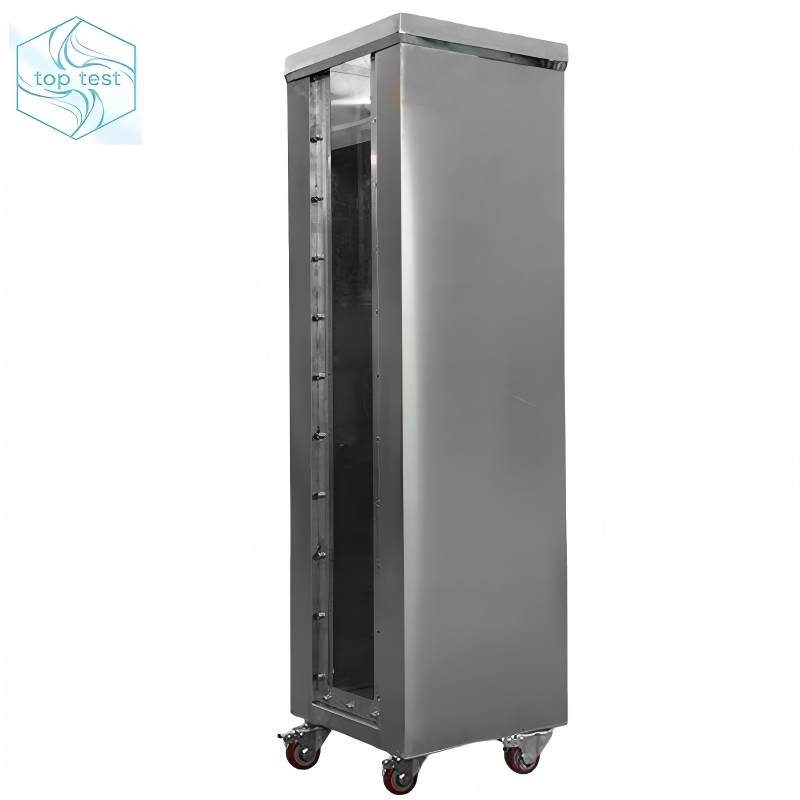
3. Stainless Steel Vertical Immersion Test Chamber
- Material & Craftsmanship: Double-layer 304 stainless steel plates + seamless welding, sturdy, rust-proof and leak-proof;
- Observation & Measurement: A full-length tempered glass observation window on the front, with a stainless steel ruler attached beside for easy observation of water level and sample status;
- Sample Fixation: Metal hooks are installed at the top corners of the inner tank for fixing samples with ropes.
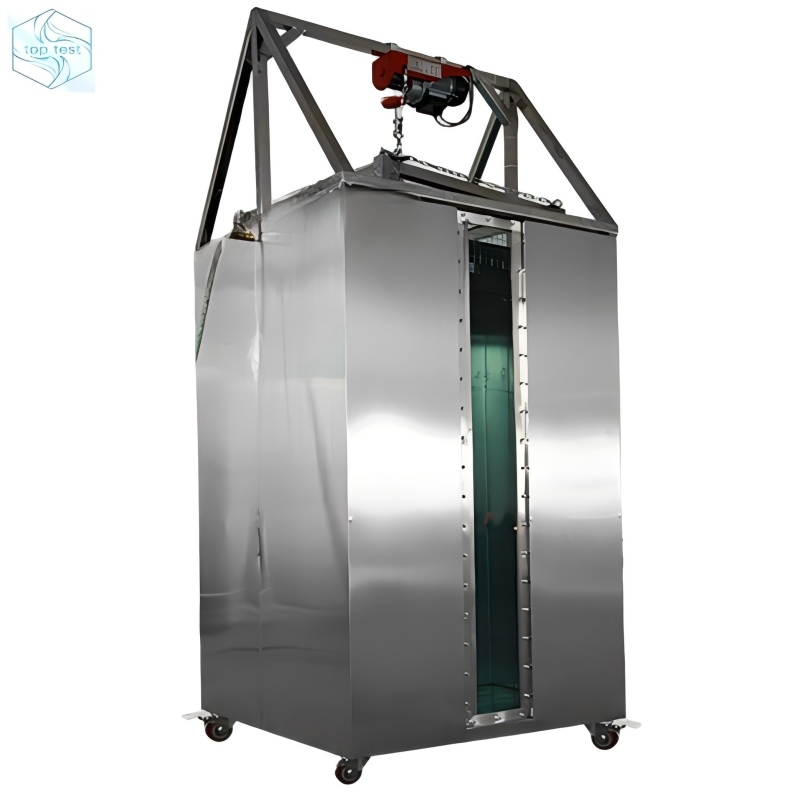
4. Stainless Steel Immersion Test Chamber with Electric Lifting Function
- Automation Design: An electric hoist is mounted on the top crossbeam, connected to a wire-gauze sample holding cage via a steel wire rope;
- Operation Method: The lifting of the sample cage is controlled by a remote controller for precise adjustment of immersion depth;
- Customization: Tank size and overall equipment height can be customized as required.
5. Other Related Equipment
We provide integrated IPX7&IPX8 immersion test chambers, dedicated IPX8 immersion test chambers and other IP rating test equipment.
Knowledge of IPX7 Waterproof Rating
1. Definition of IPX7 Waterproof Rating
- Compliant Standards: IEC 60529, ISO 20653, DIN 40050-9, etc.;
- Waterproof Performance: The product can work normally without harmful water ingress after being continuously immersed in 1-meter-deep water for 30 minutes;
- Height Requirement: When samples height ≥ 0.85m, the highest point of the sample shall be at least 0.15m below the water surface during the test.
2. Definition in IEC 60529
Ingress of water in quantities causing harmful effects shall not be possible when the enclosure is temporarily immersed in water under standardized IPX7 test conditions of pressure and time.
3. Core Parameters of IPX7 Test
- Test Duration: 30 minutes;
- Immersion Depth:
- When samples height < 850mm: The bottom is at least 1000mm from the water surface;
- When samples height ≥ 850mm: The top is at least 150mm from the water surface.
4. Differences Between IPX7 and IPX8
Item | IPX7 | IPX8 |
|---|---|---|
Test Depth | Normally 1m (except for samples with a height ≥ 0.85m) | 10~50m (customized by the demander) |
Test Duration | Fixed at 30 minutes | No mandatory limit, longer time can be customized |
Test Equipment | Ordinary water tank with a height of over 1m for direct immersion | Water tank with a pressurization device to simulate deep water pressure |
Rating Stringency | Basic waterproof rating | More stringent with a higher protection level |
FAQ:
1. What is the IPX7 waterproof rating?
According to IEC 60529, ISO 20653 and DIN 40050-9, IPX7 is an extremely high waterproof rating. If a product or component passes the IPX7 waterproof rating test, it means that under IPX7 test conditions, the product or component can still function properly without water penetrating into its interior after being continuously immersed in 1 meter water depth for 30 minutes. (On condition that the total height of the sample does not exceed 0.85 meters; if the sample height is ≥ 0.85 meters, its highest point must be at least 0.15 meters below the water surface during the test.)
2. Are IPX7 and IPX8 the same? What are the differences between them?
IPX7 and IPX8 tests are similar in that both require the sample to be completely submerged in water to test its waterproof performance, but they differ in test conditions, stringency and equipment requirements:
- Test depth: IPX7 normally requires a test 1 meter water depth (except for samples with a height of ≥ 0.85 meters); the test depth for IPX8 is deeper, which is customized by clients according to their needs, usually ranging from 10 to 50 meters.
- Test duration: IPX7 is at 30 minutes; there is no clear time limit for IPX8, and we can set a test time longer than 30 minutes, with the duration varying among different products and users.
- Test equipment: IPX7 features a relatively shallow test water depth , which can be completed by directly submerging the sample in a water tank over 1 meter high. However, IPX8 testing usually involves a water depth of tens of meters, and it is impossible to build a water tank of such height in a laboratory. Thus, a water tank with a pressurization device is required to simulate water pressure: first, pour a certain amount of water into the tank and immerse the sample in it; during the test, pressurize the space above the water surface in the tank to apply pressure to the water, simulating the pressure the sample bears at a specified water depth, and the test is completed after the specified duration.In summary, the test conditions for IPX8 are more stringent than IPX7, and IPX8 provides a higher level of waterproof protection.
3. How to select a suitable IPX7 testing device?
Selecting the right IPX7 testing device is crucial. It is recommended to consider the following factors:
- Tank height It depends on the total height of the sample:
- If the sample height is ≤ 850mm, a tank height of 1~1.2 meters is sufficient ;
- If sample is > 850mm, the tank height needs to be customized to comply with the testing requirements;
- In addition to the height, the lateral dimensions of the tank must also match the sample size.
- Tank materialTwo mainstream materials are available:
- Acrylic resin glass: It features high transparency for clear observation of the sample status (e.g., air bubbles) during the test, but the equipment shell has slightly low impact resistance.
- 304 stainless steel: It has strong pressure and impact resistance, suitable for manufacturing large-scale equipment, but it is not conducive to operators observing the sample's testing status.
- Operational convenience
- Lightweight samples can be manually put into and taken out of the tank;
- Manually handling heavy samples is laborious and may cause safety accidents. A solution is to install an electric hoist on the top of the tank, with a sample holding cage suspended by a steel wire rope. The automatic lifting and lowering of the sample cage can be controlled by a manual remote controller, which greatly reduces the operator's workload and improves testing safety.
4. How to maintain the IPX7 testing device?
The IPX7 testing device has a simple structure and is easy to maintain:
- Basic maintenance (applicable to all models): Keep the device clean, drain all water after each test, store it in a well-ventilated and dry place, and strictly prohibit impact on the device shell.
- Additional requirements for models with electric lifting device: Ensure that the motor does not come into contact with water during use; if the device is idle for a long time, run the lifting motor regularly (e.g., once every two weeks) to prevent malfunctions.