Oct 14, 2026News & Insights
NSS vs AASS vs CASS: ISO 9227 Salt Spray Test Methods and Chamber Selection Guide
Neutral (NSS), acetic acid (AASS) and copper-accelerated (CASS) salt spray tests differ in pH, temperature and aggressiveness. Compare the three ISO 9227 methods and matching chambers.
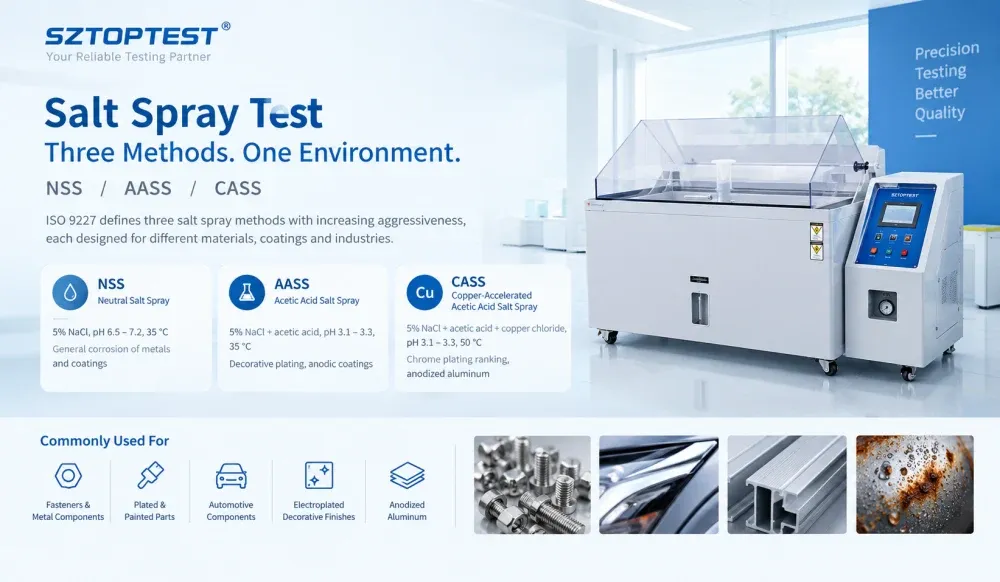
"Salt spray test" describes a family of methods, not a single test.
Under ISO 9227, the same fog chamber runs three chemistries, each more aggressive than the last:
- NSS — neutral salt spray
- AASS — acetic acid salt spray
- CASS — copper-accelerated acetic acid salt spray
Salt spray testing is commonly required for products such as:
- Fasteners and metal components
- Plated and painted parts
- Automotive components
- Electroplated decorative finishes
- Anodized aluminum
This guide compares the three methods, explains which industries use each, and describes the chamber requirements for multi-method laboratories.
The Three Methods at a Glance
Item | NSS | AASS | CASS |
|---|---|---|---|
Full name | Neutral salt spray | Acetic acid salt spray | Copper-accelerated acetic acid salt spray |
Solution | 5 % NaCl | 5 % NaCl + glacial acetic acid | 5 % NaCl + acetic acid + copper chloride |
pH | 6.5 – 7.2 | 3.1 – 3.3 | 3.1 – 3.3 |
Temperature | 35 °C | 35 °C | 50 °C |
Relative aggressiveness | Baseline | Higher | Highest |
Typical use | General corrosion of metals and coatings | Decorative plating (Cu–Ni–Cr), anodic coatings | Chrome plating ranking, anodized aluminum |
The chemistry drives the ranking. Lowering the pH from neutral to around 3 accelerates attack on many metals, and the copper salts in CASS add a galvanic acceleration that makes it the fastest method of the three.
NSS Testing – Neutral Salt Spray
Definition
NSS verifies general corrosion resistance using a 5 % NaCl solution at pH 6.5–7.2 and 35 °C.
Where It Applies
- Fasteners, galvanized steel and aluminum alloys
- Painted and coated parts
- Most automotive component specifications
A datasheet that says "48 h salt spray" without qualification means NSS.
Engineering Note
NSS is technically aligned with ASTM B117, the American neutral spray method covered in the ASTM B117 salt spray guide. Reports always state which standard was used.
AASS Testing – Acetic Acid Salt Spray
Definition
AASS acidifies the same 5 % NaCl solution with glacial acetic acid to pH 3.1–3.3, run at 35 °C.
Where It Applies
- Nickel and chromium plating on consumer goods
- Sanitary fittings and decorative hardware
- Cu–Ni–Cr plating systems
Engineering Note
The acid attacks through coating pores the way service conditions do, which is why decorative finishing specifications use AASS rather than neutral fog.
CASS Testing – Copper-Accelerated Acetic Acid Salt Spray
Definition
CASS adds copper chloride to the acidified solution and raises the chamber temperature to 50 °C.
- Solution: 5 % NaCl + acetic acid + copper chloride
- pH: 3.1 – 3.3
- Temperature: 50 °C
Where It Applies
- Quality ranking of premium electroplated finishes
- Anodized aluminum
- Plating specifications that must separate good coatings from average ones
Engineering Note
Copper ions accelerate corrosion electrochemically, simulating how defects in decorative plating concentrate attack in service. CASS runs are therefore counted in hours where NSS runs are counted in days.
Chamber Requirements for Multi-Method Testing
Method flexibility is an equipment question before it is a chemistry question. A chamber that runs all three ISO 9227 methods requires:
- Chamber temperature control up to 50 °C for CASS
- Full PP or PVC wetted paths, with no bare metal in the solution circuit
- A saturation tower heated independently of the chamber
- Solution dosing precise enough to hold pH 3.1–3.3
Top Test's TT-SST-60 salt spray test chamber supports NSS, AASS and CASS in one system per ISO 9227 and ASTM B117, with a 108 L working volume, fog settling of 1–2 ml per 80 cm² per hour and programmable timing to 999 hours.
For higher throughput or larger parts, the TT salt spray chamber range for metal coating and automotive parts scales from 270 L to 1200 L (models TT-90F to TT-200F) and runs the standard 5 % NaCl at 35 °C ± 1 °C continuously.
Where tests cycle between salt fog and controlled humidity, the composite salt spray corrosion test chamber adds programmable multi-stage cycling on a corrosion-resistant PP body rated well beyond CASS temperatures.
Test Duration and Evaluation
The standards define the environment; the product or coating standard defines the duration.
As orientation:
- NSS — 24 h for basic fastener checks, up to 480–720 h and beyond for premium coatings and marine specifications
- AASS — tens to a few hundred hours for plated decorative coatings
- CASS — often single-shift durations, because the accelerated chemistry does in hours what neutral fog does in days
After the run, evaluation follows the product or coating specification: rust coverage, blistering, and rating scales applied by a trained inspector. The corrosion spot on a chrome-plated part after 16 hours of CASS says more than a week of neutral fog.
Frequently Asked Questions
Is ASTM B117 the same as NSS?
Functionally yes for the environment: B117 is the American neutral salt spray method with 5 % NaCl at 35 °C, closely aligned with ISO 9227 NSS. Differences live in apparatus details and evaluation conventions, which is why reports name the standard used.
Can one chamber really run all three methods?
Yes, if it is built for it. The changeover is the solution chemistry, the pH target and — for CASS — the 50 °C chamber temperature. The wetted materials and dosing system must be rated for all three, which separates a multi-method chamber from an NSS-only unit.
Why does CASS add copper?
Copper ions accelerate corrosion electrochemically and reproduce how plating defects concentrate attack in service. The result is a fast ranking test for chrome-plating quality.
A customer asked for "48 h salt spray, CASS". Is that normal?
Yes. A duration that sounds short for NSS is routine for CASS because of its aggressiveness. Always confirm the method letter, the duration and the evaluation criteria together — "48 h CASS" and "48 h NSS" are very different claims.
Conclusion
NSS, AASS and CASS are one environment family at three aggression levels, defined by solution chemistry, pH and temperature.
The coating system to be qualified selects the method; the method selection then defines the chamber — acid-resistant materials, precise dosing and 50 °C capability for CASS work.
Send us the coating system or product standard to be qualified and the durations involved, and we will confirm the right method and chamber configuration. Contact Top Test for a quotation, or compare models across the salt spray test chamber range.