Oct 13, 2026News & Insights
Oscillating Tube vs Spray Nozzle: IPX3 and IPX4 Rain Test Equipment Guide
IPX3 and IPX4 can be tested with an oscillating tube, a box-type rain chamber or a hand-held spray nozzle. Compare coverage, cost and suitability to pick the right setup.
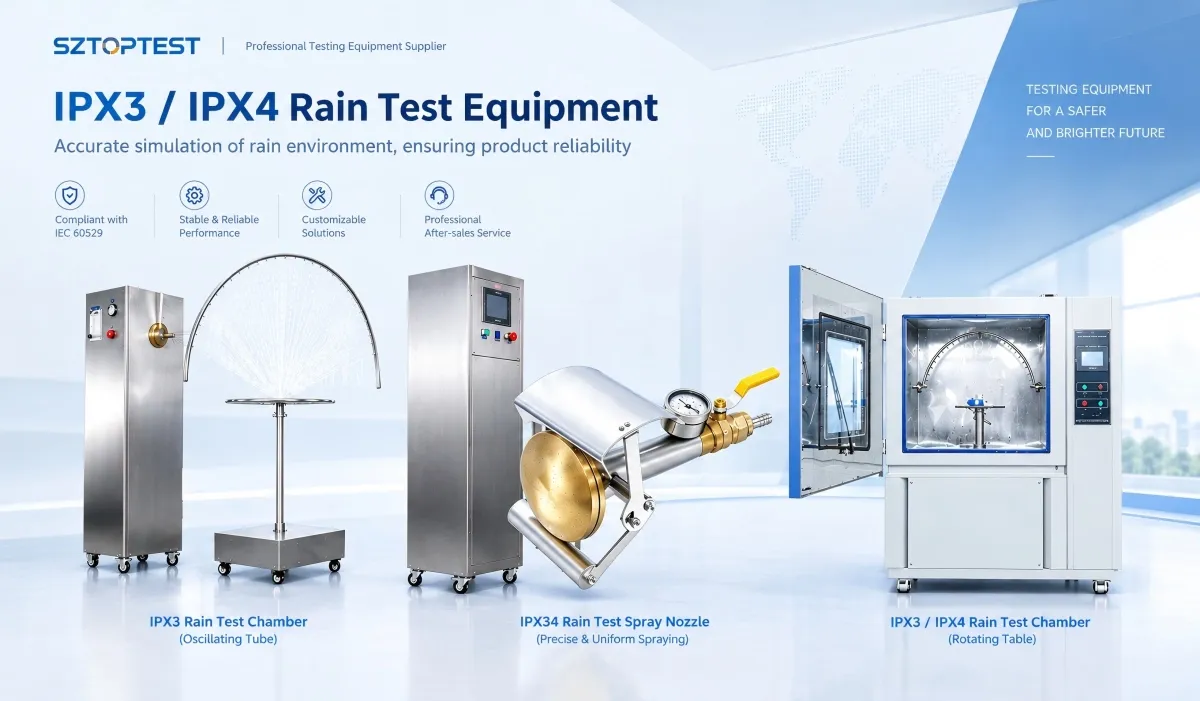
IPX3 and IPX4 are the two spraying and splashing water levels defined by IEC 60529.
The standard provides two official methods for both levels:
- The oscillating tube method
- The hand-held spray nozzle method (IEC 60529, Figure 5)
Both methods are equally valid, and a certificate from either route is accepted by certification bodies. The practical differences lie in repeatability, throughput and the size of the specimen.
IPX3 and IPX4 testing is commonly required for products such as:
- LED outdoor lighting and street lamps
- Household appliances and kitchen electricals
- Automotive electronics and headlights
- Security cameras and outdoor communication equipment
- EV charging stations
This guide compares the two methods, explains when each applies, and introduces the corresponding test equipment.
Understanding IPX3 and IPX4
Both levels verify protection against water sprayed from any direction. The difference is spray intensity.
Item | IPX3 | IPX4 |
|---|---|---|
Water condition | Spraying water | Splashing water |
Oscillating tube sweep | ±60° from vertical (120°) | Nearly full circle (350°) |
Flow rate (R400 tube) | 1.1 L/min | 1.8 L/min |
Simulates | Rain and sprayed water | Splashing from any direction |
Because the two levels share the same equipment, one correctly specified machine covers both.
Method 1: Oscillating Tube Testing
Working Principle
The oscillating tube is a stainless steel pipe with rows of Ø0.4 mm spray holes, mounted so it sweeps back and forth over the specimen.
- Oscillation angle: ±60° for IPX3, ±350° for IPX4
- Flow rate: determined by tube radius and hole count
- Specimen turntable: 1–5 rpm, so every face is exposed
- Duration: minimum 10 minutes, or as specified by the product standard
Required Equipment
Top Test offers two configurations:
- IPX34 oscillating tube rain test device — open-frame design in R800 to R1600 radii for larger specimens
- Box-type IPX3/IPX4 waterproof test chamber — R400 to R1000 radii with the spray contained in a SUS304 cabinet
Both provide adjustable turntable height, programmable sweep control and standardized flow rates.
Typical Applications
- Production quality control
- Pre-certification verification
- Laboratory testing with repeatable conditions
Engineering Note
The tube radius must match the specimen. The product should sit comfortably inside the tube arc; a specimen outside the arc never receives spray on parts of its enclosure, which invalidates the test.
Measure the largest product, including its fixture, before selecting an R value.
Method 2: Hand-Held Spray Nozzle Testing
Working Principle
The hand-held device is a machined spray head with a movable splash shield, connected to a water supply with regulated pressure.
- Shield fitted: IPX3
- Shield removed: IPX4
- The operator walks the spray around all faces of the specimen
Required Equipment
- Integrated flow regulation
- Pressure gauge
- Stainless steel construction
- Calibration certificate (available on request)
Typical Applications
- Specimens too large for any tube: street lamps, wall-mounted inverters, vehicle components, complete cabinets
- Development and screening during design iteration
- On-site and factory floor verification
Engineering Note
Coverage and duration depend on the operator, which makes the method less repeatable than a chamber. A common practice is to develop and screen with the handheld device, then confirm the final design in an oscillating tube chamber before certification.
Method Comparison
Item | Oscillating tube (chamber) | Hand-held spray nozzle |
|---|---|---|
Basis | IEC 60529 oscillating tube method | IEC 60529 Figure 5 device |
Coverage | Tube sweep + rotating turntable | Operator moves around specimen |
Repeatability | High, machine-controlled | Operator-dependent |
Specimen size | Limited by tube radius | Practically unlimited |
Best for | Routine QC and pre-certification | Large or fixed specimens, quick checks |
The Third Option: Combined IPX1–IPX6 Chambers
Laboratories that also run drip tests (IPX1/IPX2) and jet tests (IPX5/IPX6) can cover the complete range in one machine.
- Oscillating tube for IPX3/IPX4
- Drip box for IPX1/IPX2
- Ø6.3 mm and Ø12.5 mm jet nozzles for IPX5/IPX6
Flow rates and oscillation angles are preset to IEC 60529 for each level under PLC control. For laboratories certifying outdoor lighting or consumer electronics across the full IP scale, one combined chamber occupies less floor space and costs less than separate units.
How to Choose the Right Setup
Three questions determine the configuration:
- Specimen size — fits inside a tube radius, or too large/fixed for any tube?
- Test frequency — routine production QC, or occasional design verification?
- Scope of the IP code — IPX3/IPX4 only, or the full range from IPX1 to IPX6?
Bench-sized specimens tested weekly justify an oscillating tube chamber. Large, fixed or site-tested specimens justify the handheld nozzle. Full-range scope favors the combined chamber.
Frequently Asked Questions
Is a hand-held spray nozzle test accepted for certification?
Yes. IEC 60529 includes the hand-held device as an official method, and test reports routinely cite it. Laboratories require that flow and pressure match the standard and that the device carries valid calibration.
Can one chamber run both IPX3 and IPX4?
Yes. On an oscillating tube, the change is the sweep angle and flow rate — an R400 tube runs 1.1 L/min at IPX3 and 1.8 L/min at IPX4. On the handheld device, the shield is fitted for IPX3 and removed for IPX4.
What tube radius is required?
Match the radius to the largest specimen, including its fixture. If in doubt, size up: an oversized radius costs a small amount of water, while an undersized radius invalidates the test.
Conclusion
Both IPX3/IPX4 methods are written into IEC 60529, and both produce valid results. The oscillating tube delivers machine-controlled repeatability for routine testing; the hand-held nozzle covers the specimens no tube can reach.
Send us your largest specimen dimensions and test frequency, and we will recommend the configuration with specifications and pricing. Contact Top Test, or browse the IP waterproof test equipment range.