Oct 9, 2026News & Insights
IP5X vs IP6X Dust Test: IEC 60529 Dust Protection Guide and Test Chamber Selection
IP5X and IP6X use the same talcum powder dust chamber but differ in acceptance criteria and vacuum arrangement. Compare the two tests and choose the right sand and dust test equipment.
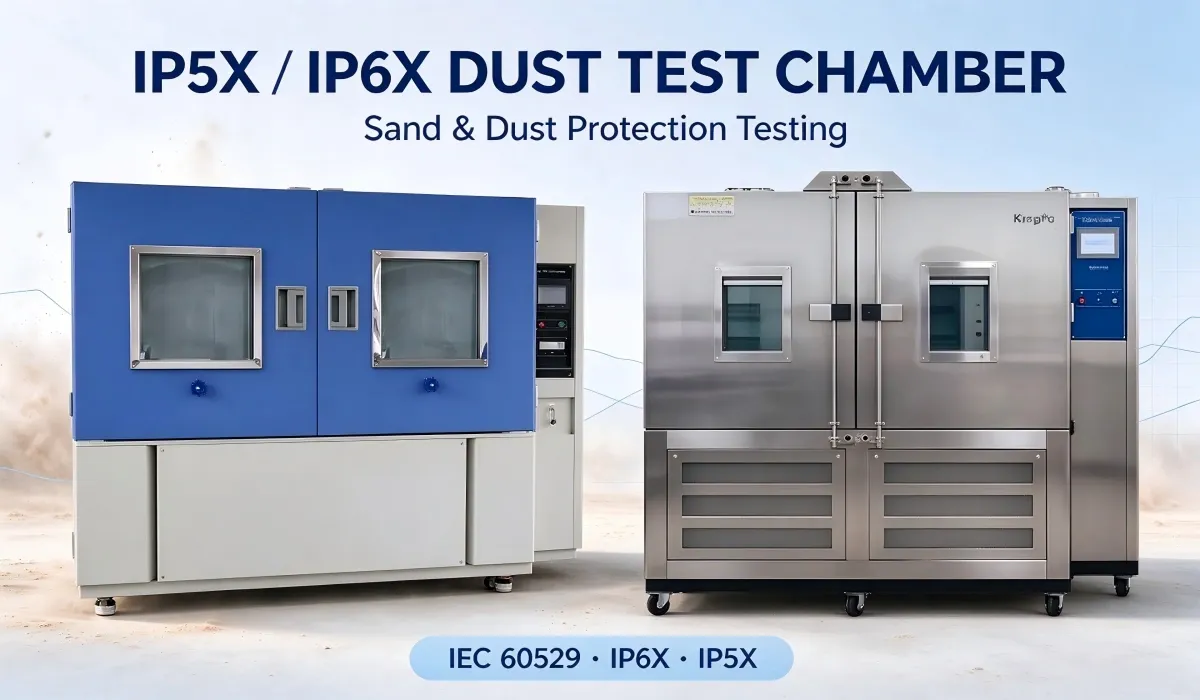
When evaluating enclosure protection against dust, the two relevant levels defined by IEC 60529 are IP5X (dust-protected) and IP6X (dust-tight).
Both levels are verified in the same type of sand and dust test chamber using talcum powder as the test medium. The difference lies in the vacuum arrangement and the acceptance criterion.
IP5X and IP6X testing is commonly required for products such as:
- EV battery packs and connectors
- Outdoor telecom and network equipment
- Industrial control cabinets
- LED luminaires and drivers
- Construction and mining electronics
- Switchgear and junction boxes
- Automotive sensors and controllers
This guide explains the technical meaning of each level, the official IEC 60529 test method, the laboratory details that affect results, and how to select the right dust test chamber.
Understanding the Dust Levels of the IP Code
The second characteristic numeral of the IP code defines water protection, while the first numeral (0–6) defines protection against solid objects and dust.
First Digit | Protection Level | Meaning |
|---|---|---|
0–4 | Object protection | Objects ≥ 50 / 12.5 / 2.5 / 1.0 mm |
5 | Dust-protected | Dust ingress not fully prevented, must not interfere with operation or safety |
6 | Dust-tight | No ingress of dust at all |
IP5X and IP6X are especially important because dust is a slow failure driver: a film of powder on a contact or an optical surface produces field failures that no functional test before shipment will catch.
Key Test Principles of IP5X and IP6X
Although the two levels carry different names, they share the same test method. IEC 60529 defines four core principles:
1. Standardized Test Dust
The test medium is talcum powder, sieved through a mesh with:
- Nominal wire diameter: 50 μm
- Nominal free distance between wires: 75 μm
Powder outside this specification produces non-repeatable results.
2. Uniform Dust Circulation
A fan keeps the powder in suspension so the chamber is filled with a homogeneous dust cloud.
Top Test chambers support both circulation modes required by the standards:
- Free dust fall
- Forced dust blowing from the bottom
3. Specified Depressurization
Enclosures are usually connected to a vacuum pump that maintains a depression of up to 2 kPa below atmospheric pressure, or the value specified in the relevant product standard.
The inward airflow draws dust toward the seals throughout the test, simulating enclosure breathing in service.
4. Defined Test Duration
The test typically runs for about 8 hours.
Product standards may specify deviations, which must be stated in the test report.
IP5X Testing – Dust-Protected
IP5X confirms that ingress of dust is not entirely prevented, but that dust does not enter in sufficient quantity to interfere with the satisfactory operation of the equipment or impair safety.
Acceptance Criterion
After the test, the inspector evaluates:
- Whether dust has reached critical internal parts
- Whether operation and safety are unaffected
Typical Applications
- Household appliances operating in dusty air
- Enclosures with ventilation or filters by design
- Industrial equipment in covered, dusty locations
Engineering Note
IP5X is a functional acceptance level. Dust that sheds off an inert surface can pass; dust on a PCB trace, a contact face or a moving part cannot.
IP6X Testing – Dust-Tight
IP6X confirms that no ingress of dust takes place whatsoever.
Acceptance Criterion
Any dust deposit found inside the enclosure after the test is a failure.
There is no partial credit at this level.
Typical Applications
- Connectors and EV battery enclosures
- Outdoor telecom and surveillance equipment
- Mining, construction and agricultural electronics
- Optics and precision instrument housings
Engineering Note
Because the criterion is absolute, the inspection discipline decides the result. Open, inspect and photograph the enclosure before cleaning it.
Laboratory Details That Affect Results
The method reads simple, and this is where results become unreliable. Four details require control:
Dust Batch Management
Talcum powder is reused across runs within the limit allowed by the standard, then retired.
Worn or agglomerated powder no longer challenges seals like fresh dust. Sieve the batch before loading; powder retained on the 75 μm mesh is spent.
Chamber Free Volume
The dust cloud must circulate freely around the specimen.
A chamber filled beyond its capacity cannot maintain uniform suspension. For large enclosures, increase the chamber size instead of compressing the loading.
Pressure Category
IEC 60529 distinguishes enclosures that develop an internal pressure difference in service from those that do not.
Only the first category is tested with the vacuum line connected. Applying the wrong arrangement changes the airflow through every gasket and, with it, the verdict.
Specimen Condition
The specimen is tested in its service configuration:
- Cable glands fitted and tightened
- Doors and covers latched
- Breathers and drains as delivered
Some product standards additionally require conditioning before the dust test, because gaskets that pass in new condition can leak after aging.
IP5X vs IP6X: Side-by-Side Comparison
Item | IP5X | IP6X |
|---|---|---|
Rating name | Dust-protected | Dust-tight |
Dust ingress allowed | Yes, if harmless to operation and safety | None |
Test dust | Talcum powder, 50 μm wire / 75 μm gap | Same |
Depressurization | Up to 2 kPa, per standard | Same |
Typical duration | About 8 hours | About 8 hours |
Acceptance | No harmful interference | No dust at all |
Which Level Does Your Product Need?
The applicable product standard states the required level. As a general rule:
- IP6X applies when any dust would degrade the product: contacts, optics, circuit boards, moving parts, or harsh outdoor and desert environments.
- IP5X applies when the enclosure breathes or filters air by design and the standard accepts dust that does not impair function.
Declaring IP6X when the standard requires IP5X increases test risk without commercial benefit. Declaring IP5X when the market expects IP6X costs orders.
Equipment for IP5X and IP6X Testing
Top Test's environment sand dust resistance test device complies with IEC 60529, ISO, JIS, DIN 40050 and GB 2423 dust test methods.
The series covers two circulation intensities:
Model | Dust Concentration | Air Velocity |
|---|---|---|
TT-C1 | 5000 mg/m³ | 5 m/s |
TT-C2 | 100 mg/m³ | 10 m/s |
Both models combine free dust fall and forced dust blowing modes in one chamber, with inner dimensions and control systems available as custom configurations.
For the water side of the IP code, the IP waterproof test equipment range covers IPX1 to IPX9K. The IEC 60529 IP ratings guide explains how all levels of the code fit together.
Frequently Asked Questions
Is the dust used in IP5X/IP6X tests ordinary powder?
No. IEC 60529 requires talcum powder sieved to a defined fineness: nominal 50 μm wire diameter and 75 μm free gap. Ordinary dust varies too much in particle size to produce repeatable results.
Can one chamber test both IP5X and IP6X?
Yes. The apparatus, dust and circulation are identical. Only the vacuum arrangement and the acceptance inspection differ, so one chamber serves both levels.
Why is depressurization applied to the specimen?
The slight internal depression maintains inward airflow through the seals for the whole test, in the same way enclosure breathing transports dust in service. Without it, a tight enclosure may sit in the cloud with almost no dust reaching its seals.
How is IP6X verified after the test?
The specimen is opened and visually inspected. Any dust deposit inside is a failure. Some product standards additionally require functional verification after the test.
Conclusion
IP5X and IP6X use the same chamber and the same talcum powder; the vacuum arrangement and the acceptance criterion are what separate them.
One correctly sized sand and dust chamber therefore covers both levels, provided the dust batch, free volume, pressure category and specimen condition are controlled.
Send us your applicable standard, specimen dimensions and weight, and the IP levels to be declared. Contact Top Test for the technical datasheet and quotation, or browse the full dust and environmental test equipment range.