Oct 9, 2026News & Insights
IP69K vs IP68: High-Temperature High-Pressure Jet Testing vs Immersion Explained
IP69K and IP68 are both top-level water protection ratings, but one tests 80°C high-pressure jets and the other tests immersion. Compare test conditions, equipment and typical applications.
IP69K and IP68 are the two most demanding water protection levels in enclosure testing.
The two ratings apply fundamentally different loads:
- IP69K — high-temperature (80 °C), high-pressure (80–100 bar) water jets
- IP68 — continuous static immersion in water
The equipment, the physics and the failure modes are different, so passing one test does not imply passing the other.
Both ratings are commonly required for products such as:
- Automotive electronics and EV battery packs
- Wiper motors and vehicle lamps
- Marine and underwater equipment
- Outdoor telecom enclosures
- Agricultural and construction machinery components
This guide explains the test conditions of each rating, the reasons the tests cannot replace each other, and the corresponding test equipment.
Understanding the Two Ratings in the IP Code
Both ratings appear near the top of the IEC 60529 water protection scale, with different origins:
- IP69K originated in DIN 40050-9 for road vehicles. ISO 20653 retains the IPX9K designation, and IEC 60529 adopted the same test as IPX9. In everyday industry usage, IP69K and IPX9K refer to the same test.
- IP68 is defined directly in IEC 60529 as continuous immersion under conditions agreed between manufacturer and user.
Because the two ratings come from different standard families, product specifications frequently require both.
IP69K Testing – High-Temperature, High-Pressure Jets
Test Conditions
The IPX9K test simulates steam-jet cleaning and high-pressure washdown:
- Water temperature: 80 °C ± 5 °C
- Pressure: 8000–10000 kPa (80–100 bar)
- Flow rate: 14–16 L/min through four fan-shaped nozzles
- Nozzle angles: 0°, 30°, 60° and 90° — 30 seconds per angle
- Specimen rotation: turntable at approximately 5 rpm
The spray cycle itself lasts about two minutes. The combination of heat, pressure and impingement is severe on seals, gaskets and cable glands.
Typical Applications
- Vehicle lamps and wiper motors
- On-board controllers and sensors
- EV battery packs
- Components cleaned with high-pressure hot water in food, chemical or industrial plants
Engineering Note
The 80 °C spray heats and softens sealing materials during the test. Seals that pass cool-water immersion can still fail IP69K.
IP68 Testing – Continuous Immersion
Test Conditions
IP68 is continuous immersion under conditions agreed between manufacturer and user:
- No fixed depth or duration is prescribed
- The agreed conditions must be more severe than IPX7 (1 m of water for 30 minutes)
- A typical test runs deeper or longer, for example 1.5 m for 60 minutes
- Pressurized tank equipment reproduces depths of tens of metres for underwater products
The load is static hydrostatic pressure, applied evenly across every seal and joint, with no temperature shock and no moving water.
Typical Applications
- Marine lights and underwater sensors
- Submerged pumps and motors
- Dive equipment
- Outdoor telecom enclosures requiring prolonged soak verification
Engineering Note
An IP68 claim is only meaningful when the test conditions are stated with it, because depth and duration are agreed values rather than fixed ones.
IP69K vs IP68: Side-by-Side Comparison
Item | IP69K (IPX9K) | IP68 |
|---|---|---|
Water condition | High-pressure, high-temperature jets | Static immersion |
Pressure | 80–100 bar, 14–16 L/min | Set by depth or tank pressure |
Temperature | 80 °C ± 5 °C | Ambient unless specified |
Duration | 30 s per angle, 4 angles | Agreed; more severe than IPX7 |
Simulates | Steam-jet cleaning, car washes | Underwater use, prolonged submersion |
Typical failure found | Seal deformation under thermal shock; jet ingress at cable entries | Slow leaks under uniform pressure |
Why the Tests Cannot Replace Each Other
The two tests load an enclosure through different mechanisms:
- Static versus dynamic load. Immersion presses uniformly on every surface; a jet concentrates extreme energy on a small spot and drives water through any gap in its path.
- Thermal shock. Only IP69K combines hot water with mechanical impact, a condition immersion testing never creates.
- Different weak points. Jet tests expose cable glands, door seals and housing joints; immersion tests expose hairline cracks, weld porosity and slow leaks.
Automotive and off-road specifications therefore frequently require both tests, each with its own equipment.
Which Rating Does Your Product Need?
- IP69K applies when the product undergoes high-pressure hot-water cleaning or is mounted on vehicles and machinery: car lamps, wiper motors, on-board electronics, EV battery packs, construction and agricultural components.
- IP68 applies when the product operates or may be stored underwater, or when the applicable standard requires a deeper or longer soak than IPX7: marine devices, underwater sensors, submerged pumps.
The applicable product standard determines the requirement. Standards referencing ISO 20653 call up IPX9K; standards referencing IEC 60529 or marine specifications call up IP68 with agreed conditions.
Equipment for IP69K and IP68 Testing
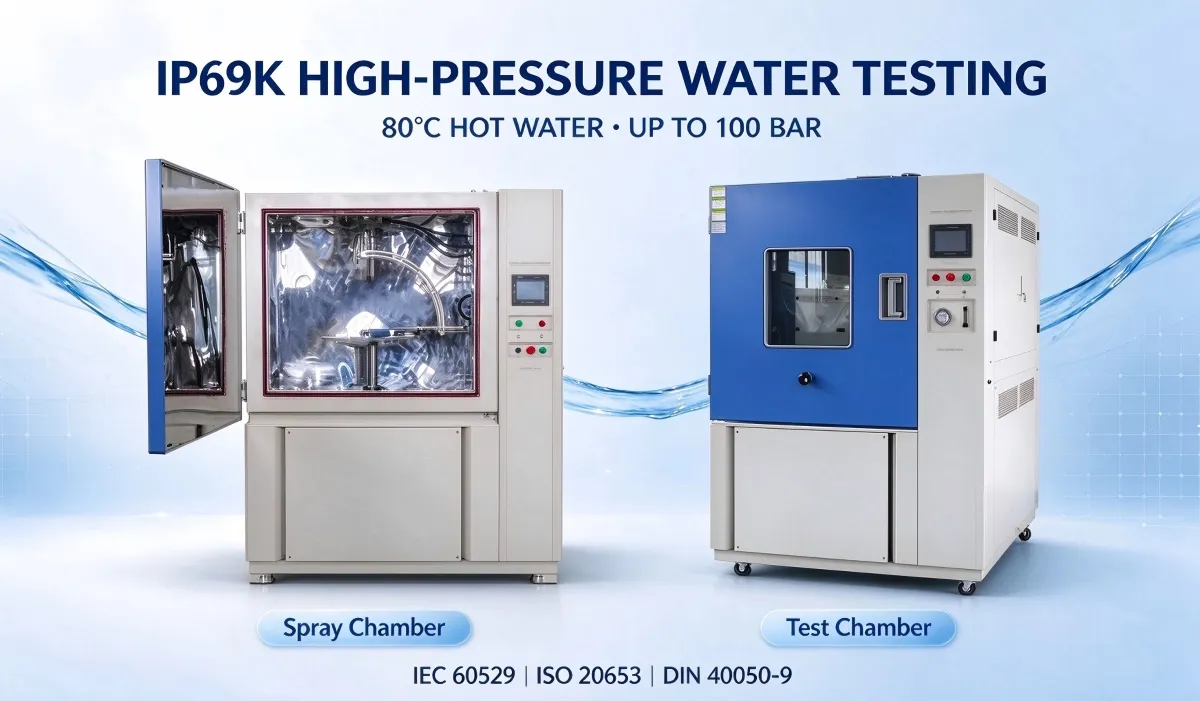
IP69K requires a chamber with heated pressurized water, four nozzles at the standard angles and a rotating specimen table. Top Test offers two configurations:
- IPX9K high temperature pressure jet waterproof test chamber — standard laboratory configuration
- TT-IPX9-800L IPX9K test equipment — 800×800×800 mm test space for larger specimens such as battery packs
Both comply with DIN 40050-9, ISO 20653 and IEC 60529.
IP68 requires a pressurized tank rather than an open bath. The IPX7/IPX8 waterproof rating tester provides adjustable pressure up to 1.2 MPa, corresponding to water depths up to 120 m, with customizable depth settings for agreed IPX8 conditions.
Frequently Asked Questions
Is IP69K "higher" or better than IP68?
No. The IP code is not a single ladder. IP69K protects against hot high-pressure jets; IP68 protects against continuous immersion. Each rating is declared separately for its own water condition.
Can an IP68 test substitute for IPX9K?
No. Immersion applies static pressure at ambient temperature, while IPX9K applies hot pressurized jets. The failure mechanisms differ, so certification laboratories test and declare them separately.
What is the difference between IPX9 and IPX9K?
The test conditions are identical: 80 °C, 80–100 bar, four spray angles. ISO 20653 uses the IPX9K designation from DIN 40050-9, while IEC 60529 lists the same test as IPX9. For equipment selection, both refer to the same chamber.
How long does a complete IPX9K test take?
Spraying lasts 30 seconds per nozzle angle across four angles, about two minutes in total. Water heating to 80 °C, turntable setup and post-test inspection add preparation time, so a complete cycle typically occupies half a day.
Conclusion
IP69K and IP68 sit at the top of the water protection scale but verify entirely different capabilities: resistance to hot high-pressure jets versus resistance to continuous immersion.
Labs serving automotive, new energy or outdoor product lines therefore need both a jet chamber and a pressurized immersion tank.
Send us your applicable standard and edition, the IP levels to declare, maximum specimen dimensions and weight, and your available power and water supply. Contact Top Test for a quotation and technical datasheet, or browse the full waterproof test equipment catalogue.