Oct 30, 2026News & Insights
IEC 60529 Spray Apparatus: IPX3 and IPX4 Water Spray Testing Guide
Learn about IEC 60529 spray apparatus for IPX3 and IPX4 testing, including spray nozzles, oscillating tubes, test methods, key requirements, and how to choose the right equipment.
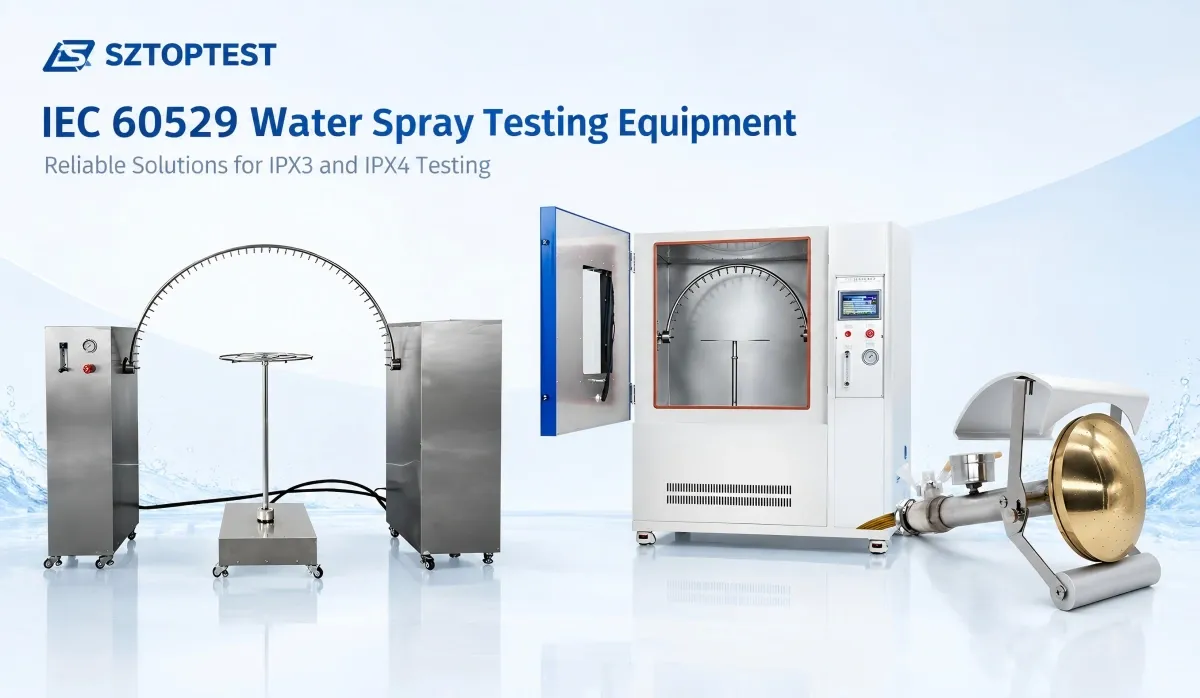
An IEC 60529 spray apparatus is used to test the protection of electrical and electronic enclosures against water spray and splashing, primarily for IPX3 and IPX4 testing. Depending on the product size and test setup, the apparatus can be a handheld spray nozzle or an automatic oscillating tube system.
The right spray apparatus depends on the test method, specimen size, and required level of automation. A handheld nozzle provides flexibility for large or irregular products, while an oscillating tube provides more controlled and repeatable spray coverage for products that fit inside the test system. When selecting equipment, the most important factors are the spray configuration, water flow, test distance, spray angle, specimen size, and applicable standard.
What Is an IEC 60529 Spray Apparatus?
IEC 60529 specifies the IP Code used to classify the degrees of protection provided by enclosures against access to hazardous parts, solid foreign objects, and water.
For IPX3 and IPX4, the water test exposes the enclosure to controlled spray or splash. The purpose is to create a repeatable test condition rather than simply spraying water onto the product.
There are two common equipment configurations:
- Handheld spray nozzle: useful for large, irregular, or difficult-to-position specimens.
- Oscillating tube: suitable for specimens that can be positioned within the tube's effective spray area and provides automated movement.
For applications where a handheld setup is sufficient, a dedicated IPX3/IPX4 handheld spray nozzle can be used. For laboratory testing requiring a more controlled setup, a complete waterproof test chamber with an oscillating tube may be more appropriate.
How Does the IEC 60529 Spray Apparatus Work?
The basic principle is straightforward: water is delivered through a specified spray arrangement and directed toward the test specimen under controlled conditions.
However, the apparatus needs to control more than just water delivery. The test setup also depends on:
- Spray pattern
- Water flow
- Spray direction
- Test distance
- Specimen position
- Exposure time
- Movement of the spray source
These factors determine how much water reaches the enclosure and help make repeated tests comparable.
For a production laboratory, this is one reason an automatic system can be preferable to a completely manual setup. Once the test parameters are established, automated movement can reduce variation between operators.
IPX3 vs. IPX4: Which Spray Test Do You Need?
IPX3 and IPX4 are both water tests under IEC 60529, but they do not use exactly the same spray exposure.
IPX3 Water Spray Test
IPX3 evaluates protection against water spray directed at the enclosure within the specified angular range.
With a handheld spray nozzle, a movable shield or baffle is used to control the spray pattern for the IPX3 configuration.
This type of test is relevant to products that may be exposed to rain or water approaching the enclosure from an angled direction.
IPX4 Water Splash Test
IPX4 evaluates protection against splashing water from all directions.
For a handheld spray nozzle, the configuration is changed so that the water can reach the specimen from the required directions.
Because the water exposure covers a wider range of directions, IPX4 can reveal sealing weaknesses that may not be exposed under an IPX3 test.
IPX3 and IPX4 Comparison
Item | IPX3 | IPX4 |
|---|---|---|
Test type | Water spray | Water splash |
Spray coverage | Specified angular range | From all directions |
Handheld nozzle configuration | Baffle used | Baffle removed |
Common equipment | Spray nozzle or oscillating tube | Spray nozzle or oscillating tube |
Typical products | Enclosures, lighting, outdoor equipment | Electronics, appliances, lighting, automotive components |
The required test should always be determined from the applicable product standard and the intended IP rating rather than assuming that IPX4 is simply a stronger version of IPX3.
IEC 60529 Spray Apparatus Test Method
A typical IPX3/IPX4 test can be divided into four practical stages.
1. Prepare the Specimen
First, determine the correct orientation and mounting position of the product.
Before testing, check:
- Product dimensions
- Enclosure configuration
- Seams and joints
- Cable entries
- Connectors
- Covers and doors
- Intended installation position
For certification work, the specimen condition and final evaluation should follow the applicable standard and product-specific requirements.
2. Set Up the Spray Apparatus
Connect the spray system to the water supply and establish the required test condition.
For a handheld system, the operator needs to control the nozzle position and direction.
For an automatic oscillating tube system, the equipment controls the movement of the spray source.
The setup should ensure that the required surfaces receive the specified water exposure without introducing uncontrolled variables.
3. Perform the Spray Test
The general sequence is:
Specimen positioning → Water-flow adjustment → Spray exposure → Required coverage → Post-test inspection
During the test, the operator or equipment should maintain the required distance and spray configuration.
For repeated laboratory testing, automated equipment can provide more consistent movement and timing than a manually operated setup.
4. Inspect the Specimen
After the water exposure, inspect the enclosure according to the applicable evaluation criteria.
The purpose is to determine whether water has entered the enclosure in a manner that causes harmful effects or otherwise fails the applicable requirements.
Visible water alone should not be used as the only basis for determining compliance. The final assessment should follow IEC 60529 and any applicable product standard.
Key Parameters of an IEC 60529 Spray Apparatus
When comparing different spray apparatus, several parameters deserve particular attention.
Spray Nozzle
The spray nozzle determines the water distribution and spray pattern.
For an IEC 60529 handheld spray configuration, the nozzle design, hole arrangement, and baffle configuration are important to maintaining the intended test condition.
A practical spray nozzle should also be:
- Corrosion resistant
- Easy to clean
- Easy to connect to the water supply
- Easy to adjust
- Suitable for repeated laboratory use
Water Flow
Stable water flow is essential for repeatable testing.
If the water flow changes significantly during testing, the specimen may receive a different water load from one test to another.
Therefore, a professional setup should consider:
- Flow control
- Flow measurement
- Pump stability
- Water supply pressure
- Water circulation
The exact flow requirement should be confirmed against the applicable IEC 60529 test configuration rather than applying one value to every IPX3/IPX4 apparatus.
Test Distance
The distance between the spray source and the specimen affects the water exposure.
This is particularly important for handheld testing because the operator must maintain the correct position throughout the test.
For automated systems, the mechanical structure can help maintain a consistent relationship between the spray source and specimen.
Spray Angle and Movement
IPX3 and IPX4 require different spray coverage.
For a handheld nozzle, the operator controls the direction manually.
For an oscillating tube system, the tube movement determines the spray coverage around the specimen.
Therefore, when purchasing an automatic system, check:
- Tube diameter
- Spray-hole arrangement
- Oscillation angle
- Rotation function
- Test speed
- Specimen positioning
Water Circulation
A complete waterproof test chamber normally includes a water tank, pump, piping, flow-control components, and drainage.
A circulation system is useful for laboratories that perform repeated tests because it reduces the need to continuously supply fresh water and makes the equipment easier to operate.
Spray Nozzle or Oscillating Tube: Which One Should You Choose?
This is one of the most important equipment-selection decisions.
Choose a Handheld Spray Nozzle When:
A handheld nozzle can be a good choice when:
- The specimen is large
- The product has an irregular shape
- The specimen cannot fit inside an oscillating tube
- Different areas need to be tested manually
- A flexible test setup is required
- The testing frequency is relatively low
It is also useful when a laboratory already has a suitable water supply and only needs the spray apparatus itself.
Choose an Oscillating Tube When:
An oscillating tube system is more suitable when:
- The specimen fits within the equipment
- Repeatability is important
- Multiple identical products are tested
- Automated spray movement is preferred
- The laboratory performs frequent IPX3/IPX4 testing
For production and laboratory environments, automation can also reduce operator-dependent differences.
Choose a Complete Waterproof Test Chamber When:
A complete chamber makes more sense when the laboratory needs an integrated solution with:
- Water tank
- Pump
- Flow control
- Oscillating tube
- Turntable
- Control system
- Drainage
- Safety protection
For example, SZTOPTEST offers an IPX1-IPX2-IPX3-IPX4 Waterproof Test Chamber for applications requiring multiple low-level water-ingress tests in one system.
How to Choose an IEC 60529 Spray Apparatus
Before purchasing equipment, start with the product rather than the equipment model.
1. Confirm the Required IP Rating
First determine whether the product requires:
- IPX3
- IPX4
- Both IPX3 and IPX4
- Additional water-ingress ratings
If several ratings are required, a combined system may reduce the need for separate equipment.
2. Check the Maximum Specimen Size
Measure the largest product that needs to be tested, including:
- Product length
- Product width
- Product height
- Connectors
- Cable extensions
- Fixtures
This is particularly important when deciding between a handheld nozzle and an oscillating tube.
3. Determine the Required Automation
For occasional testing, a manual spray nozzle may be sufficient.
For continuous laboratory or factory testing, an automated system can provide better repeatability and reduce operator workload.
4. Check Water-System Configuration
For a complete system, check:
- Tank capacity
- Pump capacity
- Flow-control method
- Water-level protection
- Filtration
- Drainage
- Water recycling
5. Consider Future Testing Requirements
If the laboratory may later need IPX1, IPX2, IPX5, IPX6, or IPX7 testing, it may be worth considering an integrated testing strategy instead of purchasing one standalone device at a time.
For example, IPX5/IPX6 use dedicated water-jet equipment rather than the IPX3/IPX4 spray method. SZTOPTEST's IPX5/IPX6 Water Jet Test Equipment uses dedicated water-jet nozzles for these tests.
IPX7, on the other hand, uses temporary immersion rather than spray. A dedicated IPX7 Water Immersion Test Equipment is therefore required when immersion testing is part of the test plan.
IEC 60529 Spray Apparatus vs. Other IP Test Equipment
Different IP water tests use different equipment because they simulate different water conditions.
Equipment | Main Test | Typical IP Rating |
|---|---|---|
Drip equipment | Vertical dripping | IPX1/IPX2 |
Spray nozzle | Water spray/splash | IPX3/IPX4 |
Oscillating tube | Water spray/splash | IPX3/IPX4 |
Water jet equipment | Water jets | IPX5/IPX6 |
Immersion tank | Temporary immersion | IPX7 |
Pressurized immersion system | Continuous/deeper immersion | IPX8 |
This distinction is important when purchasing equipment. A higher-numbered IP test is not simply a replacement for a lower-numbered test. Each test has its own method and purpose.
For example, IPX5/IPX6 equipment uses dedicated jet nozzles and water-flow conditions. IPX7 instead requires a controlled immersion setup.
Applications of IEC 60529 Spray Apparatus
Electrical Enclosures
Electrical cabinets, control boxes, junction boxes, and other enclosures may require water-spray or splash testing depending on their intended installation environment.
Consumer Electronics
Electronic products and household appliances can use IPX3/IPX4 testing during product development, design verification, and compliance testing.
Automotive Components
Automotive components may encounter rain and water splash during vehicle operation. Depending on the applicable specification, IPX3/IPX4-type water exposure may form part of a broader environmental test program.
For automotive products, IEC 60529 may also be supplemented by standards such as ISO 20653 or manufacturer-specific requirements.
Outdoor Lighting
Outdoor luminaires and lighting enclosures are common applications for water-ingress testing.
Particular attention is often paid to:
- Housing joints
- Gaskets
- Cable glands
- Covers
- Connectors
- Sealing interfaces
Outdoor Electrical Equipment
Communication equipment, sensors, electrical controls, and other outdoor devices may also require water spray or splash testing according to their intended environment.
FAQ About IEC 60529 Spray Apparatus
What is an IEC 60529 spray apparatus?
It is equipment used to expose an enclosure to controlled water spray or splash for applicable IP water-ingress tests, particularly IPX3 and IPX4.
What equipment is used for IPX3 and IPX4?
The test can use a handheld spray nozzle or an oscillating tube system, depending on the specimen and applicable test arrangement.
What is the main difference between IPX3 and IPX4?
IPX3 uses the specified water-spray exposure at defined angles, while IPX4 evaluates splashing water from all directions.
Can one spray apparatus perform both IPX3 and IPX4?
Yes. A suitable IEC 60529 spray system can be configured for both tests. With a handheld system, the spray configuration is changed between the IPX3 and IPX4 conditions.
Should I buy a spray nozzle or a complete test chamber?
Choose a spray nozzle when flexibility and large-specimen testing are the priority. Choose a complete chamber when automated, repeatable testing and an integrated water system are more important.
Can IPX4 equipment be used for IPX5 or IPX6?
No. IPX5 and IPX6 use dedicated water-jet test methods with different nozzles and flow conditions. Dedicated water-jet equipment should be used when those ratings are required.
Is IPX7 tested with a spray apparatus?
No. IPX7 is a temporary immersion test, so it requires an immersion tank or equivalent immersion test system rather than an IPX3/IPX4 spray apparatus.
Conclusion
An IEC 60529 spray apparatus is designed to provide controlled water spray or splash exposure for IPX3 and IPX4 testing. The appropriate configuration depends mainly on the specimen size, required IP rating, testing frequency, and level of automation.
For large or irregular specimens, a handheld spray nozzle provides flexibility. For repeatable laboratory testing, an oscillating tube or complete waterproof test chamber provides a more controlled solution.
When selecting equipment, focus on the actual test requirements: spray configuration, water flow, test distance, spray angle, specimen size, water circulation, automation, and applicable standards. Choosing the apparatus according to these factors helps ensure that the equipment matches the intended test rather than simply selecting a chamber based on its IP rating.