Sep 24, 2026News & Insights
Transportation Vibration Testing Explained: ASTM D999, ASTM D4169 and ISTA
How transportation vibration testing works — the standards behind it (ASTM D999, D4169, ISTA, ISO 2247), what rotary repetitive-shock testers reproduce, and how to build the full test sequence.
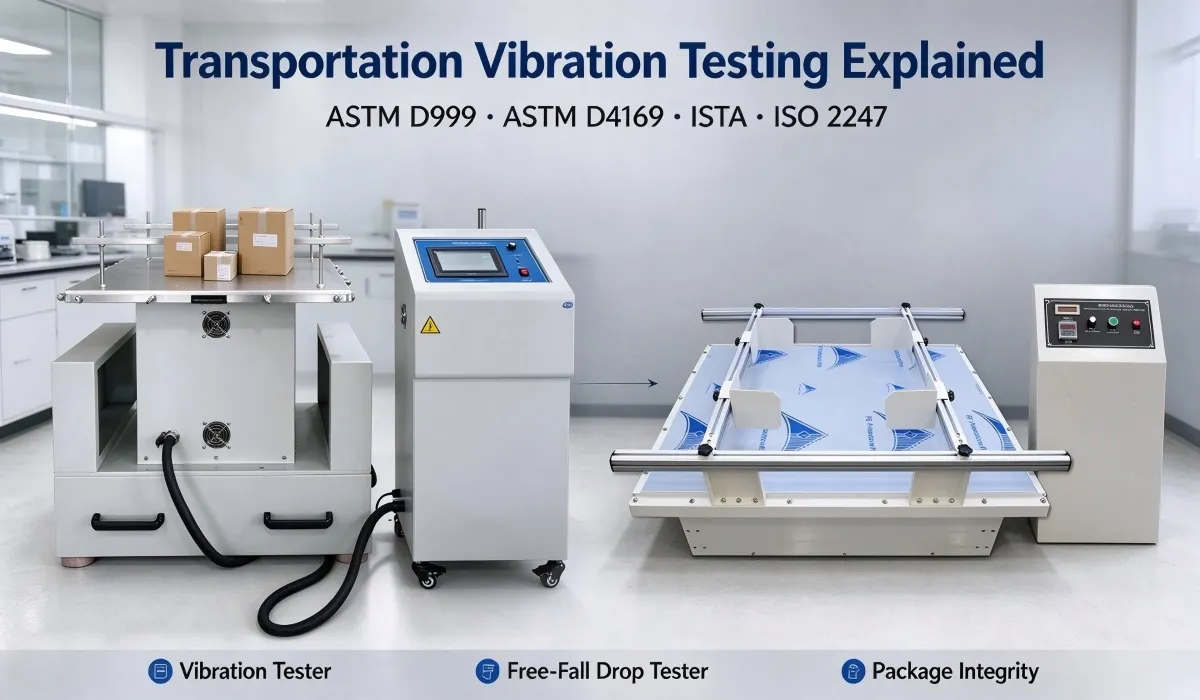
A package that survives a drop can still be shaken to pieces — vibration is the quieter half of transit damage, and it is the half most labs test less carefully.
Transportation vibration testing reproduces, in the laboratory, what hours of road vibration do to a carton, its cushioning and the product inside. It is written into:
• Export packaging qualification programs
• ISTA and retailer vendor compliance procedures
• Automotive parts and electronics shipping specifications
• E-commerce fulfillment packaging development
This guide explains the standards behind the test, what the machine actually does, and how to build a complete transit test sequence.
The Standards Stack
Four documents cover most transit vibration requirements:
• ASTM D999 — vibration testing of shipping containers, including the rotary repetitive-shock motion that reproduces truck transport's constant bumping.
• ASTM D4169 — performance testing of shipping units through a distribution cycle: the standard assigns a cycle (handling, stacking, vibration, drops) based on the distribution environment, and the laboratory executes the sequence.
• ISTA procedures (1A, 2A, 3A…) — pre-packaged sequences combining conditioning, vibration and drops; 3A is the e-commerce parcel standard, and retailer programs usually reference an ISTA procedure.
• ISO 2247 — fixed-frequency vibration for complete, filled transport packages.
The practical difference: D999 and ISO 2247 define how to run a vibration test; D4169 and ISTA define the whole journey the package must survive — vibration is one segment of it.
What the Tester Reproduces
The most common transport vibration machine is the rotary repetitive-shock type, and the Top Test TT-ZD-100 series transportation vibration tester is a representative configuration:
• Rotary reciprocating motion — the table tips continuously, so the load is lifted and dropped in thousands of small impacts, exactly the rhythm of a truck on jointed pavement
• Frequency range 100–300 rpm with variable-frequency speed control
• 25.4 mm (1 inch) displacement per the test convention
• SUS304 test platform, 1000×1200 mm up to 1200×1500 mm
• Test duration 0–99 hours with automatic timing and delayed start
• TT-ZD-100 — Max test load: 50 kg; Table size: 1000 × 1200 mm
• TT-ZD-100A — Max test load: 100 kg; Table size: 1200 × 1200 mm
• TT-ZD-100B — Max test load: 200 kg; Table size: 1200 × 1500 mm
Engineering note: the rotary motion's value is its realism at low cost — real road transport is not a clean sine wave but hours of small vertical shocks. The machine accumulates that damage in a controlled, repeatable, timed run.
What the Test Finds
Vibration damage is cumulative, and the post-test inspection looks for it methodically:
• Carton cracking, deformation or structural failure
• Cushioning displaced, compressed or shifted out of position
• Product movement and collision inside the package
• Loose fasteners, terminals and connectors
• Abrasion and surface wear at contact points
• Functional failure after the run
Cushioning shift deserves special attention: an insert that starts centered rarely ends centered after a vibration run, and the product's position at hour three of transit is not where the design assumed.
Building the Full Sequence
Vibration is one segment of a transit qualification, and the standards define the order:
• Conditioning — temperature and humidity per the procedure, because board strength and cushioning behavior change with climate.
• Vibration — the run time or intensity the distribution cycle assigns.
Running the segments in the procedure's order matters — damage from one segment changes how the package behaves in the next, and reordering the sequence invalidates the comparison against the standard.
Choosing a Tester
Three questions size the machine:
• How heavy is the heaviest shipping unit?
Model capacity 50/100/200 kg covers cartons through large assembled units — pick for the heaviest, not the average.
• Which procedures must the lab satisfy?
D999, D4169, ISTA and ISO 2247 requirements are all executable on a rotary repetitive-shock tester; confirm duration control (0–99 h with automatic stop) covers your longest assigned run.
• Does the sequence need drops too?
Pair the vibration tester with a free-fall drop tester so the full D4169/ISTA sequence runs in-house.
Frequently Asked Questions
What is the difference between ASTM D999 and ASTM D4169?
D999 is the vibration test method — how to vibrate a shipping container. D4169 is the distribution-cycle standard that assembles handling, vibration, stacking and impact into a full journey based on the distribution environment. Labs use D999 inside D4169-style programs.
Is rotary vibration as good as a random-vibration table?
They answer different questions. Rotary repetitive shock reproduces truck transport's cumulative bumping economically, which is what packaging standards mostly need. Random vibration tables serve product-level and automotive electronics programs with specified power spectral densities. Packaging labs typically start rotary; product labs add random.
How long does a vibration test run?
The procedure decides: runs are specified in time or distance equivalents, commonly from one to several hours per axis or sequence. The tester's 0–99 hour programmable timer with automatic stop covers the standard assignments.
Can I test a pallet load?
Yes — select the table size and capacity for the unit. The TT-ZD-100B carries up to 200 kg on a 1200×1500 mm platform for larger shipping units.
Conclusion
Transportation vibration testing turns "will it survive the truck?" into a timed, repeatable laboratory run: the standards (D999, D4169, ISTA, ISO 2247) define the journey, and a rotary repetitive-shock tester accumulates the road's small shocks until the package tells the truth about its cushioning, its closure and its product.
Send Top Test the heaviest unit weight, the procedures you must satisfy, and your lab floor space — contact us for a quotation, or browse the mechanical testing equipment range for the complete transit lab.