Oct 30, 2026News & Insights
Ozone Aging Test for Rubber: ISO 1431 Test Method and Chamber Selection
Learn about the ISO 1431 ozone aging test for rubber, key test conditions, static and dynamic testing, and how to select the right ozone test chamber.
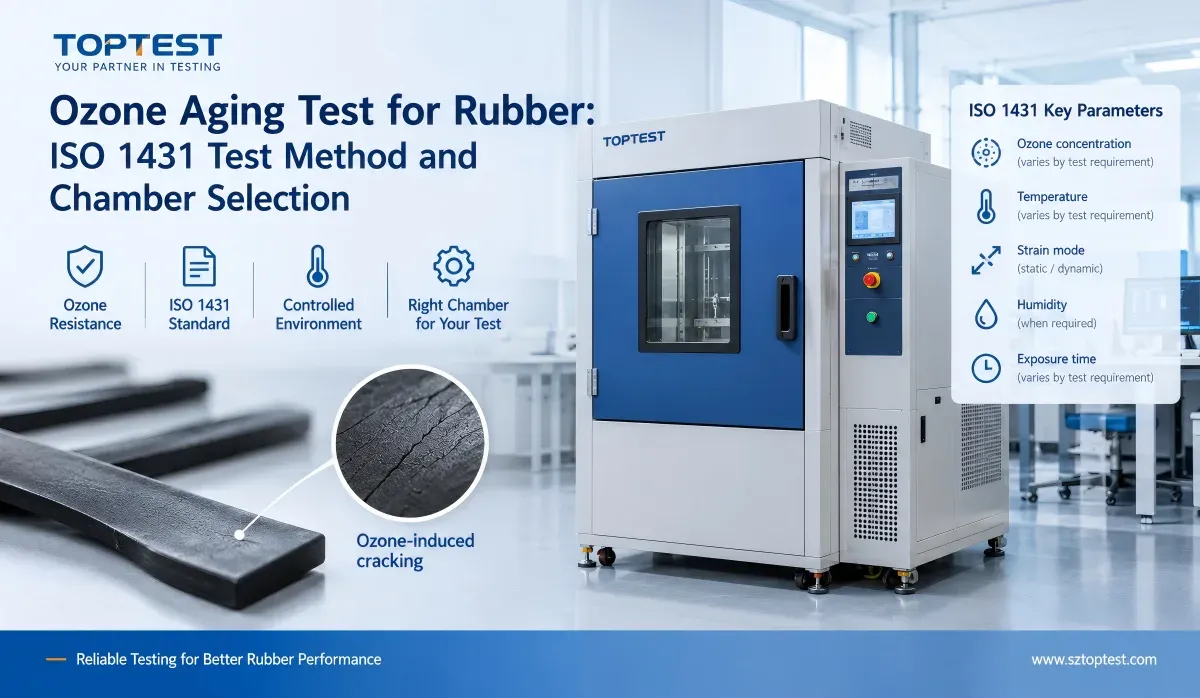
Rubber can develop surface cracks when exposed to ozone, especially when it is under tensile strain. An ozone aging test for rubber evaluates the material's resistance to ozone cracking by exposing specimens to a controlled ozone atmosphere under defined temperature and strain conditions.
The main international standard is ISO 1431-1:2024, which covers ozone cracking tests under static and dynamic tensile strain. The test requires controlled ozone concentration, temperature and, when specified, relative humidity, while direct light is excluded from the exposure environment.
This guide explains the ISO 1431 test method, important test conditions, static versus dynamic ozone testing, and how to select an ozone test chamber.
What Is an Ozone Aging Test for Rubber?
An ozone aging test evaluates the resistance of vulcanized or thermoplastic rubber to ozone-induced cracking.
Ozone is highly reactive and can attack the surface of susceptible rubber. When the rubber is stretched, small surface cracks may form and grow during exposure.
Typical applications include:
- Rubber seals and gaskets
- O-rings
- Hoses and tubing
- Cable insulation and sheaths
- Automotive rubber components
- Rubber sheets and molded products
The purpose of the test is to determine how the material behaves under controlled ozone exposure and strain, rather than simply measuring general aging.
ISO 1431-1 Ozone Test Method
ISO 1431-1:2024 specifies procedures for evaluating rubber exposed to air containing a defined ozone concentration at a defined temperature and, where required, relative humidity. Crack formation and growth can be evaluated by visual observation, image analysis, or both.
The basic process is:
Specimen preparation → conditioning → strain application → ozone exposure → crack evaluation
1. Prepare and Condition the Specimen
Test specimens are prepared and conditioned according to the applicable procedure.
Conditioning is important because the rubber's physical state can change after stretching. The applicable test specification should therefore be followed for the required conditioning procedure and time.
2. Apply the Required Strain
The specimen is exposed under either static or dynamic tensile strain.
Static strain keeps the specimen at a specified elongation during ozone exposure.
Dynamic strain repeatedly stretches the specimen according to the specified movement and frequency.
The selected strain should correspond to the applicable material, product, or test specification.
3. Expose the Specimen to Ozone
The specimen is placed in an ozone test chamber where the exposure environment is controlled.
Important parameters include:
- Ozone concentration
- Temperature
- Exposure time
- Strain condition
- Air circulation
- Relative humidity, when required
The test environment should also exclude the effects of direct light.
4. Evaluate Ozone Cracking
After exposure, the specimen is examined for surface cracks.
Depending on the test requirement, evaluation may include crack appearance, crack growth, or changes in selected physical or chemical properties.
ISO 1431 Ozone Concentration and Test Conditions
A common mistake is to treat 50 pphm as the only ISO 1431 test condition.
ISO 1431 testing can use different ozone concentrations depending on the test procedure and material requirement. Therefore, the required concentration should be confirmed before selecting the chamber.
The important parameters include:
Parameter | What to Confirm |
|---|---|
Ozone concentration | Required concentration and tolerance |
Temperature | Specified test temperature |
Strain | Static or dynamic |
Elongation | Required strain level |
Frequency | Required dynamic frequency |
Exposure time | Specified test duration |
Humidity | Whether humidity control is required |
Conditioning | Required pre-exposure procedure |
The chamber should therefore be selected according to the complete test protocol rather than ozone concentration alone.
Static vs. Dynamic Ozone Testing
Static and dynamic testing evaluate ozone resistance under different deformation conditions.
Static Ozone Test
In a static test, the rubber specimen is stretched to a specified elongation and held at that position during ozone exposure.
This approach is suitable for evaluating cracking under relatively constant tensile strain, such as materials used in seals and other components that remain deformed during service.
Dynamic Ozone Test
In a dynamic test, the specimen is repeatedly stretched and released while exposed to ozone.
This is useful for components that experience repeated deformation, such as hoses, flexible seals, cables, and other rubber parts exposed to movement.
For dynamic testing, the chamber needs a suitable mechanical stretching system. The required stroke, strain, frequency, and movement pattern should be confirmed from the applicable test method.
Why Conditioning Matters in Ozone Testing
Conditioning is an important part of reliable ozone testing.
After a specimen is stretched, its internal stress state can change over time. If specimens are not conditioned consistently, differences in preparation can affect the resulting crack behavior.
The LIB guide also highlights conditioning as an important practical consideration when comparing ASTM D1149 and ISO 1431 procedures.
For this reason, a well-designed ozone test program should clearly define:
- Stretching procedure
- Conditioning time
- Ozone exposure start time
- Exposure duration
- Strain condition
The exact conditioning requirement should always be taken from the applicable standard or product specification rather than assuming one fixed time for every ozone test.
How to Choose an Ozone Test Chamber
Choosing an ozone chamber should start with the test method, not the chamber size.
1. Confirm the Applicable Standard
Determine whether the test follows ISO 1431-1, ASTM D1149, GB/T 7762, IEC 60811-2-1, or another product-specific requirement.
Different standards may use different specimen configurations, strain conditions and evaluation procedures.
2. Check Ozone Concentration
The chamber should provide stable control over the ozone concentration required by your test.
Do not select a chamber simply because it has a high maximum concentration. The ability to maintain a stable and repeatable concentration at the actual test setpoint is more important.
3. Decide Between Static and Dynamic Testing
If your testing only requires fixed elongation, a static fixture may be sufficient.
If the rubber must be repeatedly stretched during exposure, choose a chamber with a dynamic tensile fixture.
This is one of the most important differences between basic ozone chambers and systems designed for more demanding rubber testing.
4. Check Temperature and Humidity
ISO 1431-1 defines testing at a specified temperature and, where required, relative humidity.
Therefore, confirm the required environmental conditions before selecting the chamber.
5. Consider Conditioning and Data Recording
For repeatable testing, it is useful to have programmable control for test timing and strain conditions.
For laboratories performing multiple standards, automatic recording of ozone concentration, temperature, exposure time and strain conditions can also improve test traceability.
Ozone Aging Test Chamber for Rubber
The Ozone Aging Test Chamber for Rubber from Top Test is designed for ozone cracking evaluation of vulcanized and thermoplastic rubber, cable insulation and sheaths.
The TT-OATC provides an ozone concentration range of 50–1000 pphm and a temperature range of 9–60 °C. The chamber supports static, continuous dynamic and intermittent dynamic testing, with a 0.5 Hz dynamic test configuration. These are equipment specifications of the TT-OATC and should not be interpreted as universal ISO 1431 test requirements.
The chamber can be configured according to the required specimen geometry, ozone concentration and strain method.
Ozone Aging vs. UV Aging
Ozone aging and UV aging evaluate different degradation mechanisms.
An ozone test focuses on ozone-induced cracking, particularly when rubber is exposed under tensile strain.
UV aging evaluates degradation associated with ultraviolet radiation and environmental factors such as heat and moisture. For a comparison of UV and xenon weathering methods, see our guide to UV vs. Xenon Weathering Test.
For outdoor rubber products, both ozone and UV testing may be useful, but they should not be treated as interchangeable tests.
For another complementary rubber durability evaluation, the Rubber Low Temperature Brittleness Tester can be used to evaluate cracking behavior under specified low-temperature impact conditions.
Ozone Test Chamber Selection Checklist
Before selecting an ozone aging test chamber, confirm:
- Applicable test standard
- Required ozone concentration
- Test temperature
- Static or dynamic strain
- Required elongation
- Dynamic frequency, if applicable
- Conditioning procedure
- Exposure duration
- Humidity requirement
- Specimen dimensions
- Number of specimens
Once these requirements are defined, the chamber volume, ozone control system and fixture configuration can be selected more accurately.
Conclusion
An ozone aging test for rubber evaluates resistance to ozone cracking under controlled environmental and strain conditions. ISO 1431-1:2024 covers both static and dynamic tensile strain testing and requires controlled ozone exposure at a defined temperature, with humidity control where applicable.
When selecting an ozone test chamber, focus first on the applicable standard, ozone concentration, strain method and conditioning procedure. Chamber size and additional functions should then be selected according to the actual specimens and testing workload.
A properly configured ozone aging chamber can provide repeatable data for rubber material development, product evaluation and quality control.