Sep 30, 2026News & Insights
UV vs. Xenon Weathering Test: Which Test Chamber Do You Need?
Compare UV vs xenon weathering tests, including ASTM G154, ASTM G155, ISO 4892-2 and ISO 4892-3, and learn how to choose the right weathering test chamber.
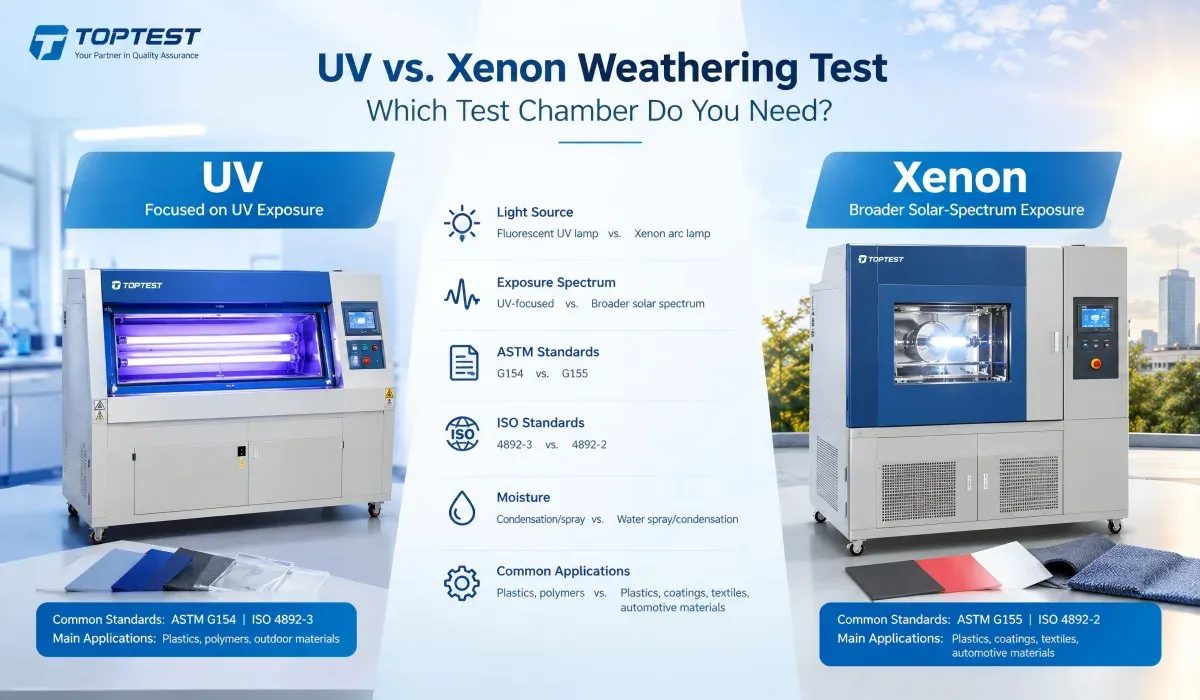
Choosing between a UV weathering test chamber and a xenon arc weathering test chamber mainly depends on the required test standard, light source, material, and exposure conditions.
In simple terms, choose a UV weathering test chamber when the test requires fluorescent UV exposure, such as ASTM G154 or ISO 4892-3. Choose a xenon arc weathering test chamber when the test requires xenon-arc exposure, such as ASTM G155 or ISO 4892-2. Neither chamber is universally better—the correct choice is the one that matches your actual test method.
A UV chamber uses fluorescent UV lamps, while a xenon chamber uses a filtered xenon arc lamp to provide a broader solar-spectrum exposure. Because the light sources and exposure conditions are different, the two types of chambers should not automatically be considered interchangeable.
UV vs. Xenon Weathering Test: Quick Answer
Requirement | UV Weathering Test | Xenon Weathering Test |
|---|---|---|
Light source | Fluorescent UV lamp | Xenon arc lamp |
Main exposure focus | UV radiation, heat and moisture | Broader solar-spectrum radiation, heat and moisture |
ASTM standard | ASTM G154-23 | ASTM G155-25 |
ISO standard | ISO 4892-3:2024* | ISO 4892-2:2013 + Amd 1:2021* |
Typical equipment | UV aging test chamber | Xenon arc weathering test chamber |
Common applications | Plastics, polymers, outdoor materials | Plastics, coatings, textiles, automotive materials |
Moisture | Condensation and/or spray depending on method | Water spray and/or other moisture conditions depending on method |
*ISO 4892-3 applies specifically to plastics; coatings use applicable coating standards such as ISO 16474-3. ISO 4892-2:2013 remains the current published edition, with Amendment 1:2021; a replacement edition is under development.
What Is a UV Weathering Test?
A UV weathering test uses fluorescent UV lamps to expose test specimens to controlled radiation, temperature and moisture.
The test is commonly used to evaluate changes such as:
- Color change
- Gloss loss
- Cracking
- Chalking
- Yellowing
- Brittleness
- Tensile or other mechanical-property changes
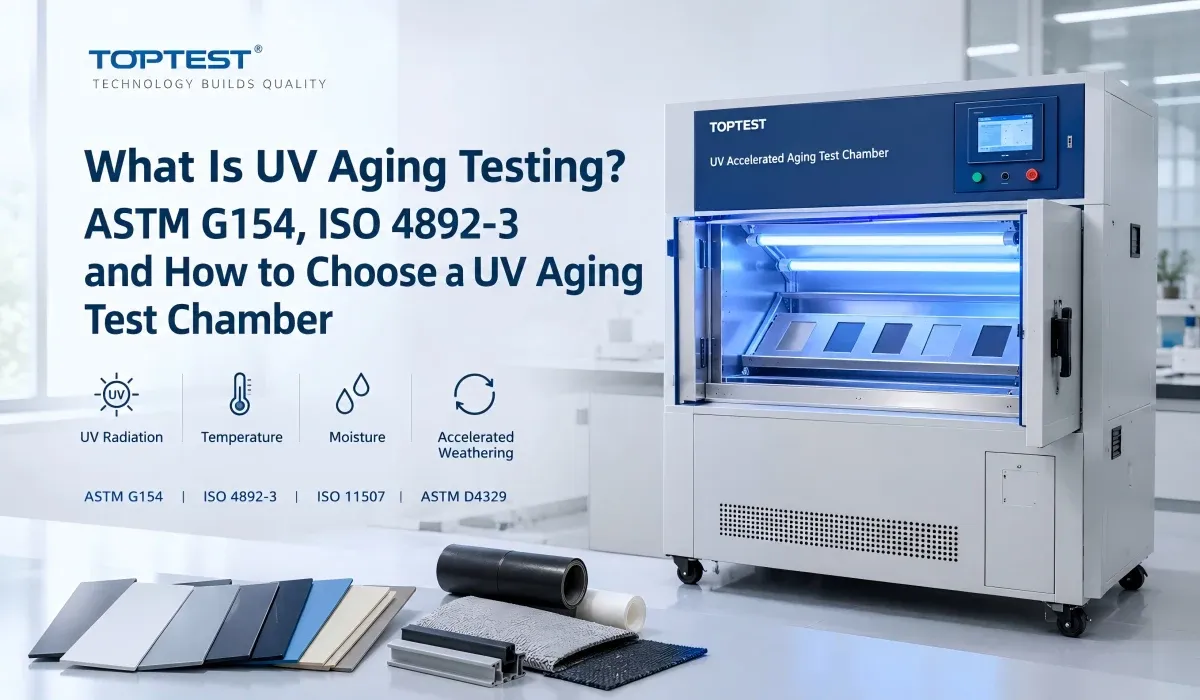
ASTM G154-23 covers the operation of fluorescent UV lamp apparatus for material exposure. The standard provides a range of exposure conditions and should be used together with the applicable test method that defines the required exposure conditions.
For plastics, ISO 4892-3:2024 specifies exposure using fluorescent UV radiation, heat and water. For paints, varnishes and other coatings, the applicable coating standard should be checked, such as ISO 16474-3.
What Is a Xenon Arc Weathering Test?
A xenon arc weathering test uses a xenon arc lamp and optical filters to expose materials to a controlled spectrum intended to reproduce relevant solar exposure conditions.
Typical evaluations include:
- Color fading
- Gloss retention
- Yellowing
- Cracking
- Surface degradation
- Tensile strength
- Elongation
- Other physical-property changes
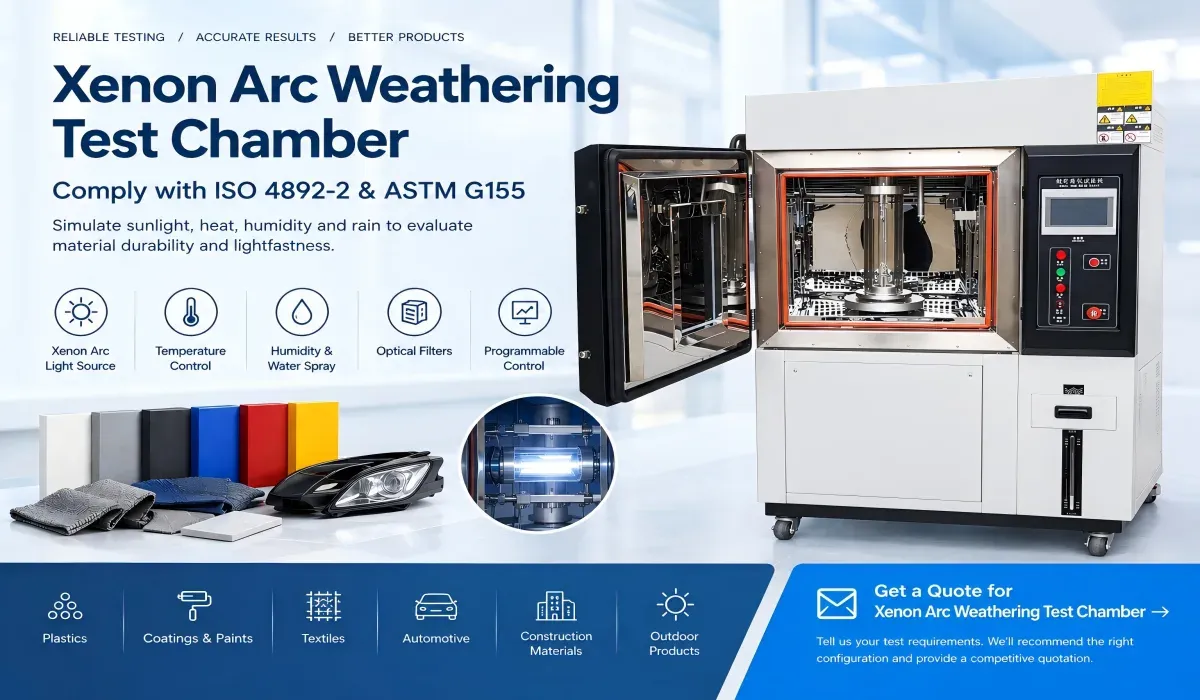
ASTM G155-25 is the current ASTM practice for operating xenon arc lamp apparatus for exposure of materials.
For plastics, ISO 4892-2:2013 covers xenon-arc exposure in the presence of moisture. Amendment 1:2021 addresses the classification of daylight filters. A new revision of ISO 4892-2 is currently under development.
The Main Difference: UV vs. Xenon Light Source
The biggest difference between UV and xenon weathering testing is the light source and resulting spectral exposure.
UV Weathering Chamber
A fluorescent UV chamber focuses on the ultraviolet portion of exposure. It is suitable when the required test method specifies fluorescent UV lamps.
Xenon Weathering Chamber
A xenon arc chamber uses a xenon lamp with appropriate filters to provide a broader simulated solar exposure.
This does not mean that one method is always more accurate or more severe.
The important question is:
Which exposure method does your test specification require?
ASTM G154 vs. ASTM G155
The ASTM standard is often the easiest starting point for equipment selection.
Standard | Exposure Source | Equipment |
|---|---|---|
ASTM G154-23 | Fluorescent UV lamp | UV weathering test chamber |
ASTM G155-25 | Xenon arc lamp | Xenon arc weathering test chamber |
However, the standard number alone does not define every test condition.
The actual test specification may also define:
- Irradiance
- Temperature
- Moisture cycle
- Condensation
- Water spray
- Exposure duration
- Lamp type
- Filter type
Therefore, when requesting a quotation, provide the complete test method or customer specification, not just “ASTM G154” or “ASTM G155.”
ISO 4892-2 vs. ISO 4892-3
For plastics, the ISO 4892 series provides another common basis for equipment selection.
Standard | Light Source | Current Status |
|---|---|---|
ISO 4892-2:2013 + Amd 1:2021 | Xenon arc | Current published version |
ISO 4892-3:2024 | Fluorescent UV | Current published version |
ISO 4892-3:2024 was published in October 2024 and replaced ISO 4892-3:2016. It specifies fluorescent UV exposure for plastic specimens using radiation, heat and water.
ISO 4892-2:2013 remains the current published edition, with Amendment 1:2021 concerning daylight-filter classification. A new ISO 4892-2 revision is currently under development.
Why the Standard Alone Is Not Enough
A common purchasing mistake is to select a machine based only on the standard number.
For example:
ASTM G154 → Buy any UV chamber
is not enough.
ASTM G154-23 provides a range of exposure conditions and does not specify one universal exposure cycle for every material.
The same principle applies to xenon testing.
Before selecting a chamber, confirm:
- Light source
- Lamp type
- Irradiance
- Temperature
- Black panel or black standard temperature, where applicable
- Moisture method
- Water spray
- Condensation
- Exposure cycle
- Exposure duration
- Sample dimensions
- Sample capacity
- Irradiance monitoring and calibration
The correct purchasing process is:
Customer specification → Applicable standard → Exposure cycle → Equipment configuration
UV vs. Xenon for Different Materials
The material and application should also be considered.
Material / Application | UV Testing | Xenon Testing |
|---|---|---|
Plastics | Common | Common |
Automotive plastics | Common | Common |
Outdoor polymer products | Common | Common |
Rubber | Possible | Possible |
Coatings | Standard dependent | Common |
Textiles | Possible | Common |
Color-sensitive products | Possible | Common |
Products requiring broader solar exposure | Method dependent | Often applicable |
These are general guidelines rather than universal rules. The customer's product specification should always take priority.
For coatings, do not automatically use ISO 4892-3 simply because fluorescent UV testing is required. The applicable coating-specific standard should be confirmed before selecting the equipment.
UV vs. Xenon for Automotive Testing
Both UV and xenon weathering tests can be used for automotive materials.
Typical applications include:
- Interior plastics
- Exterior plastics
- Trim components
- Coatings
- Polymer materials
- Rubber components
- Textiles
- Other appearance-sensitive materials
The equipment should be selected according to the OEM specification, supplier specification or applicable international standard.
For automotive projects, the customer's test document is often more useful than simply knowing that the product needs “weathering testing.”
How to Choose Between UV and Xenon
Use the following process when selecting a chamber.
Choose a UV Weathering Chamber When:
- Fluorescent UV exposure is specified.
- ASTM G154 is required.
- ISO 4892-3 is required for plastics.
- The customer's method specifies fluorescent UV lamps.
- The required test focuses on UV-related weathering effects.
Choose a Xenon Weathering Chamber When:
- Xenon arc exposure is specified.
- ASTM G155 is required.
- ISO 4892-2 is required.
- The customer's method specifies xenon arc exposure.
- A broader simulated solar exposure is required by the test method.
If No Standard Is Specified
Ask for:
- Material type
- Product application
- Indoor or outdoor use
- Required degradation evaluation
- Customer or OEM specification
- Required exposure spectrum
- Exposure cycle
- Exposure duration
This information is normally enough to determine the appropriate chamber configuration.
What Specifications Should You Request When Buying a Weathering Test Chamber?
When comparing suppliers, do not focus only on chamber size or lamp quantity.
1. Light Source
Confirm whether the equipment uses:
- Fluorescent UV lamps
- Xenon arc lamp
2. Irradiance Control
Check the irradiance range, monitoring system and calibration method.
3. Temperature Control
Confirm the required chamber or specimen temperature and its control method.
4. Moisture System
Depending on the test method, the chamber may require:
- Condensation
- Water spray
- Humidity control
- Wet/dry cycles
5. Test Programming
The controller should be able to reproduce the required exposure cycle rather than only provide a simple timer.
6. Sample Capacity
Check:
- Effective exposure area
- Sample holder dimensions
- Number of specimens
- Mounting method
7. Standard and Test-Method Compatibility
The quotation should clearly state which test methods the proposed configuration is intended to support.
Can a UV Chamber Replace a Xenon Chamber?
Not automatically.
UV and xenon chambers use different light sources and exposure methods.
If a specification requires fluorescent UV exposure according to ASTM G154, using a xenon chamber does not automatically create an equivalent test.
Likewise, if the specification requires xenon arc exposure according to ASTM G155 or ISO 4892-2, a fluorescent UV chamber is not an automatic substitute.
The equipment should therefore be selected according to the required exposure method, not simply the general purpose of weathering testing.
Common Mistakes When Choosing a Weathering Test Chamber
1. Choosing Only by Price
A lower-cost chamber may not provide the required irradiance control, moisture system or test cycle.
2. Assuming UV and Xenon Are Interchangeable
They use different light sources and exposure conditions.
3. Looking Only at the Standard Number
The actual exposure cycle and test parameters also matter.
4. Ignoring the Material Standard
The appropriate method can differ between plastics, coatings, textiles and other materials.
5. Buying Without the Customer's Test Specification
For export equipment, this can result in a chamber that technically performs weathering testing but does not meet the customer's required method.
UV Aging Chamber vs. Xenon Chamber: Decision Table
Question | UV Chamber | Xenon Chamber |
|---|---|---|
Fluorescent UV required? | Yes | No |
Xenon arc required? | No | Yes |
ASTM G154 | Yes | No |
ASTM G155 | No | Yes |
ISO 4892-3 | Yes | No |
ISO 4892-2 | No | Yes |
UV-focused exposure | Yes | Method dependent |
Broader solar-spectrum exposure | Method dependent | Yes |
Customer specifies fluorescent UV | Yes | No |
Customer specifies xenon arc | No | Yes |
The key point is simple:
The required test method determines the chamber type.
What Other Environmental Tests May Be Needed?
Weathering testing is often only one part of a complete environmental test program.
Depending on the product, manufacturers may also require:
- Temperature and humidity testing
- Thermal cycling
- Salt spray corrosion testing
- Waterproof testing
- Dust testing
- Vibration testing
- High/low temperature testing
For combined environmental testing programs, a temperature and humidity test chamber may be used for temperature/humidity exposure, while corrosion-related applications may require a salt spray corrosion test chamber.
Top Test UV and Xenon Weathering Test Solutions
Top Test supplies environmental testing equipment for manufacturers, laboratories and quality-control applications.
When requesting a UV or xenon weathering chamber quotation, provide:
- Material or product type
- Applicable ASTM or ISO standard
- Customer or OEM specification
- Test cycle
- Sample dimensions
- Number of specimens
- Required exposure time
This information allows the chamber configuration to be matched to the actual testing requirement.
For customers researching UV weathering testing, our UV Aging Test Chamber: ASTM G154 & ISO 4892-3 Guide provides additional information about UV testing and related standards.
FAQ
Is a UV Weathering Chamber the Same as a Xenon Chamber?
No. A UV chamber generally uses fluorescent UV lamps, while a xenon chamber uses a xenon arc lamp. Their exposure spectra and test methods are different.
Which Is Better, UV or Xenon Weathering Testing?
Neither is universally better. The appropriate method depends on the required standard, material, application and exposure conditions.
Is ASTM G154 for UV Testing?
Yes. ASTM G154-23 covers the operation of fluorescent UV lamp apparatus for exposure of materials.
Is ASTM G155 for Xenon Testing?
Yes. ASTM G155-25 covers the operation of xenon arc lamp apparatus for exposure of materials.
What Is the Current ISO Standard for Fluorescent UV Testing of Plastics?
The current published standard is ISO 4892-3:2024.
What Is the Current ISO Standard for Xenon Testing of Plastics?
The current published standard is ISO 4892-2:2013, with Amendment 1:2021. A replacement edition is currently under development.
Can One Chamber Perform Both UV and Xenon Testing?
A standard UV chamber and a standard xenon chamber are different equipment configurations. If both methods are required, the equipment configuration should be discussed according to the required standards and test cycles.
Conclusion
Choosing between a UV weathering test chamber and a xenon arc weathering test chamber should start with the required test method.
Choose UV when the specification requires fluorescent UV exposure, such as ASTM G154 or ISO 4892-3.
Choose xenon when the specification requires xenon arc exposure, such as ASTM G155 or ISO 4892-2.
If no standard has been specified, first identify the material, application, exposure environment and required evaluation criteria. Then determine the applicable test method and equipment configuration.
The right weathering test chamber is the one that can reproduce the exposure conditions required by your actual test method.
Request a Quote
Need help choosing between a UV aging test chamber and a xenon arc weathering test chamber?
Send us your material type, applicable ASTM/ISO standard, sample dimensions and required test cycle. Top Test can recommend a suitable chamber configuration for your testing requirements.