
Oct 8, 2026News & Insights
IEC 60335 Test Finger Nail: Testing Snap-Fit Parts With and Without Force
The IEC 60335-1 Figure 7 test finger nail verifies that snap-fit covers and enclosures stay secure, applied with 10–50 N spring-gauge force. How the test works and which probe to use.
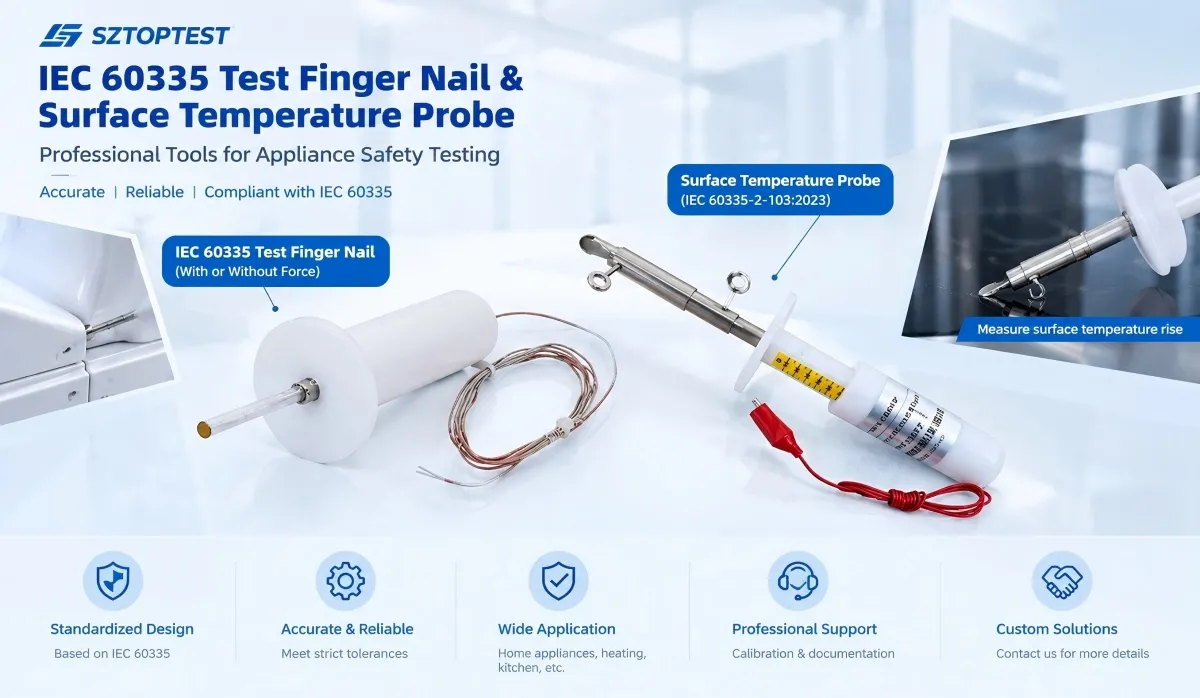
Modern appliances hold together with a lot of plastic clips: battery doors, filter covers, terminal covers, lamp housings that snap shut with a click.
The IEC 60335 test finger nail exists because a clicked cover is not the same as a secure cover — the standard wants proof that snap-together parts stay assembled and keep protecting live parts when a fingernail, applied with realistic force, works at the seam.
This guide covers where the test appears, how the probe is built, and the force levels it applies.
Where the Test Comes From
The probe is specified in IEC 60335-1 Figure 7, and its application is described in Clause 22.11 — the clause covering construction requirements for parts that can be removed without a tool.
Household appliance standards built on IEC 60335-1 (kitchen machines, personal care, heating appliances and the rest of the -2 series) inherit the test. Whenever a cover is held only by snap features, the nail probe verifies:
• The cover cannot be dislodged by nail-style force at the seam
• Live parts behind the cover remain unreachable after the attempt
• The snap features show no permanent damage that would weaken reassembly
How the Probe Is Built
• Tip: hardened stainless steel, thickness 0.2 ± 0.02 mm, tapered at 37° per IEC 60335-1 Figure 7 — thin enough to enter the seam between cover and housing, hard enough not to wear out of tolerance
• Handle: nylon, insulating and flame-retardant (UL94 V-0)
• Force gauge: integrated spring gauge in the handle, adjustable to the required force
• Force levels: 10, 20, 30, 40 or 50 N, set by the applicable clause
• Dimensional tolerances: linear ±0.05 mm, tip thickness ±0.02 mm
The "with or without force" in the name reflects how the standard uses it: the nail can be drawn along seams and inserted into joints without extra load where the clause checks accessibility, and with a specified spring-gauge force where the clause checks the security of the snap connection. The smooth tip profile is deliberate — the test must stress the snap features, not gouge the plastic into failure.
How the Test Runs
• Set the force. Adjust the spring gauge to the value the clause assigns — commonly one of the 10–50 N levels.
• Apply the nail. Insert the tip into the joint between cover and housing at the points the standard designates, and apply the force in the specified direction.
• Attempt removal. Work the seam the way a fingernail would — prying at edges and gaps, not hammering.
• Inspect. The cover must stay in place or re-engage; live parts must remain inaccessible to the standard test finger; snap features must show no damage that compromises future use.
Engineering note: the result often depends on where along the seam the nail enters. Standards expect the worst point — the corner with the widest gap, the latch tab — so laboratories probe several positions, not just the easiest one.
The Companion Tool: Surface Temperature Probe
Clause 11 of IEC 60335 (heating and temperature rise) uses a different dedicated tool from the same standard family: the surface temperature probe defined in IEC 60335-2-103:2023 Figure 103 (and its counterparts in the -2-6, -2-9 and -2-11 series).
• Tinned copper sensing disc, Ø5 mm × 0.5 mm, flat contact face
• K-type thermocouple, 0.3 mm diameter per IEC 60584-1
• Contact force 4 N ± 1 N via the handle arrangement
• Polycarbonate bushing, ID 3 mm / OD 5 mm
Where the nail probe verifies mechanical security, this probe verifies thermal safety — measuring the surface temperature rise of ovens, hobs, dryers and similar appliances at the exact contact force the standard prescribes, because contact pressure changes what a thermocouple reads.
Frequently Asked Questions
Is the test finger nail the same as test probe 11?
No. The nail probe (IEC 60335-1 Figure 7) simulates a fingernail working at a seam, with a thin 0.2 mm tip and adjustable spring force. Probe 11 (IEC 61032 Figure 7) is a rigid full-size test finger for accessibility and thrust tests. Different shapes, different clauses, different failure modes tested.
Which force should I set?
The clause governing your product assigns it. The spring gauge covers 10–50 N so one probe serves the range; record the setting in the test report, because the force is part of the result's traceability.
Why does the tip need to be hardened?
A soft tip wears a rounded edge after a few seams, and a rounded nail no longer enters joints the way the standard's 0.2 mm geometry intends. Hardened stainless steel holds the profile and the ±0.02 mm tolerance over a working life.
Does the nail test replace the accessibility test with the jointed finger?
No — they run in sequence on the same product. The jointed test finger (Probe B) checks whether live parts are reachable; the nail probe checks whether the cover protecting them stays attached. Passing one does not cover the other.
Conclusion
The IEC 60335 test finger nail turns "the cover clicked shut" into a measured claim: a standardized 0.2 mm hardened nail, a known force between 10 and 50 N, and a seam that must hold. Together with the jointed test finger for accessibility and the surface temperature probe for clause 11 measurements, it completes the appliance-safety toolset.
Send Top Test the clause you are testing against and the required force — contact us for the probe with calibration documentation, or browse the full test finger probe range.