Oct 30, 2026News & Insights
IEC 61032 Probe 11: Rigid Test Finger Applications and Test Requirements
Learn about IEC 61032 Probe 11, including rigid test finger applications, test requirements, Probe 11 vs. Probe B, and how to select the right test probe for safety testing.
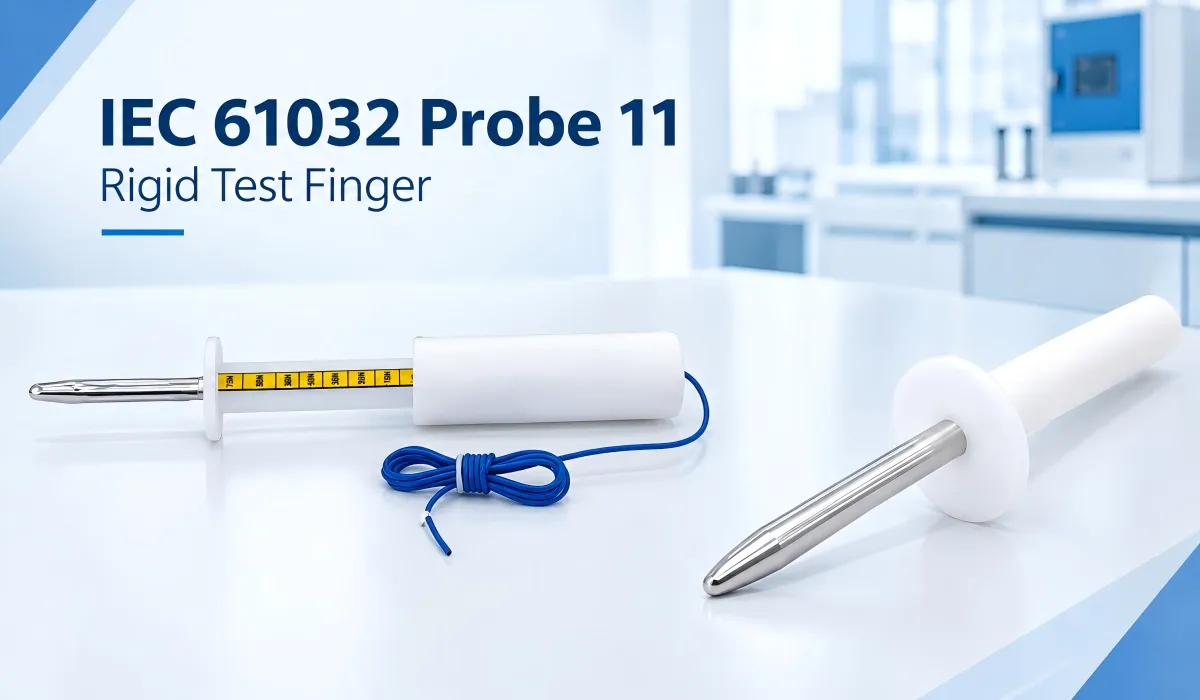
IEC 61032 Probe 11 is a rigid, unjointed test finger used to evaluate whether an enclosure or protective barrier can prevent access to hazardous parts. It is commonly used for electrical appliances, electronic equipment, enclosures, and other products requiring mechanical or accessibility testing.
An important point when selecting Probe 11 is that rigid test fingers can be supplied in different configurations, including versions without a built-in thrust mechanism and versions designed for specified thrust-force testing. The correct type depends on the test method and the requirements of the applicable product standard.
What Is IEC 61032 Probe 11?
IEC 61032 defines test probes used to verify protection against access to hazardous parts and other enclosure-related requirements.
Probe 11 is a rigid and unjointed test finger. Unlike an articulated Probe B, its finger section does not bend. This fixed geometry makes it suitable for tests where a rigid finger must be applied to an enclosure, opening, protective barrier, or other part of a product.
Top Test provides an IEC 61032 Test Finger Probe 11 Unjointed Test Finger for rigid-finger accessibility and related safety testing.
However, Probe 11 is not necessarily one single configuration. Depending on the application, users may need to choose between a non-thrust type and a thrust-force type.
Probe 11 With Thrust vs. Without Thrust
This is one of the most important considerations when purchasing an IEC 61032 Probe 11.
Probe 11 Without Thrust
A standard rigid Probe 11 without a built-in thrust mechanism is mainly used when the test procedure requires the probe to check accessibility or when the required force is applied separately.
In this configuration, the probe itself provides the specified geometry, while the operator or an external force-measuring device can provide the required test force when necessary.
This type can be suitable for laboratories that already have a force gauge or other force application equipment.
Probe 11 With Thrust
A thrust-type Probe 11 is designed for tests where a specified force needs to be applied through the probe.
Depending on the test requirement, the probe can be used with an appropriate force mechanism or force gauge to apply the required load to the enclosure or protective structure.
For example, certain product standards require Probe 11 to be applied with a specified force for a defined period. IEC/EN 60065 historically included a test using Probe 11 with a 50 N force for 10 seconds to evaluate resistance to external forces.
Top Test also provides a rigid test probe 11 with 50N/75N force for applications requiring controlled thrust testing.
The important point is that the force should be determined by the applicable product standard, rather than assuming that every Probe 11 test uses the same force.
Which Type Should You Choose?
Probe 11 Type | Main Feature | Typical Application |
|---|---|---|
Without thrust | Rigid probe, force applied separately when required | Accessibility and general probe testing |
With thrust | Designed for controlled thrust-force testing | Mechanical strength and specified-force tests |
Force gauge compatible | Allows external force measurement/control | Laboratory compliance testing |
Therefore, before purchasing Probe 11, confirm not only the probe dimensions but also whether the test requires controlled thrust force.
What Is IEC 61032 Probe 11 Used For?
The main purpose of Probe 11 is to evaluate whether a product's enclosure or protective structure provides adequate protection against access to hazardous parts.
Typical applications include:
- Electrical household appliances
- Electronic equipment
- Electrical control equipment
- Power supplies and chargers
- Electrical enclosures
- Lighting equipment
- Consumer electronic products
- Products with protective barriers or openings
Probe 11 can also be used in mechanical-strength evaluations where the applicable standard specifies that a rigid test finger should be pressed against the enclosure or internal barrier.
Probe 11 vs. IEC 61032 Probe B
Probe 11 is often confused with IEC 61032 Probe B because both are finger-shaped test probes.
The main difference is their construction.
Probe B is an articulated test finger. Its joints allow it to bend and simulate the movement of a human finger. Top Test's Test Probe B of IEC 61032 is designed for accessibility testing where a flexible finger is required.
Probe 11 is rigid and unjointed. It is used when the applicable test requires a fixed finger geometry, and in some applications it is used together with a specified thrust force.
In simple terms:
Feature | Probe B | Probe 11 |
|---|---|---|
Structure | Jointed | Rigid / unjointed |
Finger movement | Flexible | Fixed |
Main purpose | Accessibility | Accessibility and specified mechanical tests |
Thrust versions | Depends on test setup | With-thrust and without-thrust configurations |
Selection basis | Applicable product standard | Applicable product standard |
Probe 11 should therefore not automatically be considered a replacement for Probe B. The correct probe depends on the exact test clause.
How Is Probe 11 Applied During Testing?
The actual procedure should always follow the applicable product standard, but the general process can be understood in several steps.
1. Identify the Area to Be Tested
Inspect the product enclosure and identify openings, barriers, covers, or other areas that may require testing.
2. Position the Probe
Place Probe 11 against the opening or protective structure in the direction specified by the test requirement.
Because Probe 11 is rigid, its position and direction are important when evaluating an enclosure or barrier.
3. Apply the Required Force
If the test requires a thrust force, apply the specified force through the probe.
The required force varies according to the applicable standard and test clause. For example, some standards specify a 50 N force for Probe 11, while other applications can specify different values.
A force gauge can be used where the test requires controlled or verified force.
4. Check Accessibility or Structural Performance
After applying the probe under the specified conditions, check whether:
- The probe reaches a hazardous part
- The protective barrier deforms excessively
- The enclosure becomes unsafe
- A hazardous live part becomes accessible
- The product remains compliant with the applicable requirement
The acceptance criteria depend on the relevant product standard.
Why Is Enclosure Accessibility Testing Important?
An enclosure is designed not only to protect internal components but also to prevent users from contacting hazardous parts.
Openings, gaps, ventilation slots, removable covers, and protective barriers can therefore require careful evaluation.
Potential hazards may include:
- Live electrical parts
- Moving components
- Hot components
- Other parts classified as hazardous by the applicable standard
For manufacturers, performing accessibility and mechanical testing during product development can identify enclosure problems before formal certification.
What Products Commonly Require This Type of Test?
IEC 61032 probes are used across many electrical and electronic product categories.
Household Appliances
Washing machines, refrigerators, ovens, and other appliances may contain openings around ventilation structures, controls, motors, and internal components.
Electrical and Electronic Equipment
Power supplies, chargers, control units, and electronic equipment commonly contain ventilation slots and enclosure openings that need to be evaluated.
Lighting Equipment
Lighting products may have openings around ventilation structures, terminals, switches, and other components.
Electrical Enclosures
Electrical cabinets and equipment enclosures may require accessibility or mechanical-strength testing to verify the effectiveness of protective barriers.
For broader enclosure testing, Top Test's IP Test Finger Probe Kit for Enclosure Protection Testing combines several commonly used probes for different accessibility requirements.
Other IEC 61032 Probes
Probe 11 is only one member of the IEC 61032 probe family.
Commonly encountered probes include:
- Probe B: Articulated test finger
- Probe 11: Rigid, unjointed test finger
- Probe 18: Small articulated finger for specific accessibility testing
- Probe 19: Small finger probe for more restrictive applications
- Probe 31: Probe for mechanical hazard accessibility testing
- Probe 41: Probe for protection against access to hot or glowing components
For example, Top Test's IEC 61032 Test Finger Probe 18 and IEC 61032 Test Probe 19 are intended for different small-finger accessibility applications.
How to Select an IEC 61032 Probe 11
When purchasing Probe 11, the most important consideration is the actual test requirement.
1. Check the Applicable Standard
First identify the product standard that applies to the product.
IEC 61032 defines the test probe, while the product standard may define the actual force, duration, direction, and acceptance criteria.
2. Choose With Thrust or Without Thrust
Determine whether the test requires:
- A standard rigid probe without a built-in thrust function
- A probe for use with an external force gauge
- A thrust-force configuration for controlled testing
This is particularly important for laboratories performing mechanical-strength or enclosure-resistance tests.
3. Confirm the Required Force
Do not assume that all Probe 11 tests use the same force.
The applicable standard may specify 10 N, 50 N, 75 N, or another value depending on the test purpose. The force must therefore be confirmed from the exact test clause.
4. Verify Probe Dimensions
The probe dimensions and geometry should comply with the applicable IEC 61032 requirements.
Dimensional accuracy is particularly important because the physical geometry determines how the probe interacts with the enclosure opening.
5. Consider the Complete Test Setup
If the test requires a controlled force, check whether a force gauge or other accessory is needed.
For products that also require IP enclosure testing, additional probes may be necessary. For example, Top Test provides an IP3X IP4X Test Probe for enclosure protection evaluation.
Practical Testing Tips
Choose the probe according to the test clause, not only the product name.
Confirm whether thrust force is required. This determines whether a standard Probe 11 or a force-controlled configuration is more appropriate.
Do not assume one force value applies to every product. The required force and duration depend on the applicable standard.
Keep the probe dimensionally accurate. Damaged or poorly manufactured probes can affect repeatability.
Use a force gauge when required. Controlled force is important when the test specifies a defined mechanical load.
Document the test conditions. Record the probe type, applied force, test duration, test location, and result.
Frequently Asked Questions
What is IEC 61032 Probe 11?
IEC 61032 Probe 11 is a rigid, unjointed test finger used to evaluate accessibility and, in applicable standards, the mechanical resistance of enclosures and protective barriers.
Does Probe 11 have different types?
Yes. Probe 11 can be supplied in configurations with thrust-force capability and without thrust-force capability, depending on the intended testing method and equipment setup.
What is the difference between a Probe 11 with thrust and without thrust?
A non-thrust Probe 11 provides the required rigid probe geometry, while the test force can be applied separately when required. A thrust-type configuration is intended for applications where a specified force must be controlled and applied through the probe.
Is Probe 11 the same as Probe B?
No. Probe B is articulated, while Probe 11 is rigid and unjointed. They are used for different test conditions.
Can Probe 11 replace Probe B?
Not automatically. The correct probe must be selected according to the applicable product standard and test clause.
What should I confirm before buying Probe 11?
Confirm the applicable standard, probe dimensions, whether thrust force is required, the required force and duration, and whether a force gauge or other accessory is needed.
Conclusion
IEC 61032 Probe 11 is a rigid, unjointed test finger used for enclosure accessibility and specific mechanical testing applications. When selecting Probe 11, users should pay attention not only to the probe dimensions but also to whether the test requires a thrust-force or non-thrust configuration.
The required force, duration, direction, and acceptance criteria should always be determined from the applicable product standard. A correct match between the Probe 11 type, force requirement, and test method helps laboratories and manufacturers obtain more reliable and repeatable test results.