Sep 30, 2026News & Insights
Xenon Arc Weathering Test Chamber: ISO 4892-2 & ASTM G155 Guide
Learn how a xenon arc weathering test chamber works, including ISO 4892-2 and ASTM G155 requirements, test conditions, applications, and equipment selection.
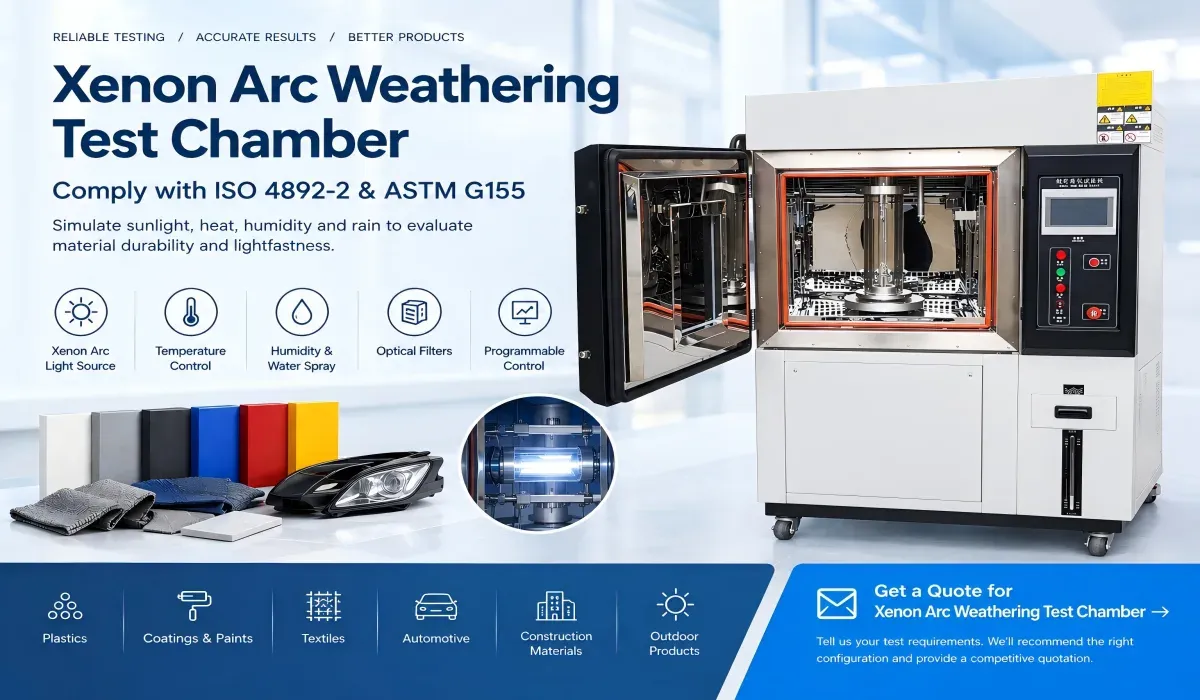
Outdoor materials are exposed to sunlight, heat, humidity, rain, and repeated wetting and drying throughout their service life. Over time, these environmental factors can cause color fading, gloss loss, cracking, chalking, embrittlement, surface deterioration, and changes in mechanical properties.
A xenon arc weathering test chamber is designed to accelerate this type of environmental exposure under controlled laboratory conditions. By combining xenon arc light with controlled temperature, humidity, and water exposure, manufacturers can evaluate the weathering resistance and lightfastness of materials without relying exclusively on long-term outdoor testing.
Xenon arc weathering testing is widely used for plastics, coatings, paints, textiles, automotive components, building materials, and other products that may be exposed to sunlight during their service life.
Two important references for xenon arc weathering are ISO 4892-2 and ASTM G155. These standards provide guidance for laboratory exposure using xenon arc light sources, but the exact exposure conditions should always be selected according to the material, product specification, and intended application.
This guide explains how xenon arc weathering testing works, what ISO 4892-2 and ASTM G155 cover, how xenon arc chambers differ from fluorescent UV chambers, and what to consider when selecting a xenon arc weathering test chamber.
What Is Xenon Arc Weathering Testing?
Xenon arc weathering testing is an accelerated laboratory method used to evaluate how materials respond to simulated sunlight and associated environmental conditions.
A xenon arc lamp produces a broad spectrum of light that can be filtered to approximate different sunlight exposure conditions. During testing, specimens may also be exposed to controlled temperature, humidity, and water spray.
The purpose is to reproduce selected environmental stresses that materials may experience during actual use.
Depending on the test method, the exposure can be used to evaluate changes such as:
- Color fading
- Gloss loss
- Surface cracking
- Chalking
- Embrittlement
- Peeling
- Yellowing
- Loss of mechanical strength
- Changes in appearance
- Photo-stability
A xenon arc weathering test does not simply measure how a material reacts to UV light. The combination of light, heat, moisture, and wetting conditions can be important to the overall weathering behavior.
ASTM G155 describes the basic principles and operating procedures for xenon arc lamp and water apparatus used to reproduce weathering effects associated with sunlight and moisture. The standard also emphasizes that different operating conditions can produce different results, so the specific exposure conditions should be reported with the test results.
How Does a Xenon Arc Weathering Test Chamber Work?
A xenon arc weathering chamber combines a controlled light source with environmental control systems.
The basic process can be divided into several components.
1. Xenon Arc Light Source
The xenon arc lamp is the central component of the system.
Unlike fluorescent UV lamps, which concentrate primarily on the ultraviolet portion of the spectrum, a xenon arc source can provide a broader solar-like spectrum when used with appropriate optical filters.
Lamp output is filtered according to the required exposure method.
Filter selection is important because different filters produce different spectral distributions and therefore different exposure conditions.
2. Irradiance Control
The amount of light reaching the test specimens must be controlled.
A xenon arc weathering test chamber typically uses an irradiance sensor and control system to monitor the light intensity at the specimen plane.
Stable irradiance helps improve repeatability between test cycles.
The appropriate irradiance level should not simply be selected according to the maximum capability of the equipment. It should be determined by the applicable test method or product specification.
3. Temperature Control
Temperature can significantly influence material degradation.
During xenon arc exposure, the chamber controls the temperature according to the selected test procedure.
Depending on the equipment and standard, temperature may be monitored using black standard temperature, black panel temperature, chamber air temperature, or another specified measurement method.
Stable temperature control helps maintain consistent test conditions.
4. Humidity and Water Exposure
Outdoor materials are exposed to moisture as well as sunlight.
Xenon arc weathering systems can therefore incorporate humidity control and water spray functions.
Water may be introduced to reproduce rain or wetting conditions, while controlled humidity can reproduce moisture-related environmental effects.
The combination of light and moisture can produce degradation mechanisms that would not necessarily occur under dry light exposure.
5. Programmable Exposure Cycles
Modern xenon arc weathering test chambers use programmable controllers to manage different exposure stages.
A test cycle may include:
- Light exposure
- Dark exposure
- Temperature control
- Humidity control
- Water spray
- Exposure duration
- Irradiance control
The exact sequence depends on the selected test procedure.
For laboratories that perform multiple environmental reliability tests, a xenon arc system can also be combined with other environmental testing equipment according to the materials and products being evaluated.
What Is ISO 4892-2?
ISO 4892-2 is an international standard covering exposure of plastics to laboratory light sources using xenon-arc lamps.
The current published version is ISO 4892-2:2013, which has been reviewed and confirmed by ISO. A revision is also in progress.
The standard specifies methods for exposing specimens to xenon-arc light in the presence of moisture to reproduce weathering effects associated with daylight or daylight filtered through window glass.
These effects can include:
- Temperature
- Humidity
- Wetting
- Solar radiation
- Daylight exposure
ISO 4892-2 is particularly relevant when laboratories need controlled xenon arc exposure for plastics and polymer materials.
For applications focused specifically on fluorescent UV exposure, see our guide to UV aging testing.
However, the standard itself does not mean that every material should use the same exposure cycle.
The correct exposure conditions depend on the intended application and the specific test requirements.
What Is ASTM G155?
ASTM G155 is a standard practice for operating xenon arc lamp apparatus for exposure of materials.
The current ASTM listing identifies ASTM G155-25 as the active version.
ASTM G155 covers the basic principles and procedures for operating xenon arc lamp and water apparatus.
The standard describes exposure of specimens to optically filtered xenon arc light under controlled environmental conditions.
The practice is intended to reproduce weathering effects associated with:
- Direct sunlight
- Sunlight filtered through window glass
- Heat
- Humidity
- Rain
- Dew
- Other controlled moisture conditions
ASTM G155 also makes an important distinction: the practice defines how exposure conditions are obtained, measured, and controlled, but it does not specify one universal exposure condition that is suitable for every material.
This is important when selecting equipment because compliance with a standard does not mean that every test should use identical settings.
ISO 4892-2 vs. ASTM G155
ISO 4892-2 and ASTM G155 both address xenon arc laboratory weathering, but they should not simply be treated as identical test procedures.
Item | ISO 4892-2 | ASTM G155 |
|---|---|---|
Main focus | Xenon-arc exposure of plastics | Operation of xenon arc lamp apparatus for materials |
Light source | Xenon arc | Xenon arc |
Moisture | Controlled moisture exposure | Water and moisture exposure |
Temperature | Controlled | Controlled |
Filters | Defined according to exposure method | Different optical filters can be used |
Main purpose | Laboratory exposure of plastics | Controlled xenon arc weathering exposure |
Application | Plastics and polymer materials | Broader material exposure applications |
The correct standard should therefore be selected according to the product, material, customer requirement, and intended test application.
A laboratory should also define the specific exposure cycle instead of simply stating that a test was performed according to “xenon aging.”
Why Are Optical Filters Important?
The xenon arc lamp itself does not automatically reproduce every natural sunlight condition.
Optical filters are used to modify the spectral output of the xenon arc source.
Different filter configurations can be used to represent different exposure environments, such as outdoor daylight or daylight passing through window glass.
This means that two xenon arc tests can produce different results even when they use the same basic lamp technology.
For this reason, the test report should identify the relevant operating conditions and filter configuration.
ASTM G155 specifically addresses the use of different xenon arc light sources and filter combinations, making the selected exposure conditions an important part of the test method.
What Materials Can Be Tested in a Xenon Arc Weathering Chamber?
Xenon arc weathering is used across many industries.
Plastics
Plastic materials can gradually lose color, strength, flexibility, and surface quality when exposed to sunlight and moisture.
Typical samples include:
- ABS
- Polycarbonate
- PVC
- Acrylic
- Plastic housings
- Outdoor profiles
- Polymer components
- Automotive plastics
ISO 4892-2 is particularly relevant to laboratory xenon-arc exposure of plastics.
Coatings and Paints
Paints and coatings may fade, chalk, crack, blister, or lose gloss after prolonged environmental exposure.
Xenon arc testing can be used to compare coating formulations and evaluate their resistance to simulated sunlight and moisture.
ASTM also maintains application-specific practices for xenon arc exposure of coatings.
Textiles
Outdoor fabrics can experience color fading and loss of appearance after exposure to sunlight.
Xenon arc testing is commonly used when lightfastness and weathering performance are important.
Typical applications include:
- Outdoor fabrics
- Awnings
- Tents
- Synthetic fibers
- Upholstery materials
- Automotive textiles
Automotive Components
Automotive products may experience sunlight, temperature changes, humidity, and rain throughout their service life.
Xenon arc testing can be used for:
- Exterior trim
- Plastic components
- Coatings
- Interior materials
- Lighting-related materials
- Rubber components
- Decorative surfaces
Construction Materials
Building materials may remain outdoors for years.
Weathering evaluation can therefore be important for:
- Roofing materials
- Exterior coatings
- Facade materials
- Window profiles
- Sealants
- Plastic building products
- Composite materials
For automotive and outdoor materials where corrosion is also a concern, weathering tests can be combined with corrosion evaluation using a composite salt spray test chamber.
What Does Xenon Arc Weathering Testing Measure?
The test itself exposes the specimen, but the evaluation method determines what property is measured.
Color Change
Color measurements can be performed before and after exposure to determine whether the material has faded or changed color.
This is particularly important for automotive trim, coatings, textiles, consumer products, and decorative materials.
Gloss Loss
Surface gloss may decrease as the material deteriorates.
Gloss measurements can provide quantitative information about surface changes.
Cracking and Chalking
Visual inspection can identify:
- Cracks
- Chalking
- Peeling
- Blistering
- Surface deterioration
The evaluation criteria should be defined by the applicable product standard.
Mechanical Property Changes
Some materials are evaluated mechanically after exposure.
Depending on the application, testing may include:
- Tensile strength
- Elongation
- Flexural strength
- Impact resistance
- Hardness
The exact evaluation method depends on the material and product requirements.
Xenon Arc Weathering vs. UV Aging Testing
One of the most common questions when selecting a weathering chamber is whether to use a fluorescent UV chamber or a xenon arc chamber.
The two technologies have different characteristics.
Feature | UV Aging Chamber | Xenon Arc Chamber |
|---|---|---|
Light source | Fluorescent UV lamps | Xenon arc lamp |
Spectral focus | Primarily UV portion | Broader solar-like spectrum |
Typical standards | ASTM G154, ISO 4892-3 | ASTM G155, ISO 4892-2 |
Moisture | Condensation / spray | Humidity / water spray |
Typical use | Accelerated UV weathering | Broader weathering and lightfastness |
Common materials | Plastics, rubber, coatings | Plastics, coatings, textiles, automotive materials |
Main consideration | UV-related degradation | Solar-spectrum and weathering response |
A UV chamber should not automatically be considered a cheaper version of a xenon chamber, and a xenon chamber should not automatically be considered a stronger UV chamber.
They are different testing technologies.
The correct choice depends on the degradation mechanism, material, product specification, and required standard.
When Should You Choose a Xenon Arc Weathering Test Chamber?
A xenon arc chamber may be considered when the testing program requires broader-spectrum simulated sunlight exposure.
It can be particularly relevant when the test objective includes:
- Lightfastness evaluation
- Color stability
- Photo-stability
- Outdoor weathering resistance
- Coating durability
- Textile light resistance
- Plastic weatherability
- Automotive material evaluation
If the applicable test method specifically requires fluorescent UV exposure, a UV aging chamber may be more appropriate.
Therefore, the first step should always be to identify the required standard and test method.
How to Choose a Xenon Arc Weathering Test Chamber
Choosing a xenon arc weathering chamber requires more than comparing lamp power or chamber size.
The equipment should be matched to the actual test method.
1. Confirm the Required Standard
First determine whether the test needs to follow:
- ISO 4892-2
- ASTM G155
- ASTM G151
- ASTM D6695
- A customer-specific method
- Another industry-specific standard
The standard determines the relevant exposure conditions.
2. Check the Xenon Lamp System
The lamp should provide stable output and be suitable for the intended exposure method.
Lamp life, replacement requirements, optical stability, and maintenance should also be considered.
3. Check Optical Filters
Filter selection is important because it affects the spectral distribution reaching the specimen.
Make sure the equipment configuration supports the filter type required by your test method.
4. Check Irradiance Control
The system should be capable of measuring and controlling irradiance according to the required test conditions.
Stable irradiance improves repeatability and makes exposure results easier to compare.
5. Check Temperature Control
Temperature control should be stable throughout the test.
The equipment should also provide the appropriate temperature measurement method for the selected test procedure.
6. Check Water Spray and Humidity
If the test method requires moisture exposure, the chamber should provide controlled water spray and/or humidity functions.
Water quality, spray uniformity, drainage, and nozzle maintenance can also affect long-term operation.
7. Check Sample Capacity
Consider the size and number of specimens that will be tested.
The sample holder should allow specimens to be positioned correctly without interfering with the exposure conditions.
8. Check Programmable Control
A programmable controller should allow users to set and monitor:
- Irradiance
- Temperature
- Humidity
- Water spray
- Exposure time
- Light/dark cycles
This is particularly useful for laboratories running different test procedures.
9. Consider Calibration and Maintenance
Xenon arc systems require regular maintenance and calibration.
When comparing equipment suppliers, ask about:
- Irradiance calibration
- Temperature calibration
- Sensor replacement
- Xenon lamp replacement
- Filter replacement
- Spray system maintenance
- Technical support
- Spare parts
Long-term operating cost should be considered together with the initial equipment price.
Top Test Xenon Arc Weathering Test Chamber
Top Test provides a Xenon Arc Weathering Test Chamber designed for accelerated weathering and lightfastness testing.
The system uses a xenon arc light source together with optical filters and environmental control to simulate sunlight, temperature, humidity, and water exposure.
Typical applications include:
- Plastics
- Coatings
- Paints
- Textiles
- Automotive components
- Construction materials
- Outdoor products
The equipment can be configured according to the required test method and specimen requirements.
For laboratories working with ASTM or ISO weathering procedures, the chamber configuration should be selected according to the required standard, irradiance level, filter system, temperature condition, moisture cycle, and sample capacity.
When requesting a xenon arc weathering chamber, providing the material, specimen dimensions, applicable standard, required exposure cycle, and evaluation method can help ensure that the equipment is configured correctly.
Common Questions About Xenon Arc Weathering Testing
What is a xenon arc weathering test chamber?
A xenon arc weathering test chamber is laboratory equipment that uses a xenon arc light source and controlled environmental conditions to accelerate the weathering of materials.
It can simulate selected effects of sunlight, temperature, humidity, and moisture.
What is ASTM G155 used for?
ASTM G155 provides procedures for operating xenon arc lamp apparatus for exposure of materials.
It describes how exposure conditions are obtained, measured, and controlled rather than defining one universal exposure condition for every material.
What is ISO 4892-2 used for?
ISO 4892-2 specifies methods for exposing specimens to xenon-arc light in the presence of moisture to reproduce weathering effects associated with daylight or daylight filtered through window glass.
Is xenon arc testing the same as UV aging testing?
No.
A fluorescent UV chamber focuses on UV exposure, while a xenon arc chamber provides a broader simulated sunlight spectrum.
The appropriate technology depends on the required standard and testing objective.
How long does xenon arc weathering testing take?
There is no universal test duration.
The exposure time depends on the applicable standard, material, exposure cycle, irradiance, temperature, moisture conditions, and evaluation criteria.
Can xenon arc testing predict outdoor lifetime?
Xenon arc testing can provide accelerated information about weathering behavior, but laboratory exposure time should not automatically be converted into a specific number of outdoor years.
Results depend on the exposure conditions and material.
The test is generally most useful when used as a controlled comparison or qualification method based on an established test procedure.
Conclusion
A xenon arc weathering test chamber provides a controlled way to evaluate material performance under simulated sunlight and environmental exposure.
Standards such as ASTM G155 and ISO 4892-2 provide important frameworks for xenon arc exposure testing. ASTM G155 covers the operation of xenon arc exposure apparatus, while ISO 4892-2 addresses xenon-arc exposure methods for plastics.
The right chamber should not be selected simply by comparing lamp power, chamber volume, or price.
Instead, laboratories should first identify the applicable standard and exposure method, then evaluate the xenon lamp, optical filters, irradiance control, temperature control, humidity, water spray, specimen capacity, programmable cycles, calibration, and maintenance requirements.
For plastics, coatings, textiles, automotive components, construction materials, and other outdoor products, a properly configured xenon arc weathering test chamber can provide controlled and repeatable accelerated exposure data. Other environmental simulations, such as rain and water-ingress testing, can be performed with an IPX1-IPX4 rain test chamber.
For laboratories looking for a xenon arc weathering test chamber for ASTM G155, ISO 4892-2, or a specific customer test method, providing the material, specimen size, required standard, exposure cycle, and evaluation criteria to the testing equipment supplier is the starting point for selecting the appropriate chamber configuration.