Sep 29, 2026News & Insights
IEC 60529 Drip Box Test: Test Method, Requirements and Equipment Selection
Learn how the IEC 60529 drip box test works for IPX1 and IPX2. Understand test requirements, equipment selection, sample positioning and drip test chamber options.
What Is an IEC 60529 Drip Box Test?
The IEC 60529 drip box test is a water ingress protection test used to evaluate whether an electrical or electronic enclosure can prevent harmful water ingress under controlled dripping conditions.
The test is mainly associated with IPX1 and IPX2 protection levels. IPX1 evaluates protection against vertically falling water drops, while IPX2 evaluates protection against dripping water when the enclosure is tilted.
Unlike IPX3 and IPX4, which use spraying or splashing water, IPX1 and IPX2 rely on controlled water droplets falling onto the test specimen.
For laboratories and manufacturers, the equipment used for this test must provide stable water distribution, accurate specimen positioning, and repeatable testing conditions.
For a broader explanation of IP ratings and the different types of equipment used for each protection level, see the IEC 60529 IP Ratings & Testing Equipment Guide.
IPX1 vs IPX2 Drip Testing
IPX1 and IPX2 are both drip tests under IEC 60529, but the specimen positioning and test conditions are different.
IPX1 Drip Test
IPX1 evaluates the enclosure under vertically falling water drops.
The specimen is normally positioned in its intended operating orientation, with water falling from above. The purpose is to determine whether vertically falling water causes harmful effects or enters the enclosure in a way that could affect the product.
IPX2 Drip Test
IPX2 is designed for products that may experience dripping water while tilted.
During the test, the enclosure is positioned at different angles so that water can reach surfaces that would not necessarily be exposed during a purely vertical drip test.
This makes specimen positioning particularly important when performing an IPX2 test.
For a detailed comparison of IPX1, IPX2, IPX3 and IPX4, you can refer to IPX1 vs IPX2 vs IPX3 vs IPX4.
How Does the IEC 60529 Drip Test Work?
A typical IEC 60529 drip test system consists of a water supply system, drip box, specimen support or turntable, control system and water collection system.
The drip box is positioned above the test specimen and generates controlled water drops over the defined test area.
The specimen must be positioned according to the applicable test method. For IPX2 testing, the inclination of the specimen is particularly important because the test is intended to evaluate protection while the enclosure is tilted.
A typical test process includes:
- Place the test specimen in the required position.
- Check the water supply and test system.
- Set the required test parameters.
- Start the controlled dripping process.
- Maintain the test for the specified duration.
- Inspect the specimen for harmful water ingress or other effects.
- Evaluate the result according to the applicable standard and product requirements.
The exact test conditions should always be confirmed against the applicable edition of IEC 60529 and any product-specific standard, because additional requirements may apply depending on the product being tested.
What Equipment Is Used for IPX1/IPX2?
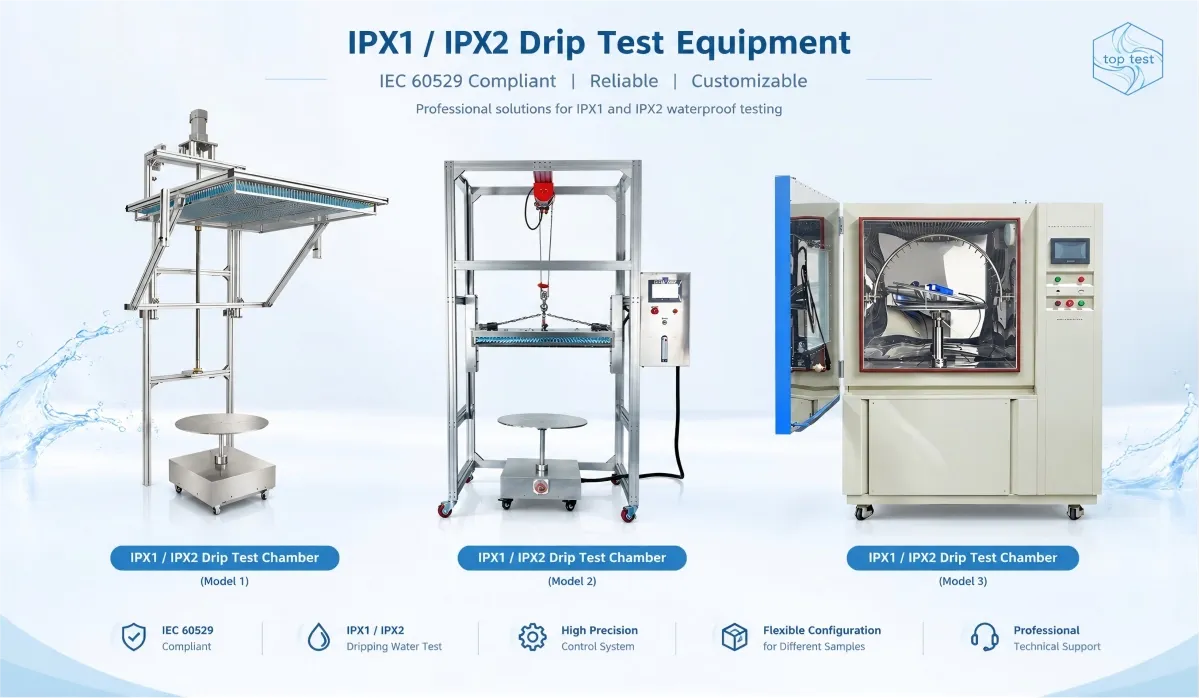
An IPX1/IPX2 drip testing system generally includes a controlled drip box and a specimen support system.
For laboratories that need to perform several IP water resistance levels with one system, an integrated IPX1 IPX2 IPX3 IPX4 Waterproof Test Chamber can combine IPX1/IPX2 dripping tests with IPX3/IPX4 spray and splash testing.
This type of combined equipment can be useful when a laboratory needs to test different IP ratings without purchasing a separate chamber for every test level.
The main components of an IPX1/IPX2 testing system may include:
- Drip box
- Water supply and circulation system
- Water flow control system
- Specimen support or turntable
- Adjustable specimen positioning system
- Control panel
- Water collection and drainage system
- Safety protection system
When selecting equipment, the laboratory should consider the dimensions and weight of the specimens, required IP levels, available laboratory space, water supply and drainage conditions.
What Products Can Be Tested?
IEC 60529 drip testing can be applied to a wide range of electrical and electronic products where enclosure water protection is required.
Typical applications include:
- Electrical enclosures
- Electronic devices
- Outdoor lighting
- LED products
- Automotive electronics
- Electrical control cabinets
- Household appliances
- Communication equipment
- Outdoor instruments
- Charging equipment
- Industrial electrical components
The appropriate equipment configuration depends on the product size, enclosure design, required IP rating and applicable product standard.
For example, a small electronic enclosure may require a relatively compact drip testing system, while large electrical cabinets or outdoor equipment may require a larger testing area and customized specimen support.
How to Choose an IEC 60529 Drip Box
Choosing a suitable drip box requires more than simply selecting equipment labeled “IPX1/IPX2.”
Several technical factors should be considered.
1. Required IP Rating
First determine whether the product requires IPX1, IPX2, or multiple water protection levels.
If the product requires IPX1 and IPX2 only, dedicated drip testing equipment may be sufficient.
If the laboratory also performs IPX3 and IPX4 testing, an integrated system may provide greater flexibility.
2. Specimen Dimensions
The effective testing area needs to be large enough for the product being tested.
The maximum specimen dimensions and weight should therefore be confirmed before ordering the equipment.
3. Specimen Positioning
IPX2 testing requires controlled specimen inclination.
The equipment should therefore provide an appropriate support or positioning mechanism for repeatable testing.
4. Water Supply and Drainage
The laboratory should have suitable water supply and drainage conditions.
A circulation system can also be useful for laboratories performing frequent testing.
5. Applicable Standards
IEC 60529 should not be considered in isolation.
Depending on the application, automotive, lighting, electrical appliance or other product standards may introduce additional requirements.
IPX1/IPX2 Drip Test Chamber for Laboratory Testing
For laboratories performing enclosure protection testing, an integrated waterproof test chamber can simplify the testing workflow.
Top Test's IPX1/IPX2/IPX3/IPX4 waterproof test chamber integrates vertical dripping and oscillating tube spray testing in one system. The equipment is designed for applications including electronics, electrical products, lighting, automotive components and outdoor equipment.
The equipment supports:
- IPX1 vertical dripping testing
- IPX2 inclined dripping testing
- IPX3 oscillating tube spray testing
- IPX4 splash testing
This configuration is particularly useful for laboratories that need to evaluate several water ingress protection levels using the same testing platform.
IEC 60529 Drip Box vs IPX3/IPX4 Spray Equipment
One important distinction is that IPX1/IPX2 and IPX3/IPX4 use different water exposure methods.
IPX1 and IPX2 use dripping water, while IPX3 and IPX4 involve spraying or splashing water.
For IPX3 and IPX4 testing, an IPX34 Oscillating Tube Rain Test Device can be used to simulate directional spraying and splashing conditions. The equipment is specifically designed for IPX3 and IPX4 testing under IEC 60529.
Therefore, a drip box should not simply be regarded as a replacement for an oscillating tube system.
The correct equipment depends on the required IP test level.
Extending the Test Range Beyond IPX1 and IPX2
Some laboratories need to test products across a wider range of IP protection levels.
For example, after IPX1/IPX2 dripping tests, a product may also require IPX5 or IPX6 water jet testing.
For these applications, an IPX5 IPX6 Water Jet Test Chamber can be used for controlled water-jet testing. The system supports IPX5 and IPX6 testing and includes dedicated water nozzles and a controlled water circulation system.
This illustrates why equipment selection should be based on the complete test program rather than a single IP rating.
Common Mistakes When Selecting Drip Test Equipment
Choosing Equipment Only by the IP Rating
A common mistake is to specify equipment simply as “IPX1/IPX2 tester” without providing specimen dimensions or the required test configuration.
The equipment should be selected according to the actual test method and product requirements.
Ignoring Specimen Size
The drip area must adequately cover the specimen.
For large products, the effective test area is especially important.
Using the Wrong Test Equipment
A drip box is intended for dripping tests, while oscillating tubes and spray nozzles are used for other water protection levels.
Using the wrong equipment can result in an invalid or non-representative test.
Ignoring Product-Specific Standards
IEC 60529 defines the IP classification system, but individual product standards may contain additional testing requirements.
Always check the complete applicable standard before finalizing the equipment specification.
FAQ
What is a drip box in IEC 60529?
An IEC 60529 drip box is testing equipment used to generate controlled water drops for IPX1 and IPX2 enclosure protection testing.
What is the difference between IPX1 and IPX2?
IPX1 evaluates protection against vertically falling water drops, while IPX2 evaluates protection against dripping water when the enclosure is tilted.
Can one chamber perform IPX1, IPX2, IPX3 and IPX4?
Yes. Integrated waterproof test chambers can combine IPX1/IPX2 dripping with IPX3/IPX4 spray testing. The appropriate configuration depends on the specimen and applicable standard.
Do IPX1 and IPX2 require the same equipment?
They can be performed using the same basic drip testing system, but IPX2 requires appropriate specimen positioning for the inclined test condition.
Can an IPX1/IPX2 drip box perform IPX5/IPX6 testing?
Not normally. IPX5 and IPX6 use water jets and require different nozzles, water flow and test arrangements.
Conclusion
IEC 60529 drip testing is primarily used for evaluating IPX1 and IPX2 protection against water ingress.
When selecting a drip testing system, laboratories should consider the required IP levels, specimen dimensions, specimen positioning, water supply, drainage, applicable standards and future testing requirements.
For laboratories that perform multiple IP tests, the IPX1-IPX9 Waterproof Test Equipment category provides an overview of Top Test's waterproof testing equipment for different IP protection levels.
The key is to match the equipment configuration with the actual test method rather than selecting a chamber based only on the name of the IP rating.