Sep 29, 2026News & Insights
UV Aging Test Chamber: ASTM G154 & ISO 4892-3 Guide
Learn how UV aging testing works, ASTM G154 and ISO 4892-3 requirements, UV lamp selection, test cycles, and how to choose a UV aging test chamber.
What Is UV Aging Testing? ASTM G154, ISO 4892-3 and How to Choose a UV Aging Test Chamber
Outdoor products are exposed to sunlight, heat, moisture, and changing weather conditions for months or even years. During this exposure, ultraviolet radiation can gradually cause materials to discolor, crack, chalk, lose mechanical strength, or otherwise deteriorate.
UV aging testing is used to accelerate this process under controlled laboratory conditions. By exposing specimens to controlled ultraviolet radiation, temperature, moisture, condensation, and sometimes water spray, manufacturers can evaluate how materials and products may perform during long-term outdoor exposure.
A UV aging test chamber provides a controlled environment for this type of accelerated weathering testing. It is widely used for plastics, rubber, coatings, paints, textiles, automotive components, construction materials, and other products that may be exposed to sunlight during service.
This guide explains how UV aging testing works, the difference between UV aging and natural weathering, major standards such as ASTM G154 and ISO 4892-3, common applications, and the key factors to consider when selecting a UV aging test chamber.
What Is UV Aging Testing?
UV aging testing is an accelerated environmental testing method used to evaluate the resistance of materials and products to ultraviolet radiation and associated environmental stresses.
Natural outdoor exposure is difficult to control because sunlight intensity, temperature, humidity, rainfall, and seasonal conditions continuously change. A laboratory UV aging test chamber makes these factors more controllable and repeatable.
During a typical test, specimens are exposed to programmed cycles involving:
- UV radiation
- Elevated temperature
- Condensation
- Water spray
- Controlled exposure time
The purpose is not simply to expose a product to UV light. Instead, the test is designed to reproduce important environmental stresses that contribute to outdoor material degradation.
Depending on the material and test standard, researchers may evaluate changes such as:
- Color change
- Gloss loss
- Surface cracking
- Chalk formation
- Peeling
- Embrittlement
- Loss of tensile strength
- Reduced elongation
- Surface oxidation
- Appearance deterioration
The specific evaluation method depends on the material, product requirements, and applicable testing standard.
How Does a UV Aging Test Chamber Work?
A UV aging test chamber combines controlled UV radiation with temperature and moisture conditions to accelerate material degradation.
The basic testing process can be divided into several stages.
1. UV Irradiation
UV lamps expose the test specimens to controlled ultraviolet radiation.
Common lamp options include UVA-340 and UVB-313 lamps. The appropriate lamp depends on the purpose of the test and the applicable standard.
UVA-340 lamps are commonly used when the objective is to reproduce a UV spectrum similar to the shorter-wavelength portion of natural sunlight.
UVB-313 lamps provide higher-energy ultraviolet radiation and can accelerate certain degradation processes more aggressively.
Therefore, choosing the correct lamp is important when developing a test method.
2. Temperature Control
Temperature affects the rate of many material degradation processes.
A UV weathering test therefore does not rely on UV radiation alone. The chamber maintains a controlled temperature during the exposure cycle so that test conditions remain consistent.
For example, a chamber may control the black panel temperature or chamber temperature according to the selected test procedure.
Stable temperature control improves test repeatability and makes results easier to compare between different test batches.
3. Condensation and Moisture
Outdoor materials are exposed to dew, humidity, and rain as well as sunlight.
For this reason, accelerated weathering tests can include condensation cycles. The specimens are exposed to moisture under controlled conditions to reproduce an important part of outdoor weathering.
The combination of UV radiation and moisture can produce degradation that would not necessarily occur under dry UV exposure alone.
4. Water Spray
Some testing programs also use water spray to reproduce rain or other wetting conditions.
Water spray can produce rapid temperature changes on specimen surfaces and contribute to physical and chemical degradation.
A UV aging chamber may therefore integrate illumination, condensation, and spray functions into programmable test cycles.
UV Aging Testing vs. Natural Weathering
Natural weathering tests expose materials directly to outdoor conditions, while accelerated UV aging tests reproduce selected environmental stresses in a controlled chamber.
Each method has a different purpose.
Test Method | Main Characteristic | Typical Purpose |
|---|---|---|
Natural weathering | Real outdoor exposure | Long-term real-world performance |
UV accelerated aging | Controlled UV and moisture exposure | Faster comparison and material screening |
Xenon arc weathering | Broad-spectrum simulated sunlight | Lightfastness and weathering evaluation |
Natural weathering can provide valuable real-world information, but it may require months or years to obtain meaningful results.
Accelerated weathering testing allows manufacturers to compare materials or formulations within a much shorter laboratory test period.
However, accelerated testing should not automatically be interpreted as a direct one-to-one conversion between laboratory hours and outdoor years. Test results depend on the selected spectrum, irradiance, temperature, moisture cycle, specimen characteristics, and exposure environment.
The purpose of accelerated testing is generally to provide controlled comparative information and help evaluate weathering resistance.
What Is ASTM G154?
ASTM G154 is one of the major standards associated with fluorescent UV exposure testing.
It describes the use of fluorescent UV lamps and condensation or water exposure to perform accelerated weathering tests for nonmetallic materials.
A test program based on ASTM G154 may define parameters such as:
- Lamp type
- Irradiance
- Exposure temperature
- Condensation conditions
- Water spray
- Exposure cycle
- Test duration
Different applications may require different exposure cycles.
Therefore, simply purchasing a UV chamber is not enough. The test method should first be determined based on the material, product specification, customer requirement, or applicable industry standard.
What Is ISO 4892-3?
ISO 4892-3 is another important standard for accelerated weathering testing.
It addresses exposure of plastics to laboratory light sources using fluorescent UV lamps.
The standard provides guidance for controlled exposure conditions so that the weathering resistance of plastic materials can be evaluated under repeatable laboratory conditions.
For manufacturers working with plastics, polymer materials, profiles, housings, and similar products, ISO 4892-3 may therefore be an important reference when establishing a UV aging test program.
The applicable exposure cycle should always be selected according to the specific material and testing requirement rather than using the same cycle for every product.
ASTM G154 vs. ISO 4892-3
ASTM G154 and ISO 4892-3 are closely related to fluorescent UV accelerated weathering, but they should not simply be treated as interchangeable test procedures.
The applicable standard depends on the product, material, customer specification, and testing purpose.
Item | ASTM G154 | ISO 4892-3 |
|---|---|---|
Main focus | Fluorescent UV exposure | Fluorescent UV exposure of plastics |
Typical applications | Materials and products requiring accelerated weathering evaluation | Plastics and polymer materials |
UV lamps | Fluorescent UV lamps | Fluorescent UV lamps |
Moisture exposure | Condensation and/or spray depending on cycle | Controlled exposure according to method |
Test conditions | Selected according to specified cycle | Selected according to specified cycle |
Main objective | Accelerated weathering evaluation | Evaluation of plastic weathering resistance |
Before starting a test, laboratories should identify the exact standard and exposure cycle required for their application.
Which Materials Need UV Aging Testing?
UV aging testing is widely used for materials that may experience sunlight and outdoor environmental exposure.
Plastics and Rubber
Plastic and rubber products can experience discoloration, cracking, embrittlement, and loss of mechanical properties after prolonged UV exposure.
Common examples include:
- PVC
- Polycarbonate
- ABS
- Rubber seals
- Plastic profiles
- Outdoor housings
- Pipes
- Automotive plastic components
Coatings and Paints
UV exposure can cause coatings and paints to fade, chalk, crack, or lose gloss.
UV weathering testing can help manufacturers compare different coating formulations and evaluate their resistance to accelerated environmental exposure.
Textiles
Outdoor fabrics, synthetic fibers, awnings, tents, and other textile products may require UV resistance testing.
Changes in color and mechanical strength can be evaluated after controlled UV exposure.
Automotive Components
Automotive components exposed to sunlight may require accelerated weathering evaluation.
Examples include:
- Exterior trim
- Bumpers
- Lighting components
- Plastic housings
- Interior materials
- Coated components
- Rubber components
UV aging testing can form part of a broader automotive environmental durability program.
Construction Materials
Building materials can remain outdoors for many years, making weather resistance an important consideration.
Examples include:
- Roofing materials
- Facade materials
- Window profiles
- Sealants
- Exterior coatings
- Plastic building products
What Does UV Aging Testing Measure?
The test result depends on the material and evaluation method.
Common measurements include visual and physical changes after exposure.
Color Change
Color difference can be measured before and after exposure to determine whether a material has faded or changed color.
Gloss Change
Gloss measurements can be used to evaluate surface deterioration.
Cracking and Chalking
Visual inspection can identify surface cracking, chalking, peeling, and other visible deterioration.
Mechanical Property Changes
For some materials, mechanical properties are measured before and after exposure.
Possible measurements include:
- Tensile strength
- Elongation
- Flexural strength
- Impact resistance
The exact evaluation method should be defined according to the applicable product standard.
How Long Does a UV Aging Test Take?
There is no single exposure time that applies to every UV aging test.
Test duration depends on:
- Applicable standard
- Material type
- UV lamp
- Irradiance
- Exposure cycle
- Temperature
- Moisture conditions
- Required evaluation criteria
For example, one project may focus on comparing several formulations after a defined exposure period, while another may specify a particular number of exposure hours as part of a product qualification program.
Therefore, a UV aging test should be designed around the required test standard and product specification rather than selecting an arbitrary number of hours.
How to Choose a UV Aging Test Chamber
Selecting the right UV aging test chamber requires more than checking the chamber size.
The equipment should match the required test method and provide stable control of the key environmental parameters.
1. Check the Applicable Standard
First determine which standard applies to your product.
Common references include:
- ASTM G154
- ISO 4892-3
- ISO 11507
- ASTM D4329
- Relevant national or industry standards
The chamber should be capable of reproducing the exposure conditions required by the selected standard.
2. Select the Correct UV Lamp
Lamp selection directly affects the test spectrum and exposure severity.
Depending on the test method, UVA-340 or UVB-313 lamps may be selected.
Do not choose a lamp simply because it produces a higher UV intensity. The lamp should be appropriate for the intended testing method.
3. Check Irradiance Control
Stable irradiance is important for repeatable accelerated weathering tests.
A suitable chamber should provide controlled and adjustable irradiance according to the test requirements.
4. Check Temperature Control
Temperature affects material degradation, so stable temperature control is essential.
The chamber should provide reliable temperature measurement and control throughout the exposure cycle.
5. Check Condensation and Spray Functions
If the selected test procedure requires moisture exposure, the chamber should provide appropriate condensation and/or water spray functions.
Automatic control of these cycles can improve repeatability and reduce manual operation.
6. Check Sample Capacity
The number and size of specimens should also be considered.
A larger specimen area may be useful for laboratories testing multiple materials at the same time.
However, sample arrangement should still comply with the relevant test method so that specimens receive appropriate exposure.
7. Check Programmable Test Cycles
A programmable controller allows users to define different combinations of:
- UV exposure
- Temperature
- Condensation
- Water spray
- Exposure time
This makes the equipment more flexible for different testing programs.
What Is the Difference Between a UV Aging Chamber and a Xenon Arc Chamber?
UV fluorescent and xenon arc weathering equipment are both used for accelerated weathering, but they use different light sources and have different applications.
A UV aging chamber uses fluorescent UV lamps to focus on the ultraviolet portion of solar radiation.
A xenon arc weathering chamber uses a xenon arc light source designed to reproduce a broader portion of the solar spectrum.
Therefore, the two systems should not be selected simply based on which one is “stronger.”
The appropriate equipment depends on the required standard and the degradation mechanism that needs to be evaluated.
For applications primarily focused on fluorescent UV exposure, a UV aging test chamber may be appropriate.
For applications requiring broader-spectrum sunlight simulation and lightfastness evaluation, a xenon arc weathering tester may be more suitable.
Typical Applications of UV Accelerated Weathering Testing
UV accelerated weathering testing is used across multiple industries.
Automotive
Used for exterior plastics, coatings, trim, lighting components, seals, and other components exposed to sunlight.
Plastics
Used for evaluating the weatherability and durability of polymer materials and plastic products.
Coatings
Used to compare formulations and evaluate resistance to fading, chalking, cracking, and surface deterioration.
Rubber
Used for evaluating changes in appearance and mechanical properties after UV and moisture exposure.
Textiles
Used for outdoor fabrics, synthetic fibers, tents, awnings, and related products.
Construction
Used for exterior coatings, roofing products, plastic profiles, sealants, and other building materials.
Packaging
Used for packaging materials and films that may be exposed to outdoor light during storage or use.
Why Use a UV Aging Test Chamber?
A controlled UV aging chamber offers several advantages over relying exclusively on natural outdoor exposure.
Faster Evaluation
Accelerated testing can provide comparative weathering information much faster than long-term outdoor exposure.
Controlled Conditions
Laboratory conditions can be programmed and monitored, reducing the variability associated with changing outdoor weather.
Repeatability
Standardized exposure cycles allow different materials and product formulations to be compared under similar conditions.
Product Development
Manufacturers can use accelerated testing during R&D to identify materials or formulations with better weathering resistance.
Quality Control
UV exposure testing can also be incorporated into quality control and product qualification programs.
UV Aging Test Chamber from Top Test
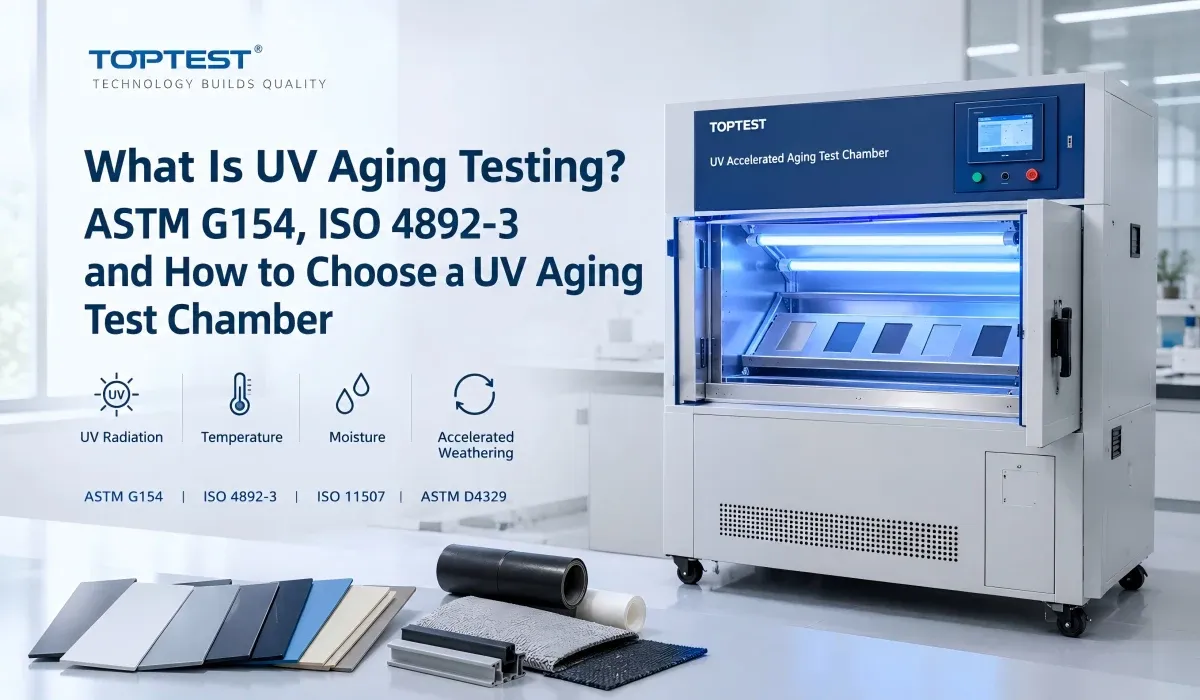
Top Test provides an ISO/ASTM compliant UV Accelerated Aging Test Chamber designed for accelerated weathering evaluation of materials and products.
The chamber uses fluorescent UV lamps, with UVA-340 and UVB-313 options, together with controlled temperature, condensation, and water spray functions.
According to the equipment specifications, the chamber supports standards including ASTM G154, ISO 4892-3, ISO 11507, and ASTM D4329, with programmable illumination, condensation, and spray cycles.
The equipment is designed for applications involving plastics, rubber, coatings, textiles, automotive components, construction materials, packaging, and other products requiring accelerated weathering evaluation.
For laboratories that need a UV aging test chamber, the appropriate configuration should be selected according to the required standard, lamp type, exposure cycle, specimen size, and testing objectives.
Conclusion
UV aging testing is an important accelerated weathering method for evaluating how materials and products respond to ultraviolet radiation, temperature, moisture, and related environmental stresses.
Standards such as ASTM G154 and ISO 4892-3 provide important references for fluorescent UV exposure testing, but the correct exposure cycle depends on the specific material, product, and testing requirement.
When choosing a UV aging test chamber, laboratories should consider the applicable standard, UV lamp type, irradiance control, temperature control, condensation, water spray, sample capacity, and programmable test cycles.
Choosing equipment based on the actual testing method rather than simply comparing specifications can help laboratories obtain more consistent and useful weathering test results.
If you are selecting a UV aging test chamber for plastics, rubber, coatings, automotive components, textiles, or construction materials, define the required standard and exposure cycle first, then select the chamber configuration accordingly.