News & Insights
Temperature Stability Testing: How to Evaluate Chamber Temperature Uniformity
Learn how to evaluate temperature uniformity & stability of temperature test chambers following IEC 60068-3-5. Understand temperature gradient, fluctuation test procedure and chamber selection tips.
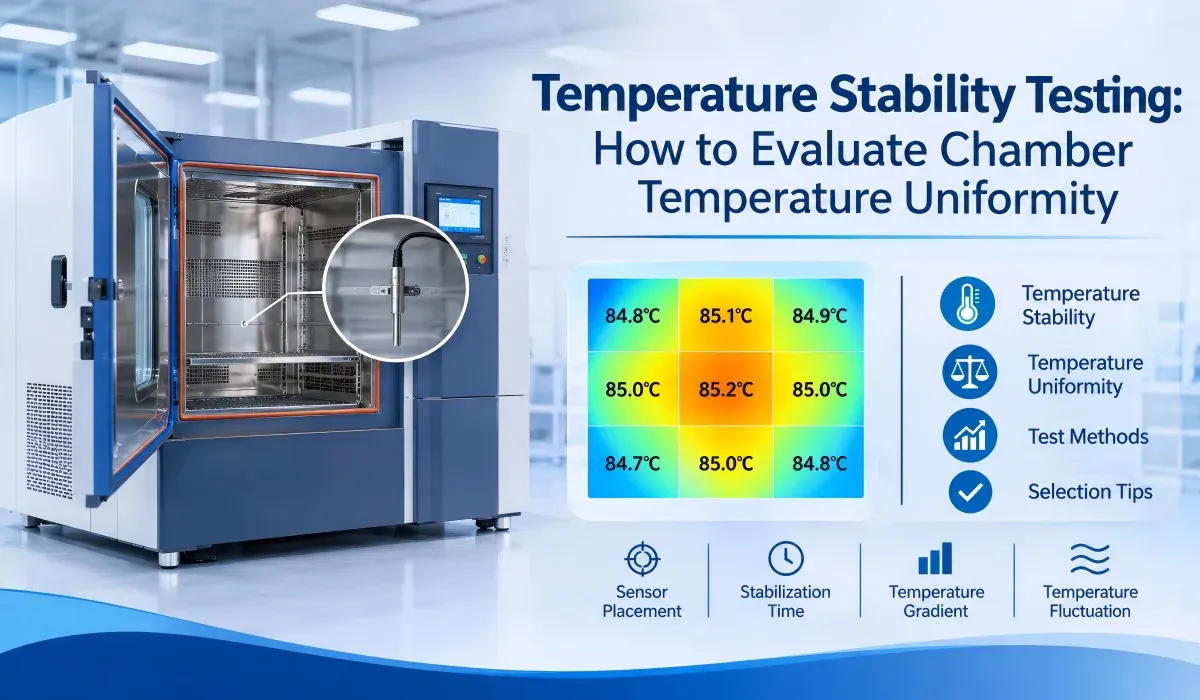
When a temperature test chamber is set to 85°C, its display may show the correct temperature, but this does not necessarily mean that every area inside the chamber is actually at 85°C. Temperature differences can occur between different locations, while the temperature at each location may also fluctuate over time.
For reliable environmental testing, it is important to evaluate both temperature stability and temperature uniformity. These measurements help determine whether a chamber can maintain consistent conditions and provide a suitable environment for repeatable testing.
This guide explains how to evaluate chamber temperature uniformity, measure temperature fluctuation, and select the right temperature testing equipment.
1. Temperature Stability vs. Temperature Uniformity
Although closely related, these two parameters describe different aspects of chamber performance.
- Temperature stability: The ability of a chamber to maintain a consistent temperature over time at a specific measurement point.
- Temperature uniformity: The ability of a chamber to maintain similar temperatures across different locations within its working space.
For example, a chamber set to 60°C may maintain a temperature between 59.8°C and 60.2°C at its center. However, the upper section may reach 61°C while the lower section remains at 59°C.
This indicates that the chamber may have good temperature stability at the center but relatively poor temperature uniformity.
A complete performance evaluation should therefore consider temperature fluctuation, temperature gradient, and spatial temperature variation.
2. How to Test Temperature Uniformity
IEC 60068-3-5 provides guidance on confirming the performance of temperature chambers through measurement and evaluation.
For chambers up to 2,000 L, the standard describes a nine-point measurement arrangement.
The measurement locations are generally distributed throughout the working space:
- Upper-left, upper-center, and upper-right
- Middle-left, center, and middle-right
- Lower-left, lower-center, and lower-right
The actual sensor arrangement should follow the applicable standard and chamber configuration.
Step 1: Prepare the Chamber
Make sure the chamber is properly installed and operating under suitable environmental conditions.
Use calibrated temperature sensors with appropriate measurement accuracy. An independent measurement system is recommended for evaluating actual chamber performance.
Step 2: Set the Target Temperature
Select the temperature according to the intended application.
For a chamber operating across a wide temperature range, it is useful to evaluate performance at relevant high, low, and intermediate temperatures.
Step 3: Allow Temperature Stabilization
After the chamber reaches the target temperature, allow sufficient time for the entire working space to stabilize.
IEC 60068-3-5 specifies a minimum stabilization period of 30 minutes after the measurement points have entered the allowable temperature range.
Starting measurements too early may produce misleading results because different areas may still be heating or cooling.
Step 4: Record Temperature Data
After stabilization, record readings from all measurement points.
For temperature fluctuation evaluation, IEC 60068-3-5 describes a 30-minute measurement period with at least 10 evenly spaced measurements at each point.
The collected data can then be used to evaluate temperature stability and uniformity.
3. How to Calculate Temperature Uniformity
Two important parameters are commonly used when evaluating temperature distribution.
Temperature Gradient
Temperature gradient represents the difference between the highest and lowest mean temperatures measured within the working space.
Formula:
Temperature Gradient = Highest Mean Temperature − Lowest Mean Temperature
For example:
- Highest mean temperature: 85.6°C
- Lowest mean temperature: 84.4°C
Temperature Gradient = 85.6 − 84.4 = 1.2°C
A smaller gradient generally indicates a more uniform temperature distribution.
Temperature Fluctuation
Temperature fluctuation describes how much the temperature changes over time at a particular measurement point.
For example, a sensor may record:
85.0°C → 85.2°C → 84.9°C → 85.1°C
These readings show that the temperature moves slightly around its average value.
IEC 60068-3-5 uses statistical evaluation, including sample standard deviation, to determine temperature fluctuation. Therefore, fluctuation should not simply be treated as the difference between the highest and lowest readings.
4. What Affects Temperature Uniformity?
Several factors can influence temperature distribution inside an environmental chamber.
Air circulation: Poor airflow distribution can create hot and cold areas. Fan design, air ducts, and the positions of heating and cooling components all influence uniformity.
Sample loading: Large or densely packed specimens may block airflow and affect heat transfer. Chamber performance under actual loading conditions may differ from empty-chamber results.
Sample placement: Placing specimens too close to chamber walls or air outlets can expose them to different temperatures.
Chamber size: Larger chambers are generally more challenging to control uniformly because of their greater internal volume and airflow requirements.
These factors should be considered when evaluating chamber performance and planning actual tests.
5. How to Choose a Temperature Test Chamber
Temperature uniformity is only one factor when selecting a chamber. The equipment should also match the required test conditions.
Temperature Range
Check whether the chamber can reach the required minimum and maximum temperatures.
For temperature cycling applications, a High and Low Temperature Alternating Test Chamber may be suitable for evaluating products under repeated heating and cooling conditions.
Temperature Uniformity and Fluctuation
Check these specifications separately. For example, temperature fluctuation of ±0.5°C and temperature uniformity of ±2.0°C describe different performance characteristics.
Do not assume that a smaller fluctuation automatically means better spatial uniformity.
Working Volume
Choose a chamber that provides sufficient space for the specimens while allowing proper air circulation.
For large assemblies and automotive components, a Walk-in Temperature and Humidity Test Chamber may be more appropriate.
Humidity Requirements
If testing requires both temperature and relative humidity control, consider a Temperature and Humidity Test Chamber rather than a temperature-only chamber.
6. Temperature Uniformity Testing Checklist
Before accepting a chamber's performance, consider the following:
- Are the temperature sensors calibrated?
- Are measurement points distributed throughout the working space?
- Has the chamber reached thermal stabilization?
- Were temperature readings recorded over the required period?
- Have temperature fluctuation and gradient been evaluated separately?
- Were the test conditions representative of actual applications?
- Are the measurement results properly documented?
A complete performance report should include the test temperature, sensor locations, measurement results, temperature fluctuation, temperature gradient, and relevant test conditions.
Conclusion
Temperature stability and temperature uniformity are essential parameters for evaluating environmental test chambers. Stability describes temperature changes over time, while uniformity describes temperature differences between locations.
By using calibrated sensors, following an appropriate measurement procedure, and evaluating temperature fluctuation and gradient separately, users can better understand actual chamber performance.
When selecting a temperature test chamber, consider the required temperature range, working volume, uniformity, fluctuation, airflow, and test conditions together. Choosing equipment that matches the intended application helps improve the reliability and repeatability of environmental testing.