News & Insights
Ozone Aging Test for Rubber: ISO 1431 Method & Chamber Guide
Learn the ISO 1431 ozone aging test for rubber, including static and dynamic testing methods, key parameters, and how to select an ozone test chamber.
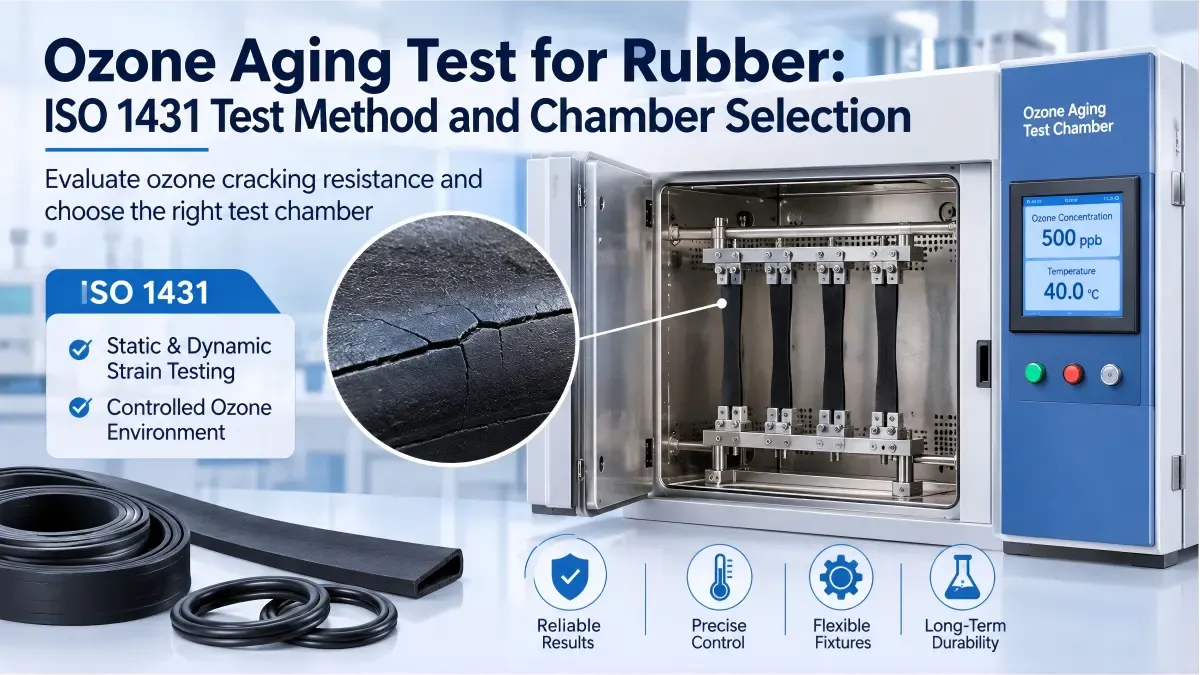
Rubber products used in outdoor environments, automotive components, electrical equipment, and industrial applications are regularly exposed to ozone in the atmosphere. Although ozone is present at relatively low concentrations, it can react with unsaturated rubber molecules and cause surface cracking, especially when the material is under tensile strain.
An ozone aging test evaluates how well rubber resists this type of deterioration under controlled conditions. ISO 1431-1 specifies the main test methods for evaluating ozone cracking resistance in vulcanized and thermoplastic rubber, using static or dynamic tensile strain in an ozone-controlled environment.
Choosing the correct ozone aging test chamber is equally important. Ozone concentration, temperature, specimen strain, exposure time, and test fixtures must all match the intended testing procedure.
1. What Is an Ozone Aging Test for Rubber?
An ozone aging test is an accelerated environmental test used to evaluate the resistance of rubber materials to ozone-induced cracking.
Ozone can attack double bonds in rubber polymers, particularly materials such as natural rubber, styrene-butadiene rubber (SBR), and nitrile rubber (NBR). When these materials are stretched, small surface cracks may develop perpendicular to the direction of tensile strain.
The severity of ozone cracking depends on several factors:
- Ozone concentration in the surrounding air
- Temperature and relative humidity
- Applied tensile strain
- Rubber formulation and ozone resistance
- Exposure duration
The test is commonly used for:
- Automotive rubber seals, hoses, and gaskets
- Tires and rubber components
- Electrical cable insulation and sheaths
- Industrial rubber belts and flexible connectors
- Outdoor rubber products exposed to atmospheric conditions
The results help manufacturers compare material formulations, evaluate product durability, and identify potential cracking problems before products enter service.
For broader environmental durability evaluations, ozone testing can also be considered alongside other aging methods, such as testing with a UV Accelerated Aging Test Chamber, which evaluates material degradation caused by ultraviolet radiation.
2. ISO 1431: Standard for Rubber Ozone Resistance Testing
ISO 1431 is the principal international standard series for evaluating ozone cracking resistance in rubber materials.
The two relevant parts are:
ISO 1431-1: Static and Dynamic Strain Testing
This part specifies procedures for exposing vulcanized or thermoplastic rubber specimens to ozone under controlled conditions. It covers both static and dynamic tensile strain testing.
The current international edition is ISO 1431-1:2024.
ISO 1431-3: Reference and Alternative Methods for Determining the Concentration of Ozone in Laboratory Test Chambers
This part addresses ozone concentration measurement, which is essential for maintaining reliable and repeatable test conditions.
For routine rubber ozone resistance evaluation, ISO 1431-1 provides the main testing framework, while ISO 1431-3 supports ozone concentration measurement.
3. ISO 1431-1 Ozone Aging Test Methods
ISO 1431-1 includes two primary testing approaches: static strain testing and dynamic strain testing.
3.1 Static Ozone Test
In a static ozone test, rubber specimens are stretched to a specified elongation and maintained at that extension throughout the exposure period.
The stretched specimens are placed inside an ozone aging test chamber, where ozone concentration and temperature are controlled.
During exposure, the material surface is examined periodically for cracks.
This method is suitable for evaluating the ozone resistance of rubber products that experience relatively constant tensile stress during service.
Typical applications include rubber seals, gaskets, and stretched rubber components.
3.2 Dynamic Ozone Test
In a dynamic ozone test, specimens are repeatedly stretched and released while exposed to ozone.
The continuous movement simulates the repeated deformation experienced by rubber components during actual use.
Dynamic testing is particularly useful for evaluating:
- Automotive rubber components subjected to repeated movement
- Flexible rubber hoses
- Rubber connectors and expansion joints
- Industrial rubber products exposed to cyclic deformation
The testing equipment must include a suitable mechanical stretching system capable of maintaining the specified strain cycle and frequency.
Static vs. Dynamic Ozone Testing
Comparison | Static Test | Dynamic Test |
|---|---|---|
Specimen condition | Constant elongation | Repeated elongation |
Mechanical fixture | Static stretching fixture | Dynamic stretching fixture |
Main purpose | Evaluate cracking under constant strain | Evaluate cracking under cyclic strain |
Typical application | Seals and gaskets | Hoses and flexible components |
The appropriate method depends on the material, product application, and relevant testing specification.
4. Important Test Parameters Under ISO 1431-1
To obtain meaningful and repeatable results, the main test conditions must be controlled carefully.
4.1 Ozone Concentration
Ozone concentration is one of the most important parameters in rubber ozone resistance testing.
ISO 1431-1 specifies several standard concentration levels:
Ozone Concentration | Equivalent Value |
|---|---|
250 ± 50 ppb | 25 ± 5 pphm |
500 ± 50 ppb | 50 ± 5 pphm |
1,000 ± 100 ppb | 100 ± 10 pphm |
2,000 ± 200 ppb | 200 ± 20 pphm |
Unless otherwise specified, the standard uses 500 ± 50 ppb as the normal test concentration.
Lower concentrations may be selected for materials intended for low-ozone environments, while higher concentrations can be used for highly ozone-resistant materials.
When comparing different rubber formulations, the ozone concentration should remain consistent.
4.2 Temperature
Temperature affects the rate of ozone-induced deterioration and the development of surface cracks.
The test temperature should be selected according to the applicable standard, material requirements, or product specification.
The chamber must maintain a stable temperature throughout the exposure period. Temperature fluctuations can influence test results and make comparisons less reliable.
4.3 Tensile Strain
The amount of specimen elongation directly influences ozone cracking.
ISO 1431-1 provides commonly used strain levels, including:
5%, 10%, 15%, 20%, 25%, 30%, 40%, 50%, 60%, and 80%.
The selected elongation should reflect the intended testing conditions and the expected deformation of the rubber in service.
For additional evaluation of rubber tensile properties, a Universal Tensile Testing Equipment can be used to measure tensile strength, elongation at break, and other mechanical characteristics.
4.4 Exposure Time
There is no single exposure duration suitable for every rubber material.
The required test period depends on the rubber formulation, ozone concentration, temperature, humidity, and applied strain.
Preliminary tests may be necessary to determine an appropriate exposure period.
4.5 Humidity and Airflow
Relative humidity should be selected according to the material and its intended application.
Airflow must also be sufficient to maintain the required ozone concentration around the specimens. Poor circulation can result in uneven exposure and inconsistent results.
5. How to Perform an ISO 1431-1 Ozone Aging Test
A typical ozone resistance test follows these steps:
Step 1: Prepare the specimens
Cut rubber specimens according to the dimensions and preparation requirements of the applicable test method. Specimens should be handled carefully to avoid surface contamination or damage.
Step 2: Apply the required strain
For static testing, stretch the specimens to the specified elongation. For dynamic testing, install them in the mechanical stretching fixture.
Step 3: Set the chamber conditions
Adjust ozone concentration, temperature, airflow, and relative humidity where required.
Step 4: Start ozone exposure
Place the specimens inside the chamber and maintain the specified environmental and mechanical conditions for the required exposure period.
Step 5: Inspect the specimens
Examine the exposed surfaces for ozone-induced cracks. Visual inspection or image analysis can be used to evaluate crack formation and development.
Step 6: Record and evaluate the results
Document crack appearance, severity, and other required observations. For comparative testing, all relevant conditions should remain consistent between samples.
6. How to Choose an Ozone Aging Test Chamber
Selecting an appropriate ozone aging test chamber requires more than checking its maximum ozone concentration. The equipment should match the test methods, specimen dimensions, and operating conditions required by the laboratory.
Consider the following factors.
6.1 Ozone Concentration Control
Choose a chamber with an ozone generation system capable of producing and maintaining the required concentration.
The measurement system should provide reliable monitoring and adjustment throughout the test.
6.2 Temperature Control
Temperature stability is essential for repeatable results.
Check the operating temperature range, temperature fluctuation, and uniformity to ensure that they meet the intended testing requirements.
6.3 Static and Dynamic Test Fixtures
If testing involves both static and dynamic strain, the chamber should support both configurations.
Static fixtures hold specimens at a fixed elongation, while dynamic fixtures provide controlled cyclic stretching.
Confirm the available strain range, movement frequency, and fixture capacity before selecting the equipment.
6.4 Chamber Capacity
The internal chamber dimensions should accommodate the required number of specimens and test fixtures without overcrowding.
Adequate spacing helps maintain consistent ozone circulation around the specimens.
6.5 Monitoring and Safety Features
A suitable chamber should include:
- Ozone concentration monitoring
- Temperature monitoring and control
- Automatic test parameter adjustment
- Alarm and fault protection
- Ozone-resistant internal materials
- Appropriate ozone exhaust and treatment arrangements
Because ozone is hazardous to breathe, the chamber should be operated in accordance with appropriate ventilation and ozone-handling safety procedures.
7. Ozone Aging Test Chamber for Rubber
For laboratories performing rubber ozone resistance testing, the TT-OATC Ozone Aging Test Chamber from Top Test is designed to evaluate ozone cracking resistance under controlled environmental conditions.
The equipment supports static, continuous dynamic, and intermittent dynamic testing.
Its main specifications include:
Parameter | Specification |
|---|---|
Model | TT-OATC |
Ozone concentration | 50–1,000 pphm, with customization available |
Temperature range | 9–60°C |
Temperature fluctuation | ±0.5°C |
Temperature uniformity | ≤2°C |
Chamber dimensions | 1,000 × 1,000 × 1,000 mm |
Test modes | Static, continuous dynamic, intermittent dynamic |
Dynamic stretching frequency | 0.5 Hz |
The chamber uses an ozone generation system and concentration monitoring to maintain the required test environment. Its static and dynamic fixtures allow different rubber specimens to be evaluated according to the selected test procedure.
Before selecting a configuration, users should confirm the required ozone concentration, specimen dimensions, strain conditions, and exposure method.
8. Common Questions About Rubber Ozone Aging Tests
What is the difference between ISO 1431-1 and ASTM D1149?
Both standards address ozone cracking resistance in rubber materials. ISO 1431-1 covers static and dynamic strain testing, while ASTM D1149 provides a separate test method for evaluating rubber deterioration caused by ozone exposure.
Their specimen requirements and test conditions should not be assumed to be identical.
What does pphm mean in ozone testing?
PPHM means parts per hundred million. It is a traditional unit used to express ozone concentration in the rubber testing industry.
For example, 50 pphm is equivalent to 500 ppb.
Can one ozone aging chamber perform both static and dynamic tests?
Yes, provided the chamber is equipped with the appropriate static and dynamic stretching fixtures and supports the required test conditions.
Which rubber materials require ozone resistance testing?
Common materials include natural rubber, SBR, NBR, EPDM, and other vulcanized or thermoplastic elastomers. The need for testing depends on their chemical composition, application, and exposure environment.
How long does an ozone aging test take?
The duration depends on the material, ozone concentration, temperature, strain, and evaluation requirements. The test period should be determined by the applicable standard or product specification rather than assuming one fixed duration.
Conclusion
Ozone aging testing is an important method for evaluating the durability of rubber materials exposed to atmospheric ozone. ISO 1431-1 provides a structured approach to static and dynamic strain testing, helping manufacturers identify ozone-induced cracking and compare material performance.
For reliable results, the test chamber must provide stable ozone concentration, temperature control, suitable specimen fixtures, and consistent airflow.