Oct 30, 2026News & Insights
Needle Flame Test IEC 60695-11-5: Method and Equipment Guide
Learn the IEC 60695-11-5 needle flame test method, flame requirements, equipment specifications, applications, and how to select a needle flame tester.
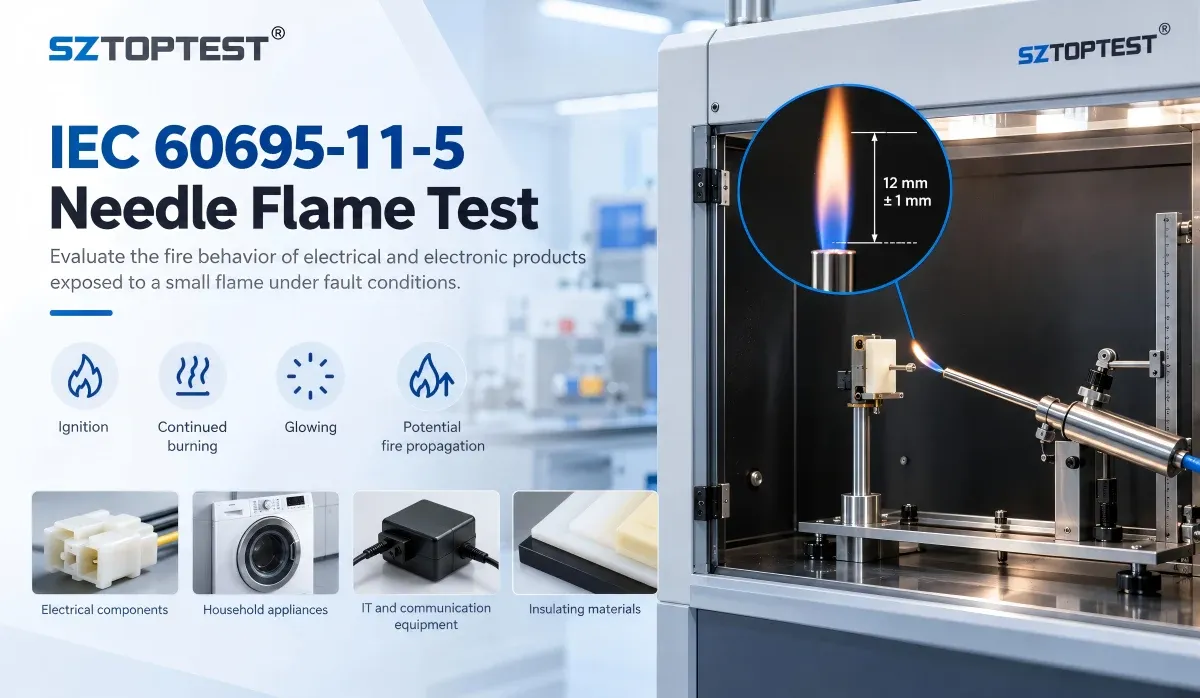
The needle flame test IEC 60695-11-5 evaluates how electrical and electronic components respond to a small flame under simulated fault conditions. It assesses ignition, continued burning, glowing, and potential fire propagation.
A suitable Needle Flame Tester IEC 60695-11-5 should provide a standardized burner, a controlled flame, adjustable timing, and a suitable test chamber. The test method is defined by IEC 60695-11-5, while the applicable product standard determines the required flame application duration and acceptance criteria.
What Is the IEC 60695-11-5 Needle Flame Test?
The needle flame test simulates a small flame that may occur because of an electrical fault or abnormal operating condition. It is commonly used to evaluate combustible components in electrical and electronic products.
Typical applications include:
- Household appliances and lighting equipment
- Electrical connectors and insulating materials
- IT and communication equipment
- Power tools and electronic components
- Plastic housings and electrical enclosures
The test helps determine whether a localized flame can ignite a specimen, cause continued burning, or ignite surrounding materials.
IEC 60695-11-5 Test Method
The needle flame test generally involves five steps.
1. Prepare the Specimen
Mount the specimen according to the applicable product standard. Select the test location based on the potential fire hazard and specified test arrangement.
2. Adjust the Flame
Adjust the needle burner to produce a flame height of 12 mm ± 1 mm.
The burner tube has an inner diameter of 0.5 mm ± 0.1 mm and an outer diameter not exceeding 0.9 mm.
3. Confirm Flame Performance
The standard includes a copper-block procedure to confirm flame performance. The specified temperature rise is from 100 °C ± 5 °C to 700 °C ± 3 °C, within 23.5 s ± 1.0 s.
4. Apply the Flame
Position the burner according to the specified test arrangement. The burner tube is normally positioned at 45° ± 5° from vertical during flame application.
The required application time depends on the applicable product standard or specification; it should not be assumed to be the same for every test.
5. Evaluate the Result
After removing the flame, observe whether the specimen continues burning or glowing and whether burning particles ignite material beneath it. Apply the acceptance criteria specified by the relevant product standard.
Key Requirements for Needle Flame Test Equipment
When selecting needle flame test equipment, check the following specifications.
Parameter | Requirement |
|---|---|
Test standard | IEC 60695-11-5 |
Burner inner diameter | 0.5 mm ± 0.1 mm |
Burner outer diameter | ≤0.9 mm |
Flame height | 12 mm ± 1 mm |
Burner angle | 45° ± 5° from vertical |
Gas | Butane or propane, minimum 95% purity |
Flame confirmation | Copper-block temperature-rise procedure |
Timer | Adjustable to the required test duration |
Burner movement | Manual or automatic |
Chamber | Suitable enclosure and observation area |
A well-configured tester should meet the required test specifications and provide stable operation, convenient specimen positioning, and appropriate safety provisions.
For product-specific requirements, the SZTOPTEST Needle Flame Tester is a relevant option to evaluate. Confirm the equipment specifications and included accessories against your testing requirements before purchase.
Needle Flame Test vs. Other Flammability Tests
Needle flame, glow wire, and UL94 tests address different fire hazards and are not interchangeable.
- Needle flame test: Applies a small flame to simulate a localized ignition source under fault conditions.
- Glow wire test: Uses a heated wire to simulate thermal stress from an overheated electrical component. See the available glow wire testing equipment.
- UL94 flame test: Evaluates the flammability characteristics of specified plastic materials and specimens. Related equipment is available in the burning test equipment range.
Depending on the product and its applicable standards, laboratories may also need a Ball Pressure Test Apparatus to evaluate heat resistance or a Tracking Index Test Apparatus to evaluate the electrical tracking resistance of insulating materials.
How to Choose the Right Needle Flame Tester
Before requesting a quotation, prepare these details:
- Applicable standard: Identify IEC 60695-11-5 and the relevant product standard or test clause.
- Specimen details: Provide the material, dimensions, and mounting arrangement.
- Flame application time: Confirm the required duration from the product standard.
- Gas supply: Specify whether butane or propane will be used.
- Equipment configuration: Confirm burner movement, timer functions, chamber design, exhaust requirements, and power supply.
Providing this information helps the supplier recommend equipment that matches your actual testing needs.
Frequently Asked Questions
What is the flame height for IEC 60695-11-5?
The specified nominal flame height is 12 mm ± 1 mm.
What gas is used for the needle flame test?
The standard specifies butane or propane gas with a minimum purity of 95%.
Is the needle flame test always 30 seconds?
No. The required flame application duration depends on the applicable product standard or specification.
What is the difference between needle flame and glow wire testing?
Needle flame testing applies a small flame directly to the specimen, while glow wire testing uses a heated wire. They simulate different fire hazards and require different equipment.
Conclusion
The IEC 60695-11-5 needle flame test evaluates the fire behavior of electrical and electronic products exposed to a small flame. Key considerations include burner dimensions, flame height, flame confirmation, gas supply, application time, and specimen evaluation.
When purchasing a needle flame tester, confirm the applicable standard, specimen requirements, and required test conditions before selecting the equipment. Contact SZTOPTEST with these details to identify a suitable testing configuration.