Oct 30, 2026News & Insights
Testing Commercial Refrigerators to ANSI/ASHRAE 72 and AHAM HRF-1: Test Packages Explained
ANSI/ASHRAE 72 and AHAM HRF-1 define the test packages that simulate food loads in commercial refrigerator testing. Compare AS 72 glycol packages, AHAM sawdust M-packages and setups.
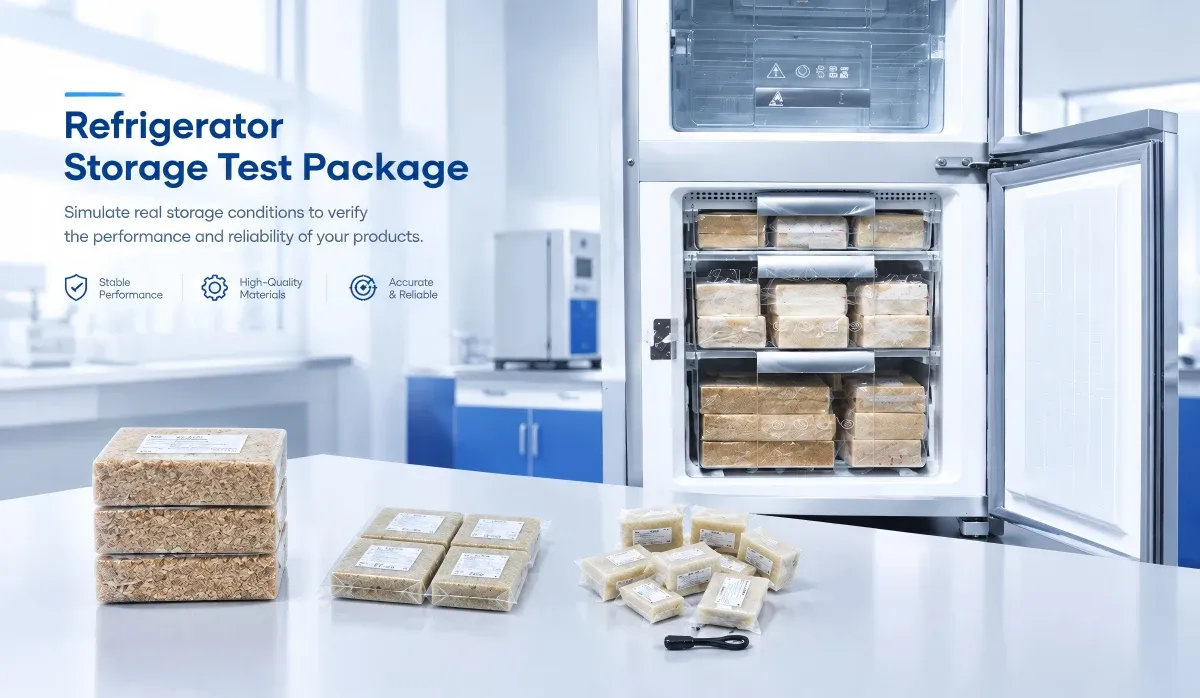
A commercial refrigerator's energy consumption, pulling-down capacity and temperature uniformity cannot be measured on an empty cabinet — the standard wants the appliance tested the way it works in service: loaded with food.
Real food is hopeless as a test load (it thaws, dries out and varies from batch to batch), so the North American standards define test packages — standardized simulators with the thermal mass of the food they replace:
• ANSI/ASHRAE 72 — the core method for commercial refrigerators and freezers in the US and Canada
• AHAM HRF-1 — the household/commercial load package standard recognized by US regulators and retailers
• SASO 2664 — the Gulf-market standard built on the same sawdust package family
This guide explains what each package is, how they differ, and how to set them up.
What the Test Packages Do
Test packages stand in for the product being refrigerated. During a performance test they absorb and release heat the way real food does, which is what makes measurements of freezing capacity, energy use and load temperature recovery meaningful and repeatable.
Two package families cover the North American market:
AS 72-2005 Packages (Commercial, Glycol-Filled)
The North American commercial refrigerator test package built to ANSI/ASHRAE 72-2005 is a polyethylene container of at least 473 ml (1 US liquid pint), nominally 50 × 100 × 100 mm, filled with a 50/50 ± 2% mixture of propylene glycol and distilled water.
The glycol mixture is the thermal simulator: it mimics food with 80–90% water content, and unlike real food it holds its properties across months of testing. Containers are airtight to prevent moisture exchange and deformation.
AHAM HRF-1 Packages (Sawdust M-Packages)
The AHAM HRF-1 package family uses a different simulator: hardwood sawdust packed to defined density in a flat, brick-shaped container:
• Dimensions: 130 ± 6 × 100 ± 4 × 40 ± 2 mm
• Weight: 290 ± 40 g
• Density: 560 ± 80 kg/m³
This is the "M package" geometry — and SASO 2664-2007 (Gulf market) uses the same sawdust package, which is why laboratories serving both markets order one package set for both.
M Packages with Thermocouples
Temperature measurement happens inside the load, not in the air. Two package weights live in these standards, and they are not a contradiction: the AHAM sawdust M-package runs 290 ± 40 g, while the instrumented 500 g M package is a separate, heavier specification built around its thermocouple. The 500 g M package with a built-in T-type thermocouple places the sensor in direct contact with the package core — the measurement point for load temperatures, recovery time and uniformity checks. Getting the thermocouple into the thermal center, with the lead routed per the standard, is the difference between data and noise.
The Global Counterpart: IEC 62552
The same testing philosophy exists internationally: IEC 62552 (with ISO 15502 heritage) defines the M-package test for household and commercial refrigeration in most of the world. The Top Test IEC 62552 freezing load test package serves that route, and laboratories certifying for both markets keep both package families — the appliance is the same, but the package the standard hands you is different.
• Market — AS 72-2005: USA / Canada commercial; AHAM HRF-1: USA regulatory & retail; IEC 62552: Global (most markets)
• Simulator — AS 72-2005: Propylene glycol/water 50/50; AHAM HRF-1: Hardwood sawdust; IEC 62552: M-package material per standard
• Container — AS 72-2005: PE, ≥473 ml (1 US pint); AHAM HRF-1: 130 × 100 × 40 mm brick; IEC 62552: Per IEC 62552 geometry
• Measurement — AS 72-2005: Package temperature per method; AHAM HRF-1: Thermocouple in package core; IEC 62552: M-package thermocouple
Setup Notes That Decide Data Quality
Test packages are simple objects with unforgiving tolerances:
• Weight and density drift break the test. The ±40 g and ±80 kg/m³ windows exist because thermal mass is the whole point — weigh packages on the schedule the standard sets.
• Inspect before every campaign. Replace any package with visible holes, cracks or deformation; a leaking glycol package silently changes your load.
• Store them cold. Long periods at room temperature deform containers and degrade the simulator — the packages live in refrigeration between tests, like the food they imitate.
• Route thermocouple leads per the standard. A lead acting as a heat path along the door gasket corrupts the core reading it was placed to take.
• Condition before the test. Packages must be at the standard's starting temperature before the run — loading warm packages is the classic way to invalidate a pulling-down test.
Frequently Asked Questions
Why propylene glycol instead of real water?
Pure water freezes solid and stops behaving like food; the 50/50 glycol mixture stays in its useful range through freeze-thaw cycles while keeping water's thermal mass. It is the compromise that makes month-long test campaigns repeatable.
Are ASHRAE 72 and AHAM HRF-1 packages interchangeable?
No — different simulator materials, geometries and weights. A glycol pint container is not a sawdust M-package. Which one your test uses is decided by the standard and market you are certifying for; laboratories serving multiple markets stock both families.
How many packages does one cabinet need?
The quantity and arrangement are prescribed by the test method — loads are built to fill the specified volume in defined patterns, with instrumented M-packages at the measurement positions. Order to your largest cabinet's load plan, not one package at a time.
Do the packages need calibration?
They need verification against their tolerances — weight, density and dimensional checks on a schedule, plus thermocouple verification for instrumented packages. The tolerances are the calibration.
Conclusion
ANSI/ASHRAE 72 and AHAM HRF-1 make refrigerator testing repeatable by replacing food with standardized simulators: glycol-filled pint containers for the commercial method, sawdust M-packages for the AHAM family, thermocouple-carrying packages for the measurements inside the load. Stock both North American families plus the IEC 62552 set, verify tolerances on schedule, and the same cabinet tells the same story in every lab.
Tell Top Test the cabinet types, target markets and load plan — contact us for a quotation on package sets and instrumented M-packages, or browse the freezing load test package range.