Sep 28, 2026News & Insights
How to Choose an IPX7 Immersion Test Chamber
Learn how to choose an IPX7 immersion test chamber based on sample size, water depth, tank material, lifting method, water-level control and testing frequency.
Choosing an IPX7 immersion test chamber should start with the product being tested, not simply the size or price of the equipment.
The correct configuration depends on the specimen dimensions, weight, required immersion depth, tank material, sample handling method, testing frequency and future testing requirements.
For laboratories and manufacturers, selecting the wrong configuration can result in insufficient tank depth, difficult sample handling or unnecessary equipment costs.
This guide explains the key factors to consider when choosing an IPX7 immersion test chamber.
What Is an IPX7 Immersion Test Chamber?
An IPX7 immersion test chamber is equipment used to perform temporary water immersion testing according to the applicable IP rating requirements.
A typical system includes:
- Water immersion tank
- Water-level measurement system
- Sample support or cage
- Lifting mechanism
- Water inlet
- Drainage system
- Sample fixtures
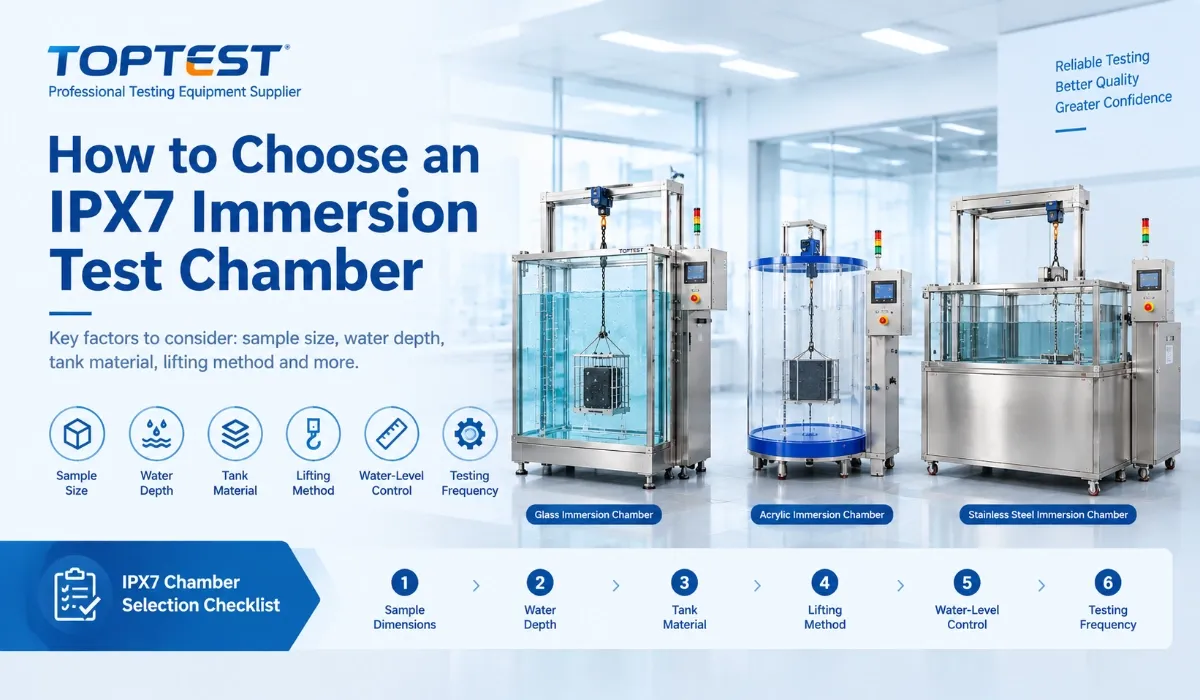
TOP TEST provides several types of IPX7 water immersion test equipment, including vertical tempered-glass chambers, acrylic cylindrical chambers, stainless-steel chambers and electric-lifting configurations.
The correct configuration depends on the actual test specimen.
1. Start With the Maximum Sample Size
The first step is to determine the largest product that will be tested.
Measure:
- Product length
- Product width
- Product height
- Cable or connector extensions
- Required fixtures
- Maximum sample envelope
Do not select the tank solely according to the product's external dimensions.
The specimen also needs enough clearance for correct positioning and handling.
If several products will be tested in the same laboratory, select the chamber according to the largest expected specimen rather than today's smallest product.
2. Check the Required Immersion Depth
Water depth is one of the most important specifications of an IPX7 immersion chamber.
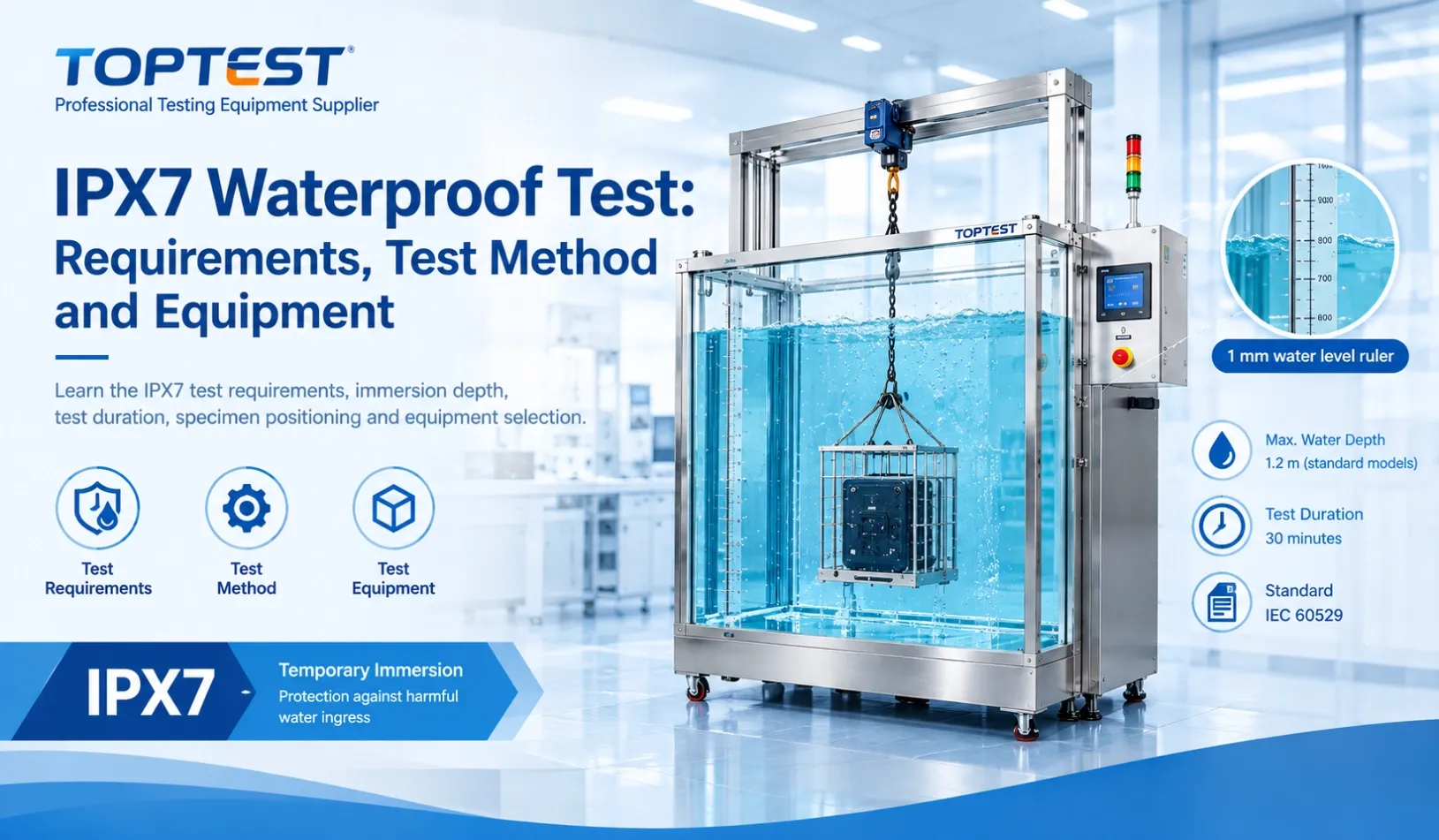
For specimens below 850 mm in height, the standard test arrangement places the bottom of the enclosure 1000 mm below the water surface.
For specimens 850 mm or higher, the top of the enclosure needs to be at least 150 mm below the water surface.
Therefore, the chamber needs sufficient usable water depth.
TOP TEST's standard IPX7 models provide maximum water depth up to 1200 mm, while customized dimensions can be considered for larger specimens.
3. Choose the Tank Size According to the Product
A larger tank is not always a better choice.
An oversized tank can increase:
- Equipment cost
- Water consumption
- Filling time
- Drainage time
- Laboratory space requirements
However, a tank that is too small can limit future product testing.
The practical solution is to select a tank that provides enough space for the largest expected specimen while maintaining the required immersion condition.
TOP TEST can customize tank dimensions according to the specimen specifications.
4. Choose the Right Tank Material
IPX7 chambers commonly use transparent materials or stainless steel.
Tempered Glass
Advantages include:
- Good visibility
- Easy observation of the specimen
- Suitable for laboratory environments
- Good structural strength
TOP TEST's vertical tempered-glass model uses 12 mm pressure-resistant tempered glass combined with 304 stainless steel.
Acrylic
Acrylic provides high transparency and makes it easy to observe the specimen and possible leakage bubbles.
It is particularly useful when visual observation during testing is important.
Stainless Steel
304 stainless steel provides a durable structure and is suitable for larger or frequently used equipment.
A stainless-steel chamber can also include a transparent observation window for easier monitoring.
5. Consider Sample Weight
Sample weight directly affects the required lifting method.
Lightweight Samples
Manual loading and unloading may be sufficient for small electronic products and components.
Heavy Samples
Large automotive components, electrical cabinets and industrial enclosures may be difficult to handle manually.
For these applications, an electric hoist and sample cage can reduce operator workload.
TOP TEST's electric-lifting IPX7 configuration uses an electric hoist connected to a wire-gauze sample cage and can be operated by remote control.
6. Manual or Electric Lifting?
Manual Configuration
A manual system may be suitable when:
- Samples are lightweight
- Testing is occasional
- The laboratory has limited space
- The number of tests is relatively low
Electric Lifting Configuration
Electric lifting is more suitable when:
- Samples are heavy
- Testing is frequent
- Operators need easier loading and unloading
- Repeatable immersion positioning is important
When requesting a quotation, always tell the equipment supplier the maximum sample weight.
This allows the lifting system to be selected correctly.
7. Check the Water-Level Measurement System
Water-level measurement is essential for IPX7 testing.
The chamber should allow the operator to clearly determine the water level.
Useful features include:
- Stainless-steel ruler
- 1 mm graduation
- Clear observation
- Stable tank structure
- Easy water-level adjustment
TOP TEST's relevant IPX7 models use a stainless-steel ruler with 1 mm graduations.
This allows the operator to set and monitor the required immersion level more accurately.
8. Consider Sample Fixation
Different products require different positioning methods.
Possible solutions include:
- Sample basket
- Wire-gauze cage
- Metal hooks
- Rope fixation
- Customized fixture
The fixture should hold the specimen securely without changing the required test condition.
If the laboratory tests products with different shapes, ask whether the supplier can provide customized fixtures.
9. Consider Water Supply and Drainage
Water management becomes increasingly important when the equipment is used frequently.
A practical chamber should provide convenient:
- Water filling
- Water drainage
- Tank cleaning
- Water replacement
- Internal access
TOP TEST's IPX7 equipment uses dedicated inlet and drain valves, while some configurations hide the water piping within the stainless-steel base.
For production or high-frequency laboratory testing, efficient drainage can reduce the time between tests.
10. Consider Testing Frequency
The appropriate equipment configuration depends on how often testing is performed.
Occasional Testing
A simple manual immersion tank may be sufficient.
Regular Laboratory Testing
Consider:
- Transparent observation
- Easy water-level measurement
- Sample fixtures
- Convenient drainage
- Mechanical or electric lifting
High-Frequency Testing
Consider:
- Stainless-steel construction
- Electric lifting
- Customized fixtures
- Easy maintenance
- Efficient water management
The objective is not to purchase the most complicated system. It is to choose the configuration that matches the actual testing workflow.
11. Check the Applicable Standards
Before ordering an IPX7 chamber, confirm the standards that apply to your product.
IEC 60529 is the main international standard for IP Code ratings.
Depending on the industry, other standards may also apply.
When contacting an equipment manufacturer, provide:
- Product type
- Maximum dimensions
- Maximum weight
- Required IP rating
- Applicable standard
- Required water depth
- Testing frequency
- Lifting requirements
This information allows the manufacturer to recommend a more appropriate configuration.
12. Do You Need IPX7 or IPX7 and IPX8?
This should be determined before purchasing the equipment.
IPX7 uses a standardized temporary immersion condition.
IPX8 uses immersion conditions agreed between the relevant parties and must be more severe than IPX7.
Therefore, an ordinary IPX7 tank should not automatically be assumed to provide complete IPX8 testing capability.
If your products may require both levels, consider an IPX7/IPX8 waterproof rating tester or another pressure-capable configuration.
Our IPX5 vs IPX6 vs IPX7 vs IPX8 testing guide provides a detailed comparison of the four water-ingress levels.
IPX7 Immersion Test Chamber Selection Checklist
Before requesting a quotation, confirm the following:
Selection factor | What to confirm |
|---|---|
Maximum sample height | Is the required immersion position possible? |
Maximum sample width | Is there enough horizontal clearance? |
Maximum sample length | Can the sample be positioned correctly? |
Sample weight | Is manual or electric lifting required? |
Water depth | Is sufficient usable depth available? |
Tank material | Glass, acrylic, stainless steel or combined design? |
Water-level measurement | Is the required level easy to read? |
Sample fixation | Basket, cage, hook or customized fixture? |
Drainage | Is water removal convenient? |
Testing frequency | Occasional, laboratory or production use? |
Applicable standard | IEC 60529 or additional requirements? |
Future testing | Will IPX8 or other IP levels be required? |
Common Mistakes When Selecting an IPX7 Test Chamber
Choosing Only by External Dimensions
The overall equipment dimensions do not necessarily equal usable testing space.
Always check the internal dimensions and maximum water depth.
Ignoring Sample Weight
A chamber may be large enough for a product but still be inconvenient if the product is too heavy for manual handling.
Buying Only for Current Products
If future products will be larger, the chamber should be selected with future dimensions in mind.
Ignoring Water-Level Measurement
Visual estimation is not an appropriate substitute for a clearly defined measurement system.
Focusing Only on Purchase Price
Equipment price is only one part of the total cost.
Consider:
- Equipment durability
- Maintenance
- Sample handling
- Testing efficiency
- Customization
- Future testing requirements
Frequently Asked Questions
What size should an IPX7 immersion test chamber be?
The chamber size should be determined by the largest specimen dimensions, required immersion depth and sample handling method.
What water depth is required for IPX7?
For specimens below 850 mm in height, the bottom of the enclosure is positioned 1000 mm below the water surface. For specimens 850 mm or higher, the top of the enclosure is positioned at least 150 mm below the water surface.
Should I choose a glass or stainless-steel IPX7 chamber?
Choose transparent glass or acrylic when observation is important. Stainless steel is suitable when structural durability is a higher priority. Combined designs can provide both structural strength and observation.
Do I need an electric hoist?
An electric hoist is recommended when samples are heavy or testing is frequent. Lightweight products can often be handled manually.
Can an IPX7 chamber be customized?
Yes. Tank dimensions, water depth, lifting systems, sample fixtures and other configurations can be customized according to the application.
Can an IPX7 chamber perform IPX8 testing?
Not necessarily. IPX8 uses different immersion conditions and may require pressure control. Confirm the required IPX8 conditions before purchasing equipment.
Conclusion
Choosing an IPX7 immersion test chamber should begin with the actual product and testing requirements.
First determine the maximum sample dimensions and weight. Then consider immersion depth, tank size, tank material, lifting method, water-level measurement, sample fixation and drainage.
If future IPX8 testing or larger product testing is expected, these requirements should also be considered before the equipment is purchased.
TOP TEST provides IPX7 immersion test chambers in different materials, dimensions and lifting configurations, with customized solutions available for specific sample and testing requirements.