
Sep 16, 2026News & Insights
UL94 V-0, V-1, V-2 Rating Explained: Complete Guide for Plastic Manufacturers
Learn the differences between UL94 V-0, V-1, and V-2 flame ratings, testing methods, and applications. Choose the right UL94 Flame Tester for your laboratory.
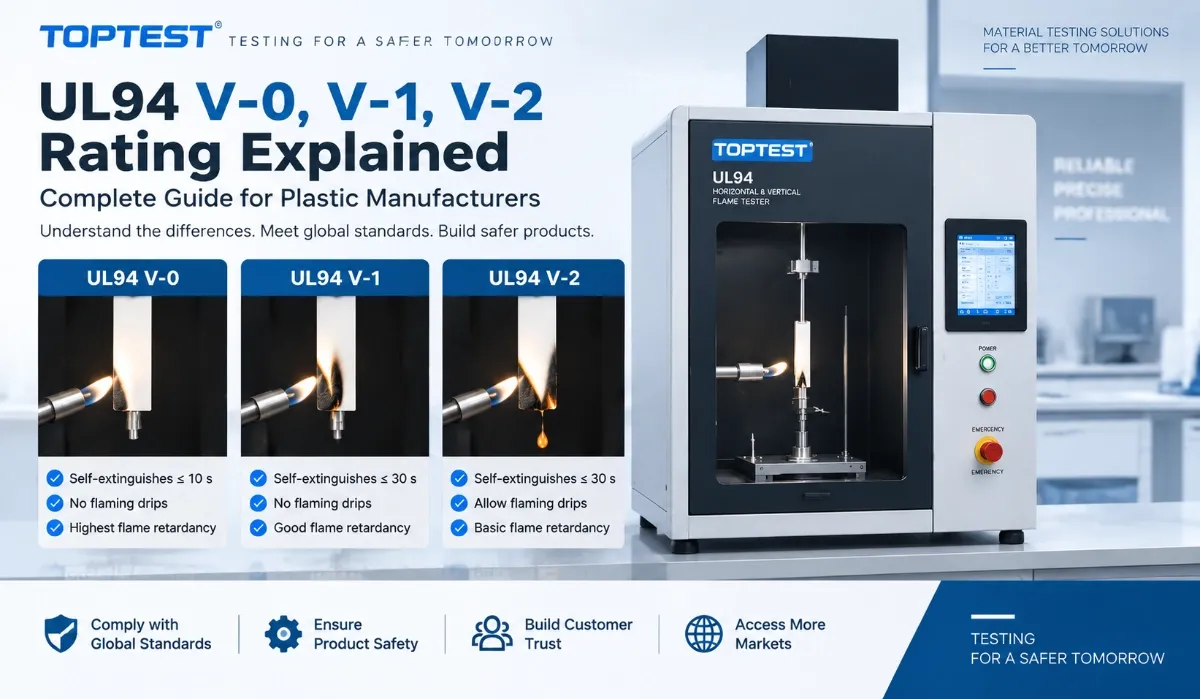
UL94 V-0, V-1, V-2 Rating Explained: Complete Guide for Plastic Manufacturers
Understand UL94 Flame Ratings and Choose the Right Flammability Tester for Plastic Materials
Plastic materials are widely used in electrical appliances, consumer electronics, automotive components, and industrial products. As fire safety regulations become more stringent, manufacturers are increasingly required to demonstrate that their materials meet internationally recognized flammability standards.
Among these standards, UL94 is one of the most widely accepted methods for evaluating the flammability of plastic materials. Engineers, buyers, and product designers frequently encounter ratings such as UL94 V-0, V-1, and V-2, but many are unsure what these classifications actually mean or how they affect product selection.
This guide explains the differences between UL94 V-0, V-1, and V-2, how the tests are performed, and how to choose the appropriate UL94 Flame Tester for your laboratory or quality control process. The UL 94 standard classifies plastic materials based on how they behave after exposure to a small test flame under controlled laboratory conditions.
What Is UL94?
UL94 is an internationally recognized flammability standard developed to evaluate the burning characteristics of plastic materials used in electrical and electronic products.
Rather than measuring whether a material is completely fireproof, UL94 evaluates how a material reacts after ignition, including:
- How quickly the flame extinguishes
- Whether the material continues to burn
- Whether burning droplets are produced
- Whether the flame spreads
These results help manufacturers determine whether a material is suitable for specific applications requiring fire safety compliance. UL94 includes several classification families, with HB, V-2, V-1, V-0, 5VB, and 5VA commonly used for molded plastic materials.
Why Is UL94 Important for Plastic Manufacturers?
Today, many international markets require flame-retardant plastic materials.
A UL94 rating is often requested by:
- Electrical equipment manufacturers
- Consumer electronics companies
- Automotive suppliers
- Medical device manufacturers
- Appliance manufacturers
For plastic suppliers, obtaining an appropriate UL94 rating can improve product competitiveness and simplify customer approval processes.
Understanding UL94 Classification
UL94 includes several flame classifications.
The most common ratings for rigid plastic materials are:
- HB
- V-2
- V-1
- V-0
Among these, V-0 is generally considered the highest level within the standard 50 W vertical burning test, while HB is the basic horizontal burning classification. The vertical ratings become progressively more stringent from V-2 to V-0.
What Is UL94 V-0?
UL94 V-0 is the highest classification among the standard vertical burning tests.
To achieve a V-0 rating, the material must:
- Extinguish quickly after each flame application
- Produce a short total burning time
- Not produce flaming drips that ignite the cotton indicator
- Prevent the flame from reaching the specimen clamp
Because of these strict requirements, V-0 materials are commonly selected for products requiring a high level of fire safety. V-0 permits a maximum afterflame time of 10 seconds after each flame application and prohibits flaming drips that ignite the cotton indicator.
Typical applications include:
- Electrical enclosures
- Circuit breakers
- Battery housings
- Power supplies
- Consumer electronics
What Is UL94 V-1?
UL94 V-1 is similar to V-0 but allows longer afterflame times.
Compared with V-0, V-1 materials:
- Take longer to self-extinguish
- Still do not allow flaming drips that ignite cotton
- Must prevent flames from reaching the holding clamp
Many industrial products can meet V-1 requirements while maintaining lower material costs.
Typical applications include:
- Industrial electrical components
- Control panels
- Plastic brackets
- Mechanical housings
What Is UL94 V-2?
UL94 V-2 is another vertical burning classification.
Its burning time requirements are similar to V-1, but there is one important difference.
A V-2 material may produce flaming droplets that ignite the cotton indicator below the specimen.
Because of this characteristic, V-2 materials are generally used where the risk associated with flaming drips is acceptable.
Typical applications include:
- General plastic parts
- Consumer products
- Low-risk electrical accessories
The primary distinction between V-1 and V-2 is whether flaming drips are permitted to ignite the cotton indicator during testing.
UL94 V-0 vs V-1 vs V-2
The following table summarizes the main differences.
Classification | Self-Extinguishing Performance | Flaming Drips | Typical Fire Performance |
|---|---|---|---|
V-0 | Fastest | Not allowed | Highest |
V-1 | Moderate | Not allowed | High |
V-2 | Moderate | Allowed | Standard |
In general:
- V-0 offers the highest level of flame resistance.
- V-1 provides good fire performance with longer extinguishing times.
- V-2 allows flaming droplets during testing.
How Is the UL94 Vertical Burning Test Performed?
The vertical burning test follows a standardized procedure.
The plastic specimen is mounted vertically inside the test chamber.
A controlled burner flame is applied to the lower end of the specimen for a specified period.
The flame is removed, and technicians observe:
- Afterflame time
- Afterglow time
- Flame spread
- Burning droplets
- Cotton ignition
- Whether flames reach the holding clamp
Based on these observations, the material receives its UL94 classification.
A professional UL94 Vertical Flame Tester provides:
- Precise burner positioning
- Automatic timing
- Stable gas control
- Accurate testing conditions
- Reliable and repeatable results
Does Material Thickness Affect UL94 Ratings?
Yes.
This is one of the most misunderstood aspects of UL94 testing.
A material may achieve:
- V-0 at 3.0 mm
- V-1 at 1.5 mm
- V-2 at 0.8 mm
This means that a UL94 classification is valid only for the tested material formulation, thickness, color, and processing conditions.
Manufacturers should always verify the rating under the intended production specifications rather than assuming one rating applies universally.
Industries That Commonly Require UL94 V-0 Materials
UL94 V-0 materials are widely used in industries where electrical safety is critical.
Examples include:
- Consumer electronics
- Electric vehicles
- Charging equipment
- Energy storage systems
- Home appliances
- Industrial automation
- Telecommunications equipment
Many OEMs specify UL94 V-0 as a minimum requirement for plastic enclosures and insulation components.
How to Select a UL94 Flame Tester
When purchasing a UL94 Flame Tester, consider the following factors.
Compliance with International Standards
Choose equipment designed according to the latest UL94 testing requirements.
Automatic Test Functions
Modern instruments often include:
- Automatic burner movement
- Digital timers
- Flame height adjustment
- Automatic gas control
These features improve testing efficiency and repeatability.
Safety Protection
Professional equipment should include:
- Safety doors
- Gas leakage protection
- Exhaust systems
- Emergency stop functions
Ease of Operation
User-friendly software and intuitive controls help reduce operator errors and improve laboratory productivity.
Common Mistakes When Interpreting UL94 Ratings
Many buyers misunderstand UL94 classifications.
Here are several common misconceptions.
Mistake 1
Assuming V-0 means the material is fireproof.
In reality, UL94 measures how a material behaves after ignition, not whether it can never burn.
Mistake 2
Assuming V-0 is always better for every application.
Higher flame resistance may increase material cost and may not be necessary for all products.
Mistake 3
Ignoring material thickness.
A material rated V-0 at one thickness may not achieve the same rating at a thinner section.
Frequently Asked Questions
Is UL94 V-0 better than V-1?
Yes.
V-0 requires faster self-extinguishing performance and does not permit flaming drips that ignite the cotton indicator.
Is V-2 acceptable for electrical products?
It depends on customer specifications and applicable safety standards.
Many consumer products accept V-2 materials, while critical electrical equipment often requires V-0.
Can one material achieve different UL94 ratings?
Yes.
The rating depends on factors such as thickness, formulation, and test conditions.
Which industries require UL94 testing?
UL94 testing is widely used in plastics, electronics, automotive, electrical appliances, energy storage, and industrial manufacturing.
Conclusion
Understanding the differences between UL94 V-0, V-1, and V-2 helps manufacturers select the appropriate plastic materials and meet international fire safety requirements.
If your products require reliable flammability testing, investing in a high-quality UL94 Flame Tester ensures accurate, repeatable, and standards-compliant test results.
Whether you are a plastic manufacturer, material supplier, or testing laboratory, choosing the right flammability testing equipment can improve product quality, simplify certification, and enhance customer confidence.
Contact us today to learn more about our UL94 Flame Testers, request technical specifications, or receive a customized quotation for your laboratory.