Sep 22, 2026News & Insights
IPX5 vs IPX6 vs IPX7 vs IPX8: Water Jet and Immersion Testing Explained
Compare IPX5, IPX6, IPX7 and IPX8 – jet testing vs immersion testing, test conditions, equipment differences and how to choose the right waterproof test chamber.
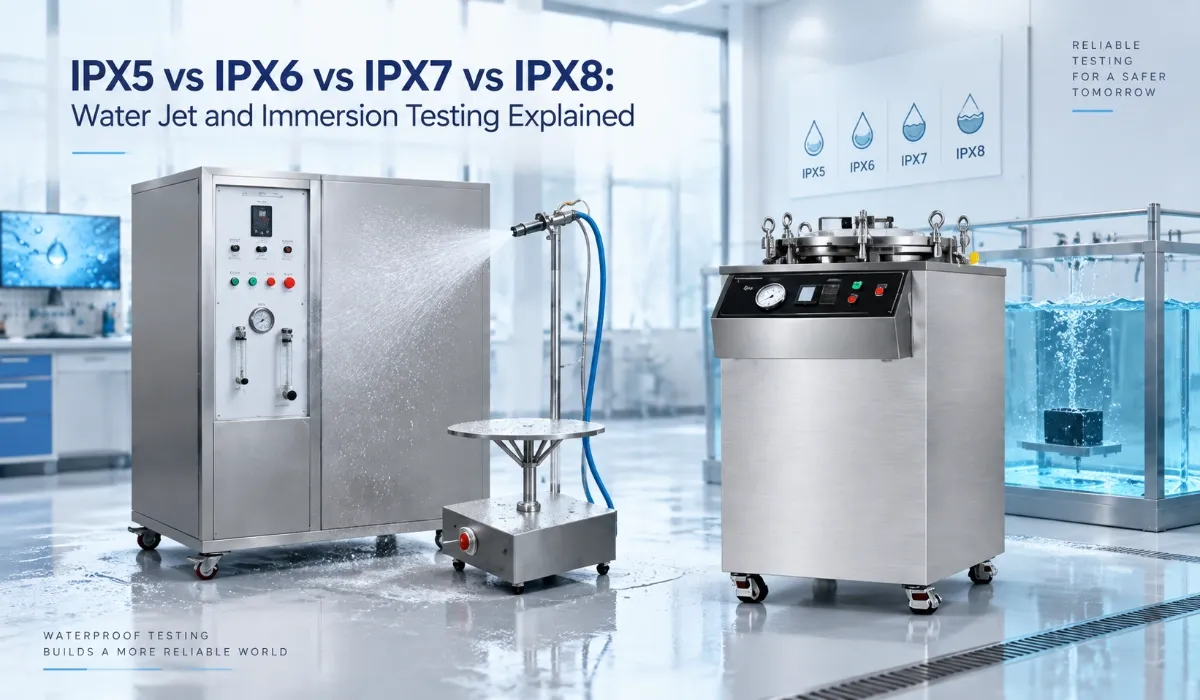
IPX5 vs IPX6 vs IPX7 vs IPX8: What's the Difference?
IPX5 and IPX6 test a product's resistance to water jets.
IPX5 uses a Ø6.3 mm nozzle; IPX6 uses a Ø12.5 mm nozzle at 100 L/min.
IPX7 and IPX8 test immersion instead: IPX7 is fixed at 30 minutes in 1 m of water, while IPX8 uses conditions agreed between manufacturer and user that must be more severe than IPX7.
All four are water-ingress levels under IEC 60529, but they fall into two families: directed jets (IPX5 and IPX6) and static immersion (IPX7 and IPX8). Jet tests and immersion tests load an enclosure in completely different ways, so passing one does not mean the product passes the other.
| IPX5 | IPX6 | IPX7 | IPX8 |
|---|---|---|---|---|
Protection against | Water jets | Powerful water jets | Temporary immersion | Continuous immersion |
Nozzle opening | Ø6.3 mm | Ø12.5 mm | — | — |
Water condition | Low-pressure jet | Jet at 100 L/min | 1 m of water, 30 minutes | Agreed, more severe than IPX7 |
Typical use | Sprayed or hosed outdoor equipment | Heavy rain, ship deck, industrial water impact | Electronics, outdoor lighting, phone casings, automotive parts | Underwater and marine equipment |
What Is IPX5?
IPX5 covers water jets from any direction: a low-pressure stream directed at the enclosure at a test distance of 2.5–3 m. It applies to products that are sprayed or hosed in normal use but never submerged, such as outdoor equipment exposed to light rainstorm and roadside water splash.
What Is IPX6?
IPX6 covers powerful water jets, and it differs from IPX5 in two ways: the nozzle opening and the jet force. The nozzle is Ø12.5 mm at a flow rate of 100 L/min. This level is used for conditions such as heavy rainstorms, ship deck and industrial water impact, and for products including outdoor LED lighting, street lamps, automotive lamps, electronics and wiring harnesses, security cameras and outdoor communication equipment.
What Is IPX7?
IPX7 covers temporary immersion: 1 m of water for 30 minutes, with the depth measured according to specimen height.
When the sample height is under 850 mm, the bottom of the enclosure sits 1000 mm below the water surface. When the sample height is 850 mm or more, the top of the enclosure sits at least 150 mm below the surface.
After the test, no water may enter in quantities that cause harmful effects or impair operation. Immersion tanks for this level are sized to hold the required depth, with a maximum water depth of 1200 mm on the standard models and a stainless steel ruler graduated in 1 mm for reading the level.
What Is IPX8?
IPX8 covers continuous immersion under conditions agreed between manufacturer and user. There is no fixed depth and no fixed duration; the agreed conditions must be more severe than IPX7. This is why IPX8 equipment is built around adjustable depth and pressure rather than a fixed tank, and why an IPX8 claim means little unless the test conditions are stated with it. Pressure immersion testers for this level reach 0–1.2 MPa and a test water depth of 0–120 m.
Jet Testing vs Immersion Testing
The two families stress an enclosure differently and cannot substitute for each other. A jet test applies water under pressure to the outside of the enclosure, concentrated at the point of the jet. An immersion test surrounds the whole enclosure with static water pressure, which can reveal slow leaks that a jet test never shows.
IPX6 does not include IPX7, and IPX7 does not include IPX8. Each declared level is tested separately.
Which Level Does Your Product Need?
IPX5 is for products that are sprayed or hosed but never submerged.
IPX6 is for products that face heavy rainstorms, ship deck conditions or industrial water impact.
IPX7 is for products such as electronic components, outdoor lighting, mobile phone casings and automotive parts that may be temporarily submerged.
IPX8 is for products that operate or are stored underwater, or must pass a more severe soak than IPX7.
Many product standards list more than one level. When that happens, every level must be tested and declared.
Equipment for IPX5 to IPX8 Testing
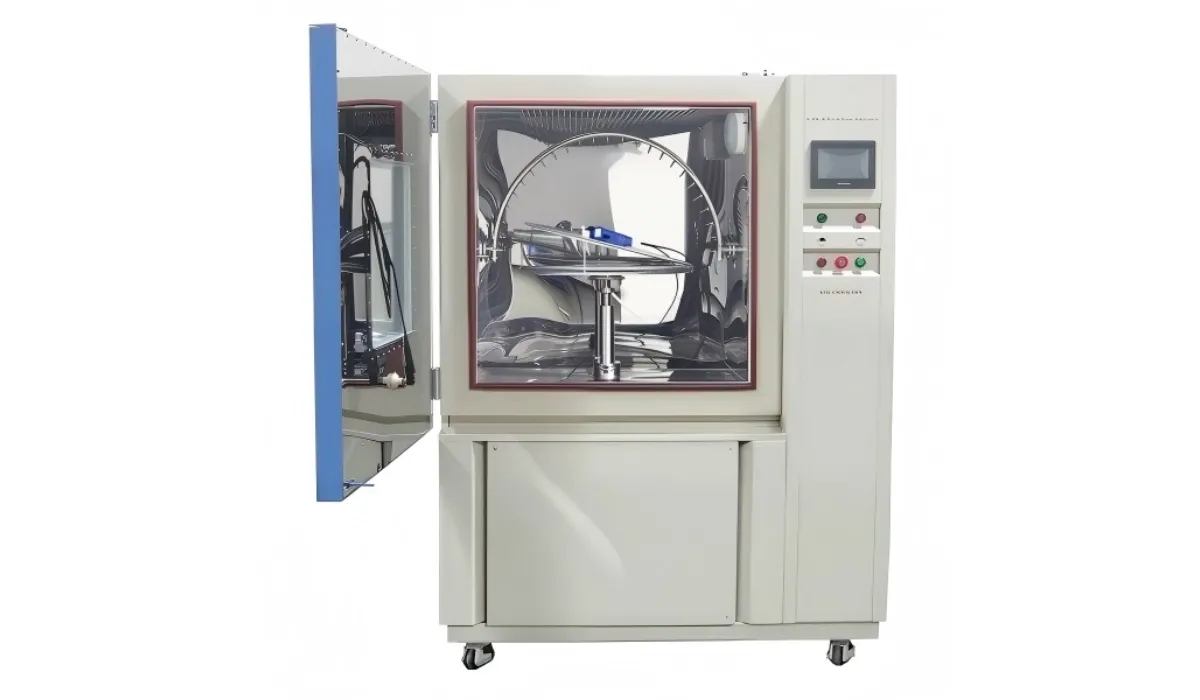
IPX5 and IPX6 need a jet chamber with dual nozzles and a fixture that holds the correct test distance. The Top Test box-type IPX5 IPX6 water jet test chamber provides the Ø6.3 mm and Ø12.5 mm nozzles, a 360° rotating turntable adjustable from 1 to 5 r/min, and PLC touchscreen control with adjustable timing, pressure and flow. For large or irregular samples that cannot be moved into a chamber, a handheld IPX5 IPX6 jet nozzle performs the same test on site.
IPX7 needs a tank providing at least 1 m of depth with a readable water level. The IPX7 immersion test equipment range covers vertical tempered-glass, acrylic cylindrical and stainless-steel tanks, including a stainless-steel model with an electric hoist that raises and lowers a wire-gauze sample cage by remote control.
IPX8 needs a pressure-capable tester rather than an open tank. The IPX7/IPX8 waterproof rating tester offers adjustable pressure and customisable depth, and can also cover IPX7.
Frequently Asked Questions
Does IPX6 include IPX7?
No. IPX6 is a powerful jet test and IPX7 is a static immersion test. They use different equipment and acceptance criteria, so each must be tested separately.
What is the difference between IPX5 and IPX6?
Nozzle opening and jet force. IPX5 uses a Ø6.3 mm nozzle, while IPX6 uses a Ø12.5 mm nozzle at 100 L/min. Both are tested at 2.5–3 m.
What is the difference between IPX7 and IPX8?
IPX7 uses fixed conditions: 30 minutes at 1 m. IPX8 has no fixed condition; depth and duration are agreed between manufacturer and user, and must be more severe than IPX7.
Can a product be IPX6 and IPX7 at the same time?
Yes, but the two ratings must be tested and declared separately, because a jet test cannot substitute for an immersion test.
Choosing IPX5, IPX6, IPX7 or IPX8 Equipment
Start with two questions: what water condition does the product actually face, and which ratings does the applicable standard require? The equipment follows from there: a jet chamber for IPX5/IPX6, an immersion tank for IPX7, and a pressure tester for IPX8.
Send us your required IP level, the applicable standard and edition, the maximum specimen dimensions and weight, and your available power and water supply, and we will recommend the right configuration. Contact us to get the technical datasheet, or browse our full range of IP waterproof test equipment.