
Sep 18, 2026News & Insights
IEC 60695 Glow Wire Test Explained: Principle, Procedure and Equipment Selection
IEC 60695 glow wire tester is intended to simulate the effects of thermal stresses produced by an electrically heated source to represent a fire hazard.
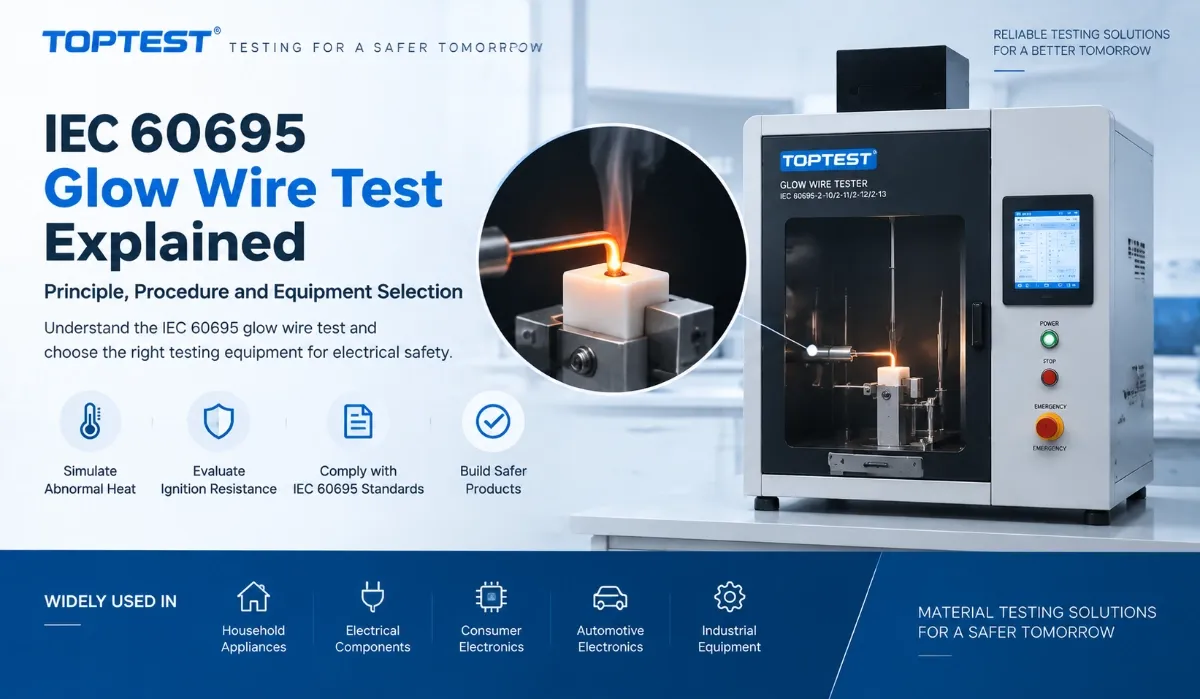
A Complete Guide to Glow Wire Testing Equipment for Electrical Safety Evaluation
Electrical products and components may generate excessive heat during abnormal conditions such as overload, poor connection, or component failure. In these situations, overheated parts can become potential ignition sources and create fire hazards.
To evaluate whether electrical materials can resist ignition caused by high temperatures, manufacturers and laboratories commonly perform the IEC 60695 Glow Wire Test.
The glow wire test is an internationally recognized fire hazard testing method used to simulate thermal stresses caused by heated elements or overloaded electrical components. It helps evaluate the ignition resistance and flammability performance of electrical insulating materials and finished products.
This article explains the principle of glow wire testing, IEC 60695 test procedures, different glow wire test methods, and how to select the right Glow Wire Tester for your laboratory.
What Is the IEC 60695 Glow Wire Test?
The IEC 60695 Glow Wire Test is a fire safety evaluation method that uses a heated wire as an ignition source to simulate abnormal heat conditions in electrical products.
Unlike traditional flame tests that use an open flame, glow wire testing evaluates how materials react when they come into direct contact with a high-temperature heat source.
The test is designed to determine:
- Whether the material ignites
- How long the flame continues after ignition
- Whether the material self-extinguishes
- Whether burning particles cause secondary ignition
The IEC 60695 series includes different glow wire test methods for materials and finished products, including:
- IEC 60695-2-10 Glow Wire Apparatus and Common Test Procedure
- IEC 60695-2-11 Glow Wire Test for End Products
- IEC 60695-2-12 Glow Wire Flammability Index (GWFI)
- IEC 60695-2-13 Glow Wire Ignition Temperature (GWIT)
Why Is Glow Wire Testing Important?
Modern electrical products contain many plastic components, including:
- Housings
- Connectors
- Switches
- Sockets
- Terminal blocks
- PCB insulation parts
During normal operation, these components may remain safe. However, abnormal conditions such as:
- Overcurrent
- Loose electrical connections
- Component failure
- Excessive heat generation
may create localized high temperatures.
A Glow Wire Tester simulates these conditions to determine whether the material can prevent fire hazards.
Glow wire testing is especially important for industries including:
- Electrical appliances
- Consumer electronics
- Automotive electronics
- Power equipment
- Household appliances
- Industrial control systems
Principle of Glow Wire Testing
The working principle of a Glow Wire Tester is based on thermal stress simulation.
The test uses a standardized nickel-chromium heated wire.
The glow wire is electrically heated to a specified temperature, commonly between 550°C and 960°C depending on the test requirement.
The heated wire is then pressed against the test specimen for a specific time.
During testing, engineers observe:
- Ignition behavior
- Flame duration
- Burning characteristics
- Material deformation
- Falling particles
The purpose is to determine whether the tested material can withstand abnormal heat sources without creating a dangerous fire condition.
IEC 60695-2-10 defines the common glow wire apparatus and procedure using a standardized electrically heated wire as an ignition source.
How Does a Glow Wire Tester Work?
A professional IEC 60695 Glow Wire Tester normally consists of several key components.
1. Glow Wire Heating System
The glow wire is usually made from nickel-chromium alloy.
The heating system controls the current passing through the wire to achieve the required temperature.
A high-accuracy temperature measurement system ensures reliable results.
2. Temperature Control System
Temperature accuracy is critical in glow wire testing.
The equipment must accurately control:
- Heating temperature
- Temperature stability
- Test duration
Incorrect temperature control may lead to unreliable test results.
3. Test Chamber
The test chamber provides a controlled environment.
A professional chamber helps:
- Prevent external airflow influence
- Improve testing repeatability
- Protect operators from smoke and flame
4. Timing and Observation System
The tester records:
- Application time
- After-flame time
- After-glow time
Modern automatic Glow Wire Test Equipment can improve efficiency and reduce operator error.
IEC 60695 Glow Wire Test Procedure
The general glow wire test procedure includes several steps.
Step 1: Prepare the Test Specimen
The specimen is mounted in the test chamber.
The sample should be positioned according to the requirements of the applicable IEC standard.
Step 2: Heat the Glow Wire
The glow wire is heated to the specified temperature.
Common test temperatures include:
- 550°C
- 650°C
- 750°C
- 850°C
- 960°C
The temperature is measured using a calibrated system.
Step 3: Apply the Glow Wire
The heated wire contacts the specimen for a specified period, commonly 30 seconds depending on the test method.
The operator observes whether ignition occurs.
Step 4: Evaluate Test Results
The following factors are evaluated:
- Ignition occurrence
- Flame duration
- After-glow time
- Burning droplets
- Material damage
Based on the results, the material or product can be evaluated for fire hazard performance.
Different Types of Glow Wire Tests
Many customers are confused about GWFI, GWIT, and finished product glow wire testing.
Understanding the differences helps select the correct equipment.
1. Glow Wire Flammability Index (GWFI)
GWFI is a material testing method.
It determines the highest temperature at which:
- The material does not ignite
- Or extinguishes within a specified time
- Does not completely burn away
GWFI is commonly used for material selection.
Typical users:
- Plastic manufacturers
- Raw material suppliers
- Material laboratories
2. Glow Wire Ignition Temperature (GWIT)
GWIT evaluates the temperature at which a material ignites under glow wire testing conditions.
It is mainly used to understand ignition resistance.
Applications:
- Engineering plastics
- Electrical insulation materials
- Electronic components
3. Glow Wire Test for End Products
IEC 60695-2-11 applies glow wire testing to finished products.
Examples:
- Switches
- Connectors
- Electrical housings
This test evaluates the actual fire safety performance of the final product.
Glow Wire Tester vs UL94 Flame Tester
The answer depends on the application.
Feature | Glow Wire Tester | UL94 Flame Tester |
|---|---|---|
Heat Source | Heated wire | Open flame |
Main Standard | IEC 60695 | UL94 |
Main Purpose | Ignition resistance | Flame behavior |
Application | Electrical components | Plastic materials |
Testing Focus | Abnormal heat sources | Burning characteristics |
Simple explanation:
UL94 asks:
"How does the plastic burn when exposed to flame?"
Glow Wire Test asks:
"Can the material resist ignition caused by overheating?"
For many electrical products, both tests may be required.
How to Choose the Right Glow Wire Tester?
When selecting Glow Wire Test Equipment, consider the following factors.
1. Compliance With Standards
Ensure the equipment meets relevant standards:
- IEC 60695-2-10
- IEC 60695-2-11
- IEC 60695-2-12
- IEC 60695-2-13
2. Temperature Accuracy
Important features include:
- Accurate temperature measurement
- Stable heating control
- Reliable thermocouple system
3. Automation Level
Automatic Glow Wire Testers can provide:
- Automatic test movement
- Digital timing
- Data recording
- Improved repeatability
4. Safety Features
Professional equipment should include:
- Smoke exhaust system
- Safety enclosure
- Emergency stop function
- Flame protection system
Applications of Glow Wire Testing Equipment
Glow Wire Testers are widely used in:
Electrical Industry
Testing:
- Switches
- Plugs
- Sockets
- Circuit components
Electronics Industry
Testing:
- PCB materials
- Connectors
- Insulation parts
Appliance Industry
Testing:
- Washing machines
- Refrigerators
- Microwave ovens
- Power supplies
Automotive Industry
Testing:
- Automotive connectors
- Charging components
- Electrical modules
Common Questions About IEC 60695 Glow Wire Test
What is the purpose of a glow wire test?
The purpose is to evaluate whether electrical materials and components can resist ignition caused by overheating or abnormal heat sources.
What standard is used for glow wire testing?
The main standard is IEC 60695-2-10, with related procedures covered by IEC 60695-2-11, IEC 60695-2-12, and IEC 60695-2-13.
What temperature is used in glow wire testing?
The test temperature depends on the application and standard requirement. Common temperatures range from 550°C to 960°C.
Is glow wire testing required for electrical products?
Many electrical safety standards reference glow wire testing for components where fire hazards from overheating need to be evaluated.
Choose the Right IEC 60695 Glow Wire Tester Supplier
Selecting reliable Glow Wire Test Equipment is essential for accurate fire safety evaluation and international compliance.
Whether you need an IEC 60695 Glow Wire Tester, GWFI Tester, GWIT Tester, or complete Electrical Safety Testing Equipment, choosing the right testing solution can help improve product quality and meet customer requirements.
Our technical team provides professional support for selecting the right flammability testing equipment based on your products, standards, and laboratory requirements.
Contact us today to request product specifications, technical support, and quotation.